

No 'back focus' problem, but incorrect focusing technique!
Thursday 13 December 2018, 10:51 by Michelle Peeters | 23,916 views | 34 commentsThis article was translated from Dutch with the help of AI. Read the original.
Many photographers, myself included, claim that their camera suffers from 'back focus' (focusing slightly too far behind the subject) and that their photos are therefore not all pin-sharp. In practice, this is often caused by handling your camera incorrectly.
Back and front focus
Back focus is when the camera focuses behind the subject. This can be nicely illustrated with the images below:
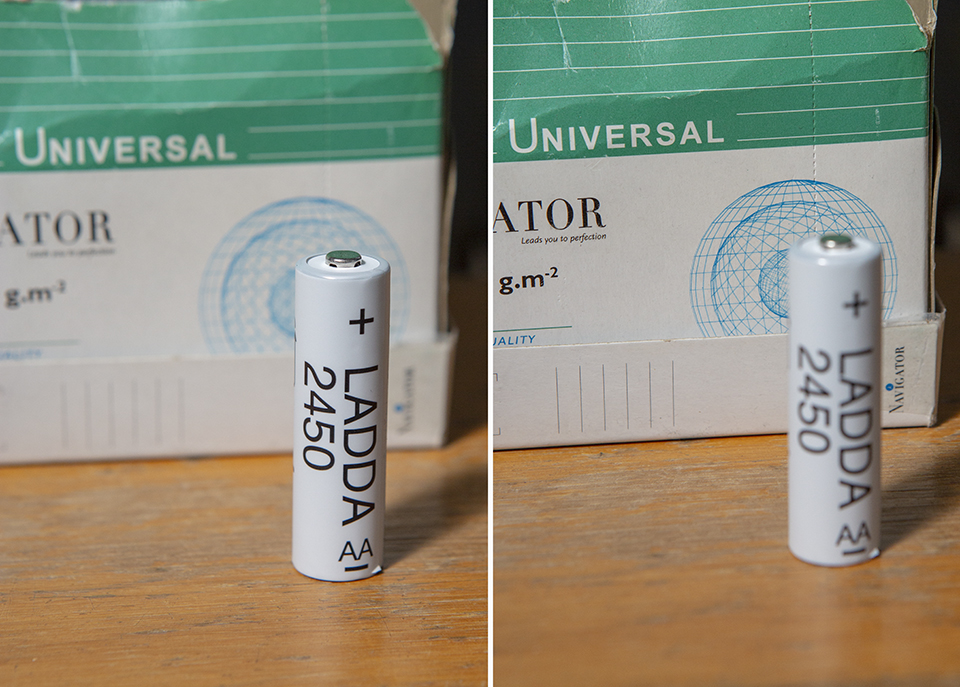
On the left, you can see the desired photo, with the battery in focus. The photo on the right shows what happens with back focus.
That was not the intention! The camera has focused behind the subject, making the subject blurry. One situation where you can recognise this is, for example, in portraits.
You focus on the person's eyes and later see that it is not the eyes, but the ears, that are sharp. This is an example of back focus.
Front focus is the opposite of back focus. In this case, the camera focuses in front of the desired subject.
One central focus point
I also always focus using one central focus point. I first focus with it and then correct the composition by turning the camera, while keeping the shutter button half-pressed so that the focus is held.
Unfortunately, this is an incorrect way of focusing and then composing your shot. It often goes wrong, even though you are sure that you focused very precisely on the subject.
First of all, this only works with stationary subjects, because you cannot follow a moving subject in this way. But it also leads to incorrect focusing with stationary subjects.
The focus plane is flat
The reason for this is that the focus plane is flat. You can clearly see the result in the image below.
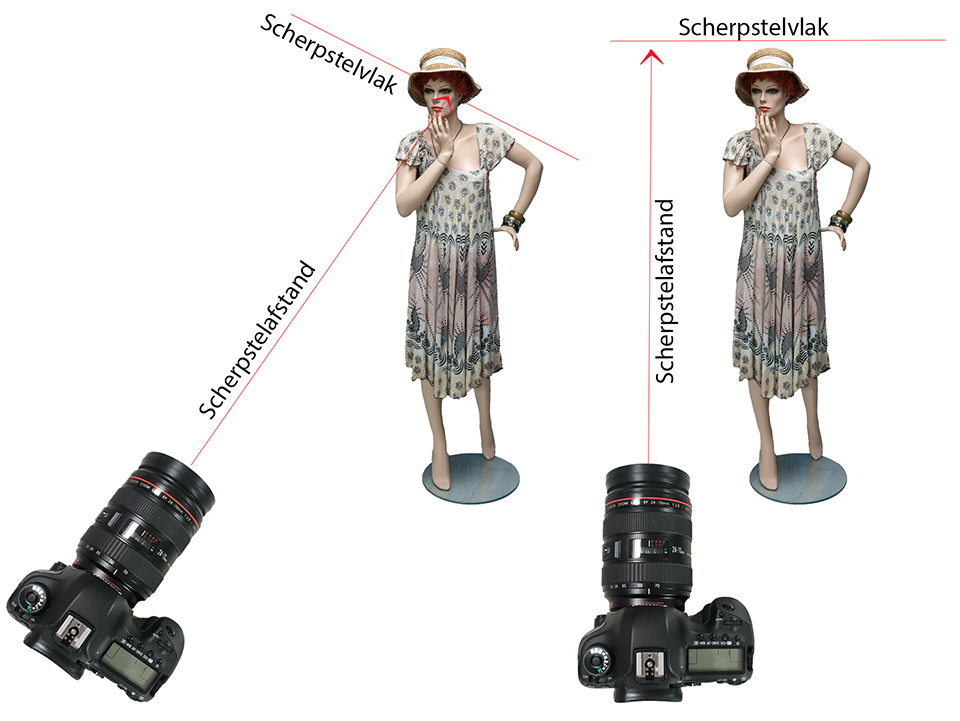
Suppose you want to take a portrait, with your model positioned one third from the right. You first point your camera at your model so that you can focus on the eyes, or the dominant eye, with your central AF point. You then turn the camera to the left to achieve the desired composition.
The focusing distance, shown by the arrow, does not change. As you can see, this means that the focus plane ends up behind your model. This results in a photo that is sharp in the wrong place.
Sometimes the effect remains within the depth of field, so you do not notice it clearly. But complaints about a camera's 'back focus' can often be traced back to an incorrect focusing technique!
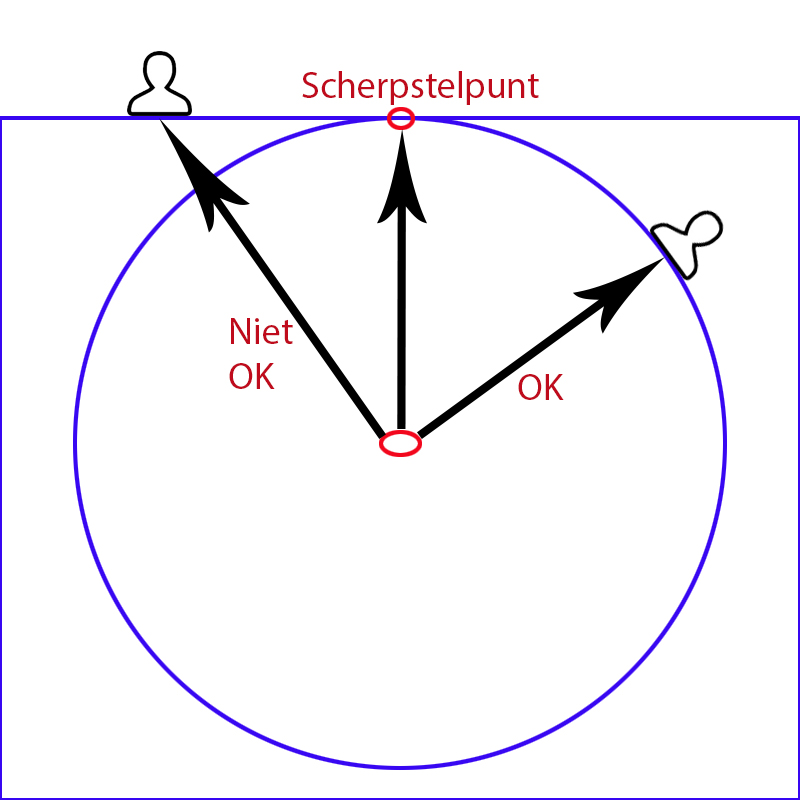
So what should you do?
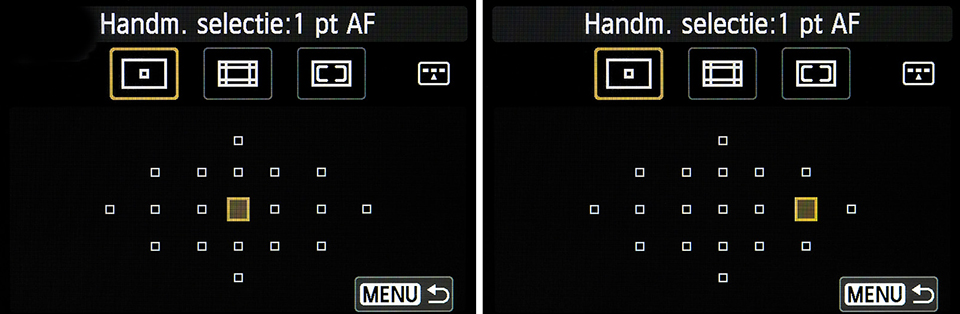
To prevent this problem, it is better to determine your composition first and then move the focus point on your camera to the point where you want it.
There are more alternative focusing options. Many cameras, including mirrorless cameras, now also offer face and eye detection for focusing.
For moving subjects, you can use AI Servo mode, called Continuous Servo on Nikon. You do not focus just once. The camera keeps focusing continuously on the subject.
Conclusion
If you often have problems with blurry photos where the focus point is clearly in front of or behind your subject, your camera may of course need to be adjusted, or calibrated again.
But the problem often lies with you. It is certainly worth checking whether your way of focusing is correct in every situation.
Want to learn more about the basics of photography?
At Photofacts Academy, our online learning environment for photographers, we have a complete photography basics course. You can follow this course for two weeks with a free trial membership.
About the author
Michelle Peeters is fotografe en oprichter van DeuxBleus Fotografie. Michelle herkent het bijzondere in het gewone en het gewone in het bijzondere. Ze heeft zich nooit willen specialiseren en is daardoor van alle markten thuis.
You might also like
-
 Have you ever heard of the Pep Ventosa technique?
by Nando Harmsen
-
 Review: Special Photography Techniques, Panoramas, HDR, Virtual Tours and More
by Michelle Peeters
-
 5 autofocus techniques explained
by Michelle Peeters
-
 5 photography techniques you should know
by Elja Trum
-
 Out with a plan... or without one?
by Juliette Gribnau

34 comments
-

 100
wrote on Tuesday 1 May 2018 at 00:18
| reply
Well, that gets tricky if your subject falls outside your focus points…
Translated from Dutch.
Another disadvantage is that the metering of many cameras isn't linked to all the individual focus points, so you may end up with a sharp but possibly incorrectly exposed photo, especially if there's a big difference in brightness between your subject and the background. And yes, that can also be solved by first metering on your subject, locking it, then determining the composition and then focusing, provided you have enough time to do all that.
The most important thing, I think, is that you know the pros and cons of the different methods (which in themselves aren't wrong). If you shoot at f/1.4, accurate focusing is more important than at f/8 or f/11 because the depth of field at f/1.4 is much smaller. If you shoot at high ISO, correct exposure is more important because you have much less room for corrections afterwards due to a lower dynamic range. -
 Liesbeth van Asselt
wrote on Tuesday 1 May 2018 at 10:43
| reply
As an addition: the middle focus point is always a cross-type sensor, with the other sensors you often don't know that (usually not all sensors are cross-type sensors, although more and more cameras are starting to have this). This means that only with the middle point can you be sure with all cameras that you can always focus properly in poor-light situations with little contrast. With other focus points, the camera may start hunting. That is why this is recommended. And there is nothing wrong with that either. Except with macro photography (short focusing distance) or with a very large aperture (1.4, 1.8 and sometimes 2.8). Then the above reasoning applies. Besides choosing another focus point (of which you therefore don't know whether it is a cross-type sensor and whether focusing will work = go fast enough), you can of course also focus manually. Especially with macro photography, that is recommended. If you work with a smaller aperture or at a greater focusing distance, the middle focus point is still the most reliable.
Translated from Dutch. -
 wim wilmers wrote on Tuesday 1 May 2018 at 10:59 | reply
the way you show the photo with that battery can of course never be due to recomposition at an aperture like the one you used now. This is simply focusing once on the battery and the second time on the background. The difference can never be that big. Unless you deviated very far from your old composition in this case. I basically explain it to my students the way you describe it as well, because of the diagonal line versus a straight line. I often show that when you focus on a pupil and recompose, you actually move your focus point slightly forward and then, for example, get the eyebrow in focus. Because you go from a straight line to a diagonal line, the distance to the point you want to focus on becomes greater. I always place my focus point in the corner where I also want the focus to be. Especially at low apertures, that is almost a must.
Translated from Dutch. -
 Bart van den Dikkenberg wrote on Tuesday 1 May 2018 at 11:00 | reply
It is also possible to check whether the focusing issue is caused by yourself or by the camera. You can check this by putting your camera on a tripod and photographing an unfolded newspaper at a 45-degree angle, manually setting the focus point each time.
Translated from Dutch.
Afterwards, you can see from the photos whether the camera actually focused on that point. With my camera, 2 focus points turned out not to work properly, and Canon's repair service subsequently fixed that. So it is not always necessarily your fault. -
 Roland wrote on Tuesday 1 May 2018 at 11:17 | reply
I frequently photograph groups and then I use the 'one-third rule'. The depth of field lies one third in front of the focus point and two thirds behind the focus point. That is why I focus on the ground in front of the people closest to me in the group, as I learned from a professional photographer. That gives me good results. That is of course somewhat less applicable with extremely large apertures or in macro photography.
Translated from Dutch. -
 guest wrote on Tuesday 1 May 2018 at 11:19 | reply
Thanks Michelle, today your piece gave me an Aha experience. So I learned something else to take into account. Step by step I’m beginning to understand more and more about taking good photos.
Translated from Dutch. -
 Wim Hendriks wrote on Tuesday 1 May 2018 at 11:21 | reply
That's why I still focus manually, then..
Translated from Dutch. -
 Rob IJsselstein wrote on Tuesday 1 May 2018 at 11:49 | reply
Geometrically, this story doesn't add up. How is the camera rotated? If you rotate the camera around the point where the sensor is, the distance between the sensor and the subject doesn't change. In practice, you rotate the camera and your head around the middle of your neck or something. The distance between the sensor and the subject then actually becomes greater, not smaller. So that should lead to front focus. If back focus does occur, there must be another explanation for it. Maybe a different optical path through the glass in the lens, I don't know. But this explanation isn't correct. Practically speaking, it is indeed usually best to determine the composition first and then the focus point.
Translated from Dutch. -
 GJ wrote on Tuesday 1 May 2018 at 12:24 | reply
Actually, Michelle doesn't want to lose weight, she always comes up with good stories, but in this case I already had some doubts, and Rob's explanation really does make sense. In short, we need to go back to the drawing board, perhaps quite literally.
Translated from Dutch. -
 Michelle Peeters wrote on Tuesday 1 May 2018 at 12:29
| reply
@Rob and GJ: if the background were circular and not a flat surface, you would be right! I'll draw a picture to clarify.
Translated from Dutch. -
Michelle Peeters wrote on Tuesday 1 May 2018 at 13:00
| reply
I added the extra image to the article, it doesn't work in the comments.
Translated from Dutch. -
Liesbeth van Asselt
wrote on Tuesday 1 May 2018 at 13:04
| reply
Ha, ha, @Wim, you said it, I thought it
Translated from Dutch. . Front or back focus is indeed never as extreme as with the photos of the batteries.
-
 Hoebert wrote on Tuesday 1 May 2018 at 14:44 | reply
A clear explanation. Think lokeend about using a depth of field calculator. With this, you calculate the distance within which everything is sharp at your setting. g / focal length / distance
Translated from Dutch.
Hoebert. -
 4BYE
wrote on Tuesday 1 May 2018 at 14:50
| reply
Thanks for this (in hindsight) simple explanation. Indeed, I probably make this mistake sometimes too. In any case, I will do it differently in situations where it will make a significant difference.
Translated from Dutch.
I use a separately assigned button on the back of both my Canon cameras, by the way. This way I remain in control of the focusing without having to half-press etc. and I can keep tracking in servo and take a shot whenever I want. -
Michelle Peeters wrote on Tuesday 1 May 2018 at 15:06
| reply
An even nicer picture, so it is possible in the comments after all!
Translated from Dutch.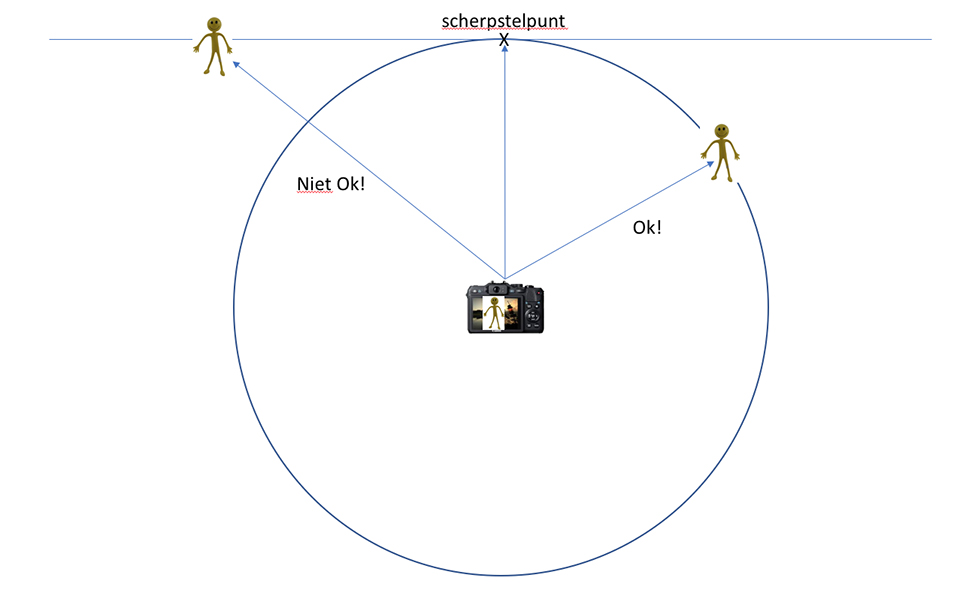
-
 MartinusR. wrote on Tuesday 1 May 2018 at 17:34 | reply
I almost always use AF-C and use the back button AF button for that. If the picture is still blurry, I used too slow a shutter speed or didn't use a tripod.
Translated from Dutch. -
 Frits wrote on Tuesday 1 May 2018 at 18:00 | reply
The nodal point isn't fixed, that's just how it is. If you were to focus and then determine the composition with a pano-head, you wouldn't have had the problem. But yeah, that's a bit cumbersome. Manually focusing is fun too
Translated from Dutch. -
Michelle Peeters wrote on Tuesday 1 May 2018 at 18:19
| reply
@Frits: such a panoramic head is indeed the solution!
Translated from Dutch. -
 Peggy wrote on Tuesday 1 May 2018 at 18:49 | reply
Dear Michelle,
Translated from Dutch.
I read your info about back & front focus with great interest.
The reactions are also educational for me.
Following that, I would like feedback.
I am a macro enthusiast. I shoot with a D7200/Nikon 105 mm.
I focus as follows:
Use 1 focus point.
In M mode or A
Determine my viewpoint
Move my focus point using the arrow keys on the back of the camera.
Very often not the middle focus point.
The D7200 indicates where your focus point falls. So in front of/behind or on the subject.
The camera often starts "hunting", then there is nothing else to do but shoot in M mode.
I find that my photos often just lack the sharpness I have in mind.
Is this way of working a good one? I would appreciate your tips/feedback. -
Michelle Peeters wrote on Tuesday 1 May 2018 at 19:06
| reply
@Peggy: as Liesbeth van Asselt already indicated, it is best to use the center focus point, because this is definitely a cross-type sensor. Sometimes not all the other sensors are cross-type sensors. If you use other focus points, the camera can indeed start 'hunting'.
Translated from Dutch.
But manual focusing actually works better for macro photography. This is easiest with Live View turned on. If that doesn't work, you can use autofocus and then lock the camera to manual focus so it doesn't keep trying to focus again.
I would also use Manual mode, not aperture-priority mode. First meter the light on the subject and then lock that exposure.
With macro photography, focusing is very precise (it works best from a tripod) and you are also dependent on there being no wind and your subject staying still.
Good luck and let me know what your experiences are! -
 Luc Vancamp wrote on Wednesday 2 May 2018 at 09:17 | reply
All well and good ... I’ve been seeing too much technical explanation lately. When are we going to practise art and learn to see? (although this subject was actually worth it, you know)
Translated from Dutch. -
Erik wrote on Wednesday 2 May 2018 at 10:28 | reply
I also think the story is somewhat exaggerated. For macro photography, this story does indeed apply. The depth of field there is so small that it is very precise.
Translated from Dutch.
If I focus on my subject (using the center focus point), I then determine the exact composition. Of course, your composition beforehand should already be roughly right.
After focusing, I never actually take a step to the side or step forward or backward. Then you do indeed have to focus again. The illustration suggests that you really move the camera to a different angle. But moving your camera (to a different angle) always means that you have to focus again, doesn't it? At least, that's one of the first things I teach my students.
When I focus, I can move my camera a few cm to the left or right without any problems. -
 Riet Machielsen wrote on Wednesday 2 May 2018 at 12:32 | reply
I recently read an article about this subject in the Belgian photography magazine 'Shoot' . It said that this problem cannot occur with mirrorless cameras because with this type of camera, focusing uses the image on the sensor.
Translated from Dutch. -
Michelle Peeters wrote on Wednesday 2 May 2018 at 14:58
| reply
@Riet: that could be, but honestly I don't know.. Is there more information about that to be found online? Or perhaps a link to that specific article you were talking about?
Translated from Dutch. -
guest wrote on Wednesday 2 May 2018 at 16:45 | reply
Very good article. Thank you. Bart's response in particular is something to take into account.
Translated from Dutch. -
 Wunigard wrote on Wednesday 2 May 2018 at 20:59 | reply
And what I miss in all the comments is that back or front focus is caused by the lens. So almost always blurry photos. My camera (Pentax) has a lens-specific correction option for that. Of course, first determine in a test setup how much needs to be corrected.
Translated from Dutch. -
 Huub wrote on Wednesday 2 May 2018 at 23:17 | reply
@Riet Machielsen: why would it be different with a mirrorless camera. There too, the focus is held when you keep the shutter button half-pressed. If you then decide on a new composition, you continue to keep the shutter button pressed. So theoretically you could then be out of focus.
Translated from Dutch. -
Wunigard wrote on Thursday 3 May 2018 at 09:52 | reply
A mirrorless camera can also have focusing problems with certain lenses. My Panasonic has this with a 30 mm Sigma.
Translated from Dutch.
Haven't had this camera for very long, but I haven't had time to dive into the menu yet. It already has too many gadgets on it that I don't use. -
Rafi wrote on Saturday 5 May 2018 at 09:26 | reply
A very nice article, because the physics behind it is explained and useful solutions are also suggested.
Translated from Dutch. -
 -mj-
wrote on Sunday 6 May 2018 at 11:06
| reply
doesn't this also have to do with the combination function of the shutter button. So that when you press it you also focus right away. On my camera I have that separated. So pressing halfway doesn't focus. I now focus with the "*" button .
Translated from Dutch. -
 Paul Oosterlaak wrote on Sunday 6 May 2018 at 13:34
| reply
The problem with focus recomposing is not in the change in distance. I once calculated this in the past (simply using Pythagoras) and it only becomes a problem at f/1.2 because the deviation is then greater than half the DoF. Michelle clearly shows where the problem lies with her drawings. But... to make something clear you have to exaggerate, and that is precisely fatal in this case. You move your lens namely from the center of your image to a 1/3 line. This is only 1/6 of the image height. If you apply Pythagoras here, it turns out that the change in distance is minimal.
Translated from Dutch.
So where is the problem?
1. the photographer does not move his camera sensor around a fixed axis. If you work with a small DoF, a movement of a few cm in the direction of your subject is fatal (your focus plane shifts along with it). If you start rotating your camera, it is difficult to do this precisely around an imaginary axis.
2. your model moves too, so actually you should continuously use autofocus.
Fortunately, many modern dslr's have more than 1 crosstype point. Unfortunately, that memo has not yet reached every manufacturer properly. Although Nikon has a nice spread of crosstype points with the 153-point AF system (D500, D5, D850), the rest of their cameras are equipped with crosstype points around the center and not on the 1/3 lines. You see the same thing with Pentax. Canon also had this for a long time, but they have solved it on almost all dslr's (except the actual entry-level dslr's with the 9-point AF system).
A few more misconceptions to clear up from the messages:
- macro photography is geometrically no different from "normal" photography. Yes, the DoF is very small, but the distance to your subject is small too. The proportions otherwise remain the same, so the deviation in distance in relation to the DoF does too. It is more difficult because of the limitation of the photographer who wants to recompose the shot handheld (see 1. above).
- the plane of sharpness does not lie 1/3 in front of and 2/3 behind the subject. This is a very persistent misconception that was once introduced into the world and is repeated as truth time and time again. The distribution of the DoF depends on the focus distance and the hyperfocal distance of the parameters used. Often the distribution is closer to 1/2 in front and 1/2 behind. At the hyperfocal distance, the ratio is 1 : infinity
- you can also get back- or frontfocus with phase detection on the sensor. Phase detection is a measurement that instructs the lens to focus at a certain distance. This can still go wrong. With contrast detection, this is almost impossible, because contrast is continuously measured and at the correct focus this contrast is at its maximum. The trick manufacturers use then is a combination of both. First use phase detection to focus almost instantly and then contrast detection to fine-tune
@-mj- No, this makes no difference for that. The only difference is that you then detach the autofocus from releasing the shutter, allowing you to choose not to focus again when you want to take the photo. This is especially useful with continuous autofocus. With AF-S you can also simply keep the shutter button half-pressed and recompose. -
100
wrote on Monday 7 May 2018 at 00:27
| reply
@Paul
Translated from Dutch.
With an 85 mm lens at a distance of 3 metres, rotating the lens 8° (which is one third of the horizontal angle of view) means a shift of the focus point of approximately 3 cm (cos 8° = 0.99 => 0.99 x 3 = 2.97 metres), which roughly corresponds to the difference between focusing on the eye or on the tip of the nose.
At f/1.2 on a FF sensor, the DOF in that case is approx. 9 centimetres, so if “a deviation greater than half the DOF” is the criterion, it would not even matter at f/1.2.
The only problem is that it is clearly visible that the nose is sharper than the eye, even at smaller apertures. DOF is an arbitrary value to indicate an area in which the sharpness is still acceptable at a certain viewing distance, nothing more than that. In reality, the focus plane is two-dimensional and therefore has a depth of zero.
It depends on the criteria (quality requirements) that a photographer imposes on themselves or that are set by the client whether such a deviation is considered acceptable. -
Paul Oosterlaak wrote on Tuesday 8 May 2018 at 00:52
| reply
Of course, DoF is an agreed-upon value and totally dependent on the magnification and the photographer's requirements. But you agree with me that the focus recompose thing in itself isn't the problem, but rather the limitations of the photographer and the model in their movements.
Translated from Dutch. -
100
wrote on Tuesday 8 May 2018 at 03:57
| reply
Both can be a problem, in combination they can reinforce each other, but also cancel each other out.
Translated from Dutch.
If I use the technique myself, I am almost certain that the axial movement of my camera is less than a centimeter. With a bit of practice, it really isn't that complicated to make a radial movement of a few degrees without making large axial movements. Also, making such a movement generally takes little time (less than a second) and I only use such a technique with reasonably static subjects.
The crux of the matter is, I think, that you need to know the consequences of the techniques used in order to apply them properly. With critical focus, such as a headshot at an aperture wider than f/2.8, the deviation caused by the technique itself is a problem. With a full body shot or when photographing several people, focus deviations of a few centimeters are often not a problem.
Have your say
Please note: Articles older than a week can only be commented on by signed-in visitors.Would you still like to comment? sign in or create a free account.
Become a better photographer every week
A practical photography tip in your inbox every week.
38,729 photography enthusiasts already receive the tips! More about the weekly mail. Or keep up to date via  Facebook.

Elja Trum
Photofacts; everything to do with photography!
Would you like to take better photos and keep up with what is happening in photography? Photofacts publishes articles that teach you something about photography — from a product announcement to a practical shooting tip or a look at a website. Photofacts covers photography every day and is a hobby project of Elja Trum's that got out of hand. The articles are written by a team of volunteer authors. If you would enjoy writing one or more articles for Photofacts, do get in touch.More about Photofacts Photos





Photofacts is made possible in part by
