

The difference between crop and full-frame in portrait photography
Wednesday 3 August 2016, 16:16 by Elja Trum | 16,882 views | 18 commentsThis article was translated from Dutch with the help of AI. Read the original.
Many portrait photographers prefer using a full-frame camera rather than a crop-sensor camera. Photographer Manny Ortiz shows why in his video. He photographs with both a full-frame and an APS-C camera and shows the results.
As you can see in the video, it is mainly about the much shallower depth of field. This makes it much easier to blur the background. Even when you photograph someone from head to toe. A blurred background is usually beneficial in a portrait, because it directs all the attention to the model.
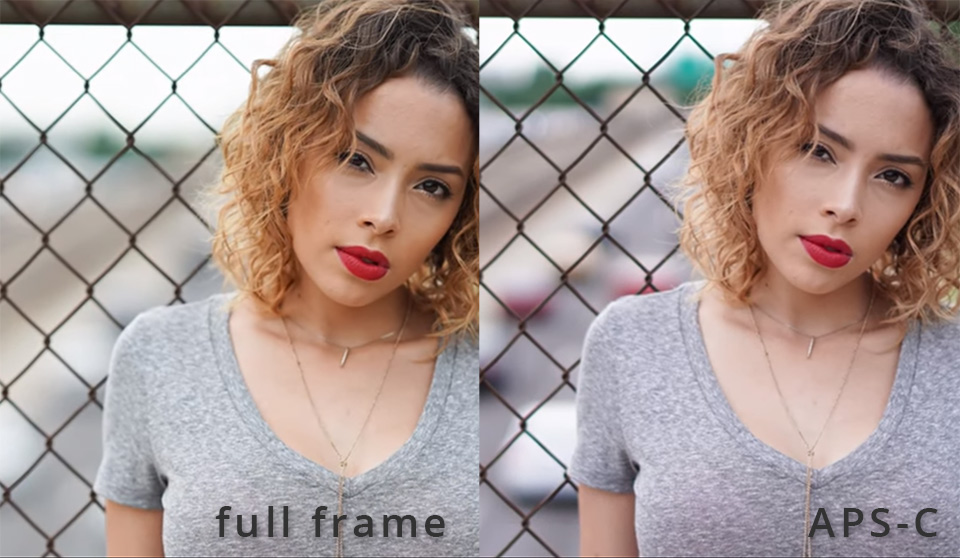
If you want more depth of field, you can of course always stop down the aperture on the full-frame camera. However, getting less depth of field with a crop camera is not so easy.
Of course, Manny's comparison is not perfect, as he himself points out in the video. After all, two different lenses are also used. But it certainly gives you an idea.
About the author
Elja Trum is the founder of Photofacts and online photography course website Photofacts Academy. He has been writing about photography since 2006. Elja is also the author of (Dutch) books on composition, black-and-white photography, flash photography and portrait photography.
You might also like
-
 Review: Sony A6700 APS-C mirrorless camera
by Nando Harmsen
-
 An APS-C lens or a full-frame lens instead?
by Nando Harmsen
-
 The advantage of a crop sensor in landscape photography
by Nando Harmsen
-
 Macro with a crop sensor means more magnification
by Nando Harmsen
-
 Canon introduces mirrorless crop cameras: the EOS R7 and EOS R10
by Nando Harmsen
-
 Will Canon launch APS-C format R cameras?
by Elja Trum
18 comments
-
 guest wrote on Wednesday 3 August 2016 at 18:08 | reply
Piece of cake to blur a background. The other way around never works.
Translated from Dutch. -
pepe wrote on Thursday 4 August 2016 at 15:24 | reply
Apples and oranges. Would have preferred to see him use the same lenses and then stand farther away from the model with the A6000 to get the same composition. Think the result would then have been better for the A6000 compared to the result of the A6000 in his test.
Translated from Dutch. -

 Paul Oosterlaak wrote on Saturday 6 August 2016 at 22:47
| reply
@pepe: then the composition changes precisely because your perspective changes. This is an apples-to-apples comparison. He shows that the crop factor also has to be taken into account in the aperture values.
Translated from Dutch.
@Elja: "Full-frame (85mm f/1.7) versus crop (82mm f/1.8)"
You also have to apply the crop factor to the aperture of the crop, so 82mm f/2.7. You can also see that this is correct, because the depth of field of the crop is greater (and therefore also the amount of noise in the photo). -
 ruudt wrote on Tuesday 9 August 2016 at 14:35 | reply
really total nonsense...! a smaller sensor from fuji x cannot be compared to a full frame from e.g. canon/nikon... otherwise fuji x would have been making full sensors long ago....
Translated from Dutch. -
 Lauran wrote on Tuesday 9 August 2016 at 14:48
| reply
This article is complete nonsense. The quality does not depend on the camera but on the lenses used.
Translated from Dutch. -
 primefoto.nl wrote on Tuesday 9 August 2016 at 15:38
| reply
Which factors determine the DOF?
Translated from Dutch.
The lens or the sensor behind it? -
 Wolves fotografie
wrote on Tuesday 9 August 2016 at 17:15
| reply
@primefoto.nl: There are 4 factors that determine the depth of field, the DOF:
Translated from Dutch.
1. the size of the sensor, the larger the sensor the blurrier the background;
2. the choice of lens, the more telephoto the blurrier the background;
3. the aperture number, the smaller the aperture number the blurrier the background and
4. the distance to the subject, the shorter the subject distance the blurrier the background. -
primefoto.nl wrote on Tuesday 9 August 2016 at 17:53
| reply
Dear Wolves, I did not mean my questions as actual questions, but as a means of encouraging logical thinking. The sensor size has absolutely no influence whatsoever on the DOF. The DOF is determined solely by focal length, aperture and the diameter of the front lens. The lens doesn't give a damn what you attach behind it. Even if you hang a lump of clay a meter behind it, the DOF remains the same. Just turn the question around. What does aperture do? You use aperture to be able to choose the DOF. So what determines the DOF? Exactly, the aperture in relation to the focal length and the diameter of the front lens. The sensor size is of no importance whatsoever for the DOF, only for the angle of view.
Translated from Dutch. -
Henk wrote on Tuesday 9 August 2016 at 22:59 | reply
What unfortunately gets too little attention in this video is the significantly lower noise with a full-frame camera. Especially in poorer lighting conditions, the difference is considerable. Just shoot something at 10,000 ISO and see the difference between full-frame and crop.
Translated from Dutch. -
Wolves fotografie
wrote on Wednesday 10 August 2016 at 04:47
| reply
@primefoto.nl: always good to get people thinking, but then you do have to understand/know exactly how things work yourself. Apparently you don't, because the sensor does indeed influence the DOF. And contrary to what you claim, the diameter of the front lens has nothing to do with it. Whether I have a lens with a 58mm diameter or one with a 77mm diameter, with the same F-number, the same focal length, the same object distance and mounted on the same camera, they will give exactly the same DOF. The front lens only has to do with the maximum aperture of the lens.
Translated from Dutch.
When you compare a crop camera and a full-frame camera, you do indeed see a difference in depth of field. I will try to explain why that is. The point we focus on is sharp. We also experience a part in front of and behind that point as sharp, but actually it is already not quite that anymore, because only the actual point that was focused on is 100% sharp.
A dot that is 100% sharp is still a dot. A dot that is no longer 100% sharp is a spot. As the dot becomes more out of focus, the spot becomes larger. As long as the spot still fits on 1 pixel, we still experience it as sharp. That therefore happens within the DOF.
A crop sensor is smaller in size than a full-frame sensor. With the same number of pixels per sensor, the pixels are therefore also smaller. As a result, the spot no longer fits on 1 pixel sooner. In other words, the depth of field with a crop is smaller than with a full-frame sensor. This is correct when the same object distance is used. However, the image is then not the same, since with a crop sensor it looks as if you are more zoomed in on the subject, the focal length is visually increased by the crop factor.
This can be solved by standing closer to the subject with a full-frame camera. However, the object distance also determines the DOF. A shorter distance results in a smaller DOF. And that means you get the result that the DOF becomes smaller as the sensor gets larger, because we compare it with the same image and not with the same object distance.
What I have written here is hopefully clear enough, but if you don't understand me or simply don't believe me, there is an easy way to check me. There are DOF calculators, after all. This is the link to the one from DOFMaster. If, for example, you choose the Canon 7D as the crop camera and the 5D as the full-frame camera and enter the same numbers for both. For example, a focal length of 100mm, an F-number of F5.6 and an object distance of 100cm. Then you will see that with the 7D you get a depth of field of 1.93cm. With the 5D it is a depth of field of 3.06 cm. Here you can see that with the same values, the depth of field with the crop is smaller than with the full frame. However, to get the same image, the object distance with the full frame must be reduced. You then enter 100/1.6=62.5cm for the object distance with the 5D (1.6 is the crop factor of the 7D). The depth of field is now 1.09cm and is therefore considerably smaller than that of the 7D, which was 1.93cm. -
primefoto.nl wrote on Thursday 11 August 2016 at 18:11
| reply
Dear Wolves, that is precisely the whole assumption.
Translated from Dutch.
Yesterday I couldn't respond because of some login problems. Fortunately I can again today, thanks to Elja.
For the DOF calculation, the COC is needed to achieve maximum sharpness and that depends on, among other things, the format. That's correct, but DOF is in fact created in the lens. The lens consistently poops the same thing out of the back, regardless of what you hang behind it. Even if you hang nothing behind it, the same thing will continue to come out optically. That is a fact. Put a lens in a clamp. Put a piece of paper behind it, at the flange distance, to project light onto and send light through the lens. Now replace the paper with a sensor or a block of wood. What comes out of the back of the lens doesn't change at all when you project onto another object. The image remains the same in format and DOF.
There is a difference between what is and what seems. Perception is not the same as fact.
If you take a lens and open it fully at, say, f1. Suppose you have a hypothetical DOF of 1M at f1 with a crop sensor. How many meters is the DOF with an FX sensor? And then with a slab of clay, a wall, a roll of film, a medium-format sensor? Just 1M everywhere. After all, nothing has changed about the light that went through it, the opening has remained the same, the front lens is just as large, the focal length is the same, the distance is the same, etc. That's where the misconception lies too. You have to keep the distance to your subject the same. You are assuming an equal crop, but that has nothing to do with the actual DOF. That is the perception of the DOF after cropping. You can also crop the FX image afterwards and make it equal to that of the DX. It just depends on how you do it. Under equal conditions, the actual DOF remains the same!!! You can measure that with a ruler at a 45-degree angle with the aperture fully open. Ignore the image framing for once and see the facts again.
The front lens is btw important for the largest possible aperture of a lens and does indeed play a role when we are talking about DOF. Less diameter less light on the sensor less DOF. The same effect as when you make the aperture smaller, logical? -
Paul Oosterlaak wrote on Thursday 11 August 2016 at 20:43
| reply
Primefoto: without CoC there is no DoF. A lens without conventions about CoC gives a (theoretically) infinitely small DoF, because all the light rays from 1 point only come together at 1 point.
Translated from Dutch.
You mention all kinds of examples, but they are all related to the CoC. In short: you’re wrong.
The front lens diameter actually only applies to telephoto lenses (and even there you mainly see deviations with zoom lenses). And a smaller diameter (provided it is larger than the required pupil size) has nothing to do with DoF, but with vignetting. Less light does not determine the DoF, but transmission. -
primefoto.nl wrote on Thursday 11 August 2016 at 23:14
| reply
No CoC, no DOF? That is complete nonsense, Paul.
Translated from Dutch.
You mean no CoC, no DOF calculation! That's right.
You can't calculate it, but the DOF is still there.
The DOF is an optical property of the lens and not of the camera. The size of the sensor only changes the angle of view and the perception of the DOF because it appears enlarged with a crop sensor and therefore the DOF also appears to be enlarged, but as I say, it only appears that way. That is perception. Take a ruler and photograph it at an angle of 45 degrees. Measuring is knowing.
Try that test. Keep distance, aperture etc. all the same. Focus on the middle of the ruler and see how far the sharpness actually reaches at a wide aperture on an FX and a DX sensor with one and the same lens. The ruler takes up a smaller % of the surface area of your image, but when you look at the ruler you see that the DOF starts and ends at the same centimeters. Ergo, the DOF has remained the same.
The story goes off the rails where people see the crop as an enlargement and see perception as a physical fact. The crop is merely a crop that gives people the perception of enlargement. In fact, there is no enlargement. -
Paul Oosterlaak wrote on Friday 12 August 2016 at 00:27
| reply
@primefoto.nl: DoF is based on what we can and cannot perceive as sharp. This depends on the magnification and the viewing distance of the shot. This was subsequently established in the CoC. Hence the CoC is also described per sensor format, such as 0.03 mm for FX, for example. Without this value, you cannot define what the DoF is either.
Translated from Dutch.
As I already mentioned, the depth of field is infinitely small if you look purely at the lens. But even just outside the focus point, something appears sharp as long as you do not magnify it too much.
As soon as you take a photo, you are already capturing and magnifying.
But you can keep claiming that this is nonsense, the optics chapters in my physics books really do say something different. -
primefoto.nl wrote on Friday 12 August 2016 at 09:30
| reply
I blindly take your word for it that it is in the books as you say. That is why you also think it is an absolute truth. After all, that is what you were told in those books.
Translated from Dutch.
Now think outside that school and books box.
Where does the DOF remain when you take the camera off the lens?
Think seriously about that question. That light only stops in the camera because you put a sensor in front of it. Nothing else changes about the light. Remove the sensor and the light is exactly the same, it is just no longer stopped by the sensor, logical?
Then the DOF must still be there, right? You just don't see it then, but it is there.
The definition of DOF is the relatively acceptable sharpness between 2 distances with an absolutely maximum point of sharpness in between, with 1/3 in front of the point of sharpness and 2/3 behind it. In short, the depth of sharpness. That definition seems clear to me. And you control that with the aperture, right?
So where is the DOF? In the camera or in the lens? If it is the lens, then it makes no difference at all what is behind it, logical?
Think out of the box. -
Paul Oosterlaak wrote on Friday 12 August 2016 at 20:36
| reply
The DoF disappears as soon as you take the lens off your camera. You have a sharp image at only 1 distance, wherever you project it. The DoF only comes into existence once you have established what is and is not still sharp (Circle of Confusion). So once again: the DoF without agreement on what we still see as sharp or not, is exactly 0 (an infinitely small point where the light rays converge). This is really not just the case in theory, but also in practice.
Translated from Dutch.
The DoF, by the way, is also not 1/3 in front of your focus point and 2/3 behind your focus point, this is a misconception that unfortunately many consider to be the truth.
Without an observing eye/sensor/film/etc. there is no sharpness, and therefore no DoF either. After all, you only have a sharp image at 1 point (at the image distance according to the well-known lens formula 1/f = 1/b + 1/v).
Out of the box? In your eyes, out of physics. But if you think that physics is not correct in practice, I challenge you to prove the contrary. To date, no one has managed to do so over the past centuries. -
primefoto.nl wrote on Friday 12 August 2016 at 22:52
| reply
quote]The DoF disappears as soon as you take the lens off your camera. You only have a sharp image at 1 distance, "wherever you project it." [/quote
Translated from Dutch.
My statement was: quote]The sensor size has absolutely no influence whatsoever on the DOF."[/quote
Even if you stick a lump of clay a meter behind it, the DOF remains the same. It is, after all, determined by the focusing point and the aperture. In short, the lens.
So now DOF suddenly no longer exists without an agreement?
That then raises the question of whether DOF exists at all.
Where does the DOF go if you use a sheet of paper instead of a sensor and look at that?
If you don't look at it, does it no longer exist? Like the black cat in the box?
DOF becomes visible by projecting a 3D image onto a 2D flat surface. The part you focused on is then sharp The light from parts that are in front of and behind that focus point is no longer sharp. Its sharpness falls in front of or behind the sensor. That then means that the light, after removing the sensor, is still sharp at the place where the sensor once was and the part that was sharp in front and sharp behind will also be sharp at those places. It is simply no longer projected onto a flat surface and is, as it were, still 3d. Now suppose I turn the aperture and make the opening larger. Will more sharp light not fall in front of and behind the focus point? You don't see it, but isn't it actually present? What happens to that light if you don't hang a sensor behind it? It continues in a straight line in 3d form until it becomes too weak or too dispersed to be seen, but the relative distances between the sharp and blurry parts remain in principle proportionally the same. Then you dog still have DOF. Using a flat surface to make the image visible to our eye has nothing to do with the presence of DOF, but only with its visibility.
You thereby equate not seeing with not existing.
That is not correct. You have a black cat and it is sitting in a box. You can see that. If you close the lid, does the cat no longer exist? You know that the cat is simply in the box. It is the same with DOF.
You also cannot see a molecule without an aid, but it does indeed exist.
But once again, make it concrete, grab the ruler and take those photos of that ruler at a 45-degree angle. Keep the distances and aperture the same and use the same lens on both cameras. Shoot with the aperture fully open, then you can see it better. Look at the photographed centimeter on both photos and see how many centimeters the DOF is. That is your actual DOF. The rest after cropping is perception and not factual. -
Paul Oosterlaak wrote on Friday 12 August 2016 at 23:38
| reply
Okay, I’ll explain it differently.
Translated from Dutch.
Light rays coming from an object point are refracted by a lens to 1 point (image point). The image is sharp only at this point (at that distance from the lens). At other distances, the point is not a point, but a blur spot. Depth of field is the margin (distance in front of and behind the focus point) within which you as an observer can still say that the image is sharp (the spot is small enough to be seen as a point). If you project the image onto a sensor and subsequently print that image (as a photo on photographic paper or simply on a screen), you are going to enlarge the image and at a greater enlargement it no longer appears sharp. This is where the agreements about the CoC come into play. How large can a spot be from a certain viewing distance before you no longer see it as a point, but as a spot. That boundary is the CoC. This depends on: aperture of the lens, the object distance (distance from lens to subject) and the enlargement of the image (how large was the sensor and how much did you enlarge that image). If you use a different sensor, that enlargement is different. Hence the differences in CoC between an FX and DX sensor(0.03mm vs 0.02mm).
Now let’s return to your example. No sensor, but a piece of paper. Your eye is now the "sensor" that perceives the image and can see when the point is still sharp or no longer sharp. If your eye could see infinitely sharply, then the point would be sharp in only 1 place (and not a micrometer next to it). But your eye also has its limitations and depends on how close you sit to your sheet of paper. At a viewing distance of 1m, that DoF appears larger than when you sit at 20cm with your eye. The DoF therefore depends on the observer. If you have no observer (no projection and no eye), there is also no DoF, because the light rays only come together at exactly 1 distance from the lens in 1 point: the image point distance. And conversely, viewed from the image point, your subject can only be seen sharply at 1 distance: the object distance.
If you place your eye at the image point (so if you look through a lens/glasses), the object can vary in distance from the lens without a difference in sharpness being perceived, because your eye does not have infinite sharpness perception. This margin in distance is just as much a DoF. It is determined by your retina (and the usual other parameters).
Let’s look at your example of that ruler. You’re forgetting 1 thing: enlargement. You have to enlarge the photo taken with the crop camera further, so you see blurriness sooner and the DoF is smaller. This is counter-intuitive, because people always say that you get a smaller DoF with a larger sensor. And that is also true, but then the framing must be the same at the same distance from the lens. And then you suddenly have to deal with different focal lengths. So for example 150mm with the FX camera and 100mm with the DX camera. If you shoot both at f/2.8 in that case, you see less depth of field with the FX (and also less noise). And that is exactly what a DoF calculator says.
You mention the word "perception" but that is also exactly what DoF is about: perception of sharpness. You think it is sharp, but it is not (outside the focus point). An object is only sharp at 1 distance and not a mm before or after it. You can also see that nicely in the graphs at the DoF calculator on http://www.tawbaware.com/maxlyons/calc.htm (only 1 point is sharp, but everything smaller than the CoC is also seen as sharp).
Have your say
Please note: Articles older than a week can only be commented on by signed-in visitors.Would you still like to comment? sign in or create a free account.
Become a better photographer every week
A practical photography tip in your inbox every week.
38,729 photography enthusiasts already receive the tips! More about the weekly mail. Or keep up to date via  Facebook.

Elja Trum
Photofacts; everything to do with photography!
Would you like to take better photos and keep up with what is happening in photography? Photofacts publishes articles that teach you something about photography — from a product announcement to a practical shooting tip or a look at a website. Photofacts covers photography every day and is a hobby project of Elja Trum's that got out of hand. The articles are written by a team of volunteer authors. If you would enjoy writing one or more articles for Photofacts, do get in touch.More about Photofacts Photos




Photofacts is made possible in part by
