

Which aperture should you use?
Wednesday 12 December 2018, 21:14 by Michelle Peeters | 14,012 views | 2 commentsThis article was translated from Dutch with the help of AI. Read the original.
Choosing your ideal aperture value is not as simple as using the widest aperture possible for portraits and stopping down as far as possible for landscapes. You need to think carefully to make sure you get the best results.
In this informative video by Matt Granger, you can see how to arrive at your optimal aperture setting.
Matt first shows a headshot taken at an aperture of f/1.8. You can see that actually only one eye is sharp. The rest of the face and the second eye are already out of focus. With headshots, it looks better to have more parts of the face in focus than just the hopefully dominant eye.
You could stop the aperture down a little, to f/5.6 for example, while still getting a nicely blurred background.
He then shows a landscape photo of Machu Picchu in Peru taken at f/1.4. The photo is still sharp throughout. The trick here is that when you are a reasonable distance from your subject and shoot with a wide-angle lens, you already have a large depth of field.
This fact, that you do not always have to shoot at f/22 or smaller, also means in many cases that you do not have to carry heavy tripods to your location, because you can use faster shutter speeds.
Many lenses perform best, meaning they are at their sharpest, at an aperture of f/11. Check your lens manual for the optimal setting and make the most of it!
Want to learn more about the basics of photography?
At Photofacts Academy, our online learning environment for photographers, we have a complete photography basics course. You can follow this course for two weeks with a free trial membership.
About the author
Michelle Peeters is fotografe en oprichter van DeuxBleus Fotografie. Michelle herkent het bijzondere in het gewone en het gewone in het bijzondere. Ze heeft zich nooit willen specialiseren en is daardoor van alle markten thuis.
You might also like
-
 When to Use Which Depth of Field in Landscape Photography
by Nando Harmsen
-
 Just use depth of field, and don't make an issue of it
by Nando Harmsen
-
 4 tips for optimal depth of field at night
by Michelle Peeters
-
 The difference between bokeh and shallow depth of field
by Nando Harmsen
-
 Depth of field distribution
by Michelle Peeters
-
A shallow depth of field for landscapes
by Nando Harmsen
2 comments
-

 Paul Oosterlaak wrote on Thursday 1 February 2018 at 11:08
| reply
Stopping down the aperture too much causes diffraction, especially on cameras with a high pixel density (24MP aps-c, 50MP full-frame). So stopping down beyond f/11 only results in softer photos. Depth of field with a wide-angle lens is often already large enough at f/5.6 or f/8.
Translated from Dutch.
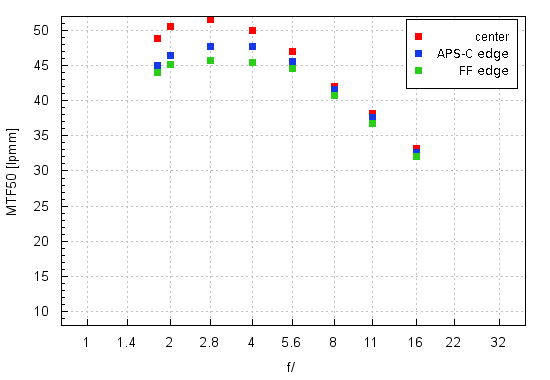
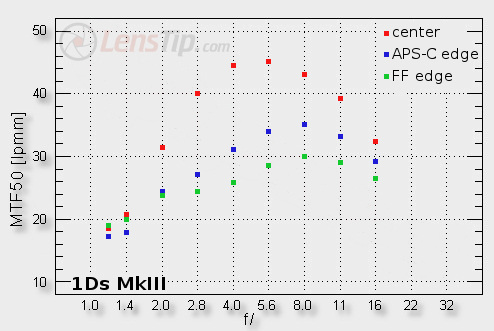
The optimal sharpness of a lens is determined by 2 things: how sharp the lens is and where the diffraction limit of your sensor lies.
An example of a super-sharp lens is the Sigma 135mm f/1.8 Art (I have one myself too).
You can see that maximum sharpness is already reached at f/2.8. This sharpness is so absurdly high that stopping down further causes more diffraction and sharpness decreases (it is still just as sharp, if not sharper than other lenses).
If we take another less sharp lens: the Canon 50mm f/1.2L, you can see that the lens has to be stopped down much further for optimal sharpness, to about f/5.6-f/8.
You can see that the maximum sharpness in the center at f/8 is the same for both lenses, because the lens is limited by diffraction there.
I only work with lenses that I stop down for more depth of field, not for more sharpness, because they are all already very sharp from corner to corner at wide apertures (Zeiss 21/2.8, Sigma 50/1.4 Art, Zeiss MP 100/2, Sigma 135/2 Art, Canon 200/2.8L).
Different rules apply to macro photography. Here, the focusing distance is so incredibly short that blur caused by diffraction is less severe than blur caused by too little depth of field. -
 Michelle Peeters wrote on Thursday 1 February 2018 at 11:19
| reply
Nice addition Paul, thank you!
Translated from Dutch.
Have your say
Please note: Articles older than a week can only be commented on by signed-in visitors.Would you still like to comment? sign in or create a free account.
Become a better photographer every week
A practical photography tip in your inbox every week.
38,763 photography enthusiasts already receive the tips! More about the weekly mail. Or keep up to date via  Facebook.

Elja Trum
Photofacts; everything to do with photography!
Would you like to take better photos and keep up with what is happening in photography? Photofacts publishes articles that teach you something about photography — from a product announcement to a practical shooting tip or a look at a website. Photofacts covers photography every day and is a hobby project of Elja Trum's that got out of hand. The articles are written by a team of volunteer authors. If you would enjoy writing one or more articles for Photofacts, do get in touch.More about PhotofactsPhotofacts is made possible in part by
