

Which digital camera is right for me?
Wednesday 12 December 2018, 21:09 by Michelle Peeters | 27,814 views | 38 commentsThis article was translated from Dutch with the help of AI. Read the original.
If you're looking for a (new camera), it can be hard to see the wood for the trees. There's so much choice! So which camera suits you best? And what are the differences?
The first question you should ask yourself when looking for a camera is: What do I want to use it for?
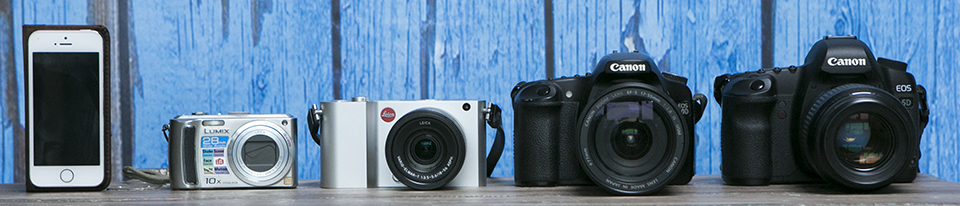
What do you want?
Do you want to photograph nature? Do you want to shoot portraits? Or do you simply want to take some nice photos on holiday? Are you expecting a baby and would you like to photograph it properly? Do you also want to film with your camera, or are you really only interested in taking photos?
And have you thought about the size? Do you want a small camera? Or does that not matter to you? And what are you going to do with the photos? Will you only put them on Facebook, or do you also want to print photos in a large format?
How easy do you want the camera to be to operate? Do you want to set nothing yourself and simply take nice photos, or do you want full control over your camera (and therefore adjust lots of settings yourself)?
These are all questions that can help you make the best choice. List your wishes and see what you really consider important.
In this article, I will explain in a simple way what the difference is between the different types of cameras and lenses, so you have a rough idea of what suits you best.
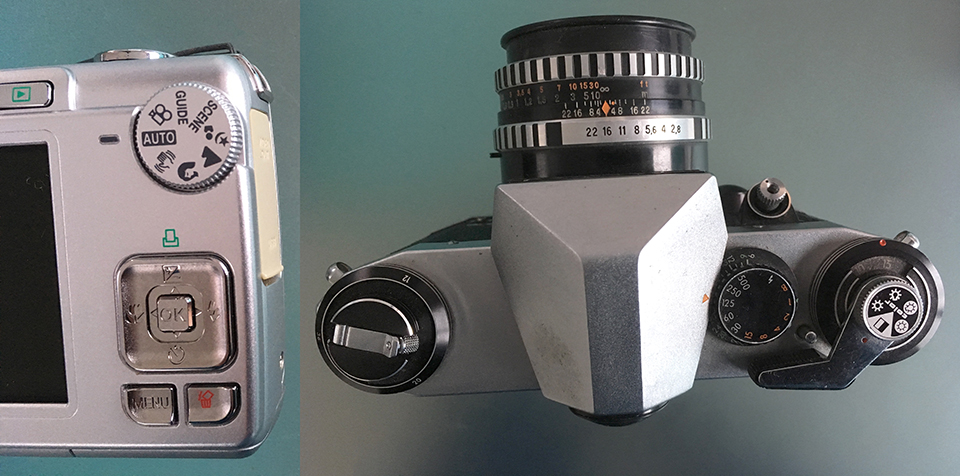
What to look for when buying
There are quite a few things to consider when buying a digital camera. Below, I explain the most important ones. The different types you can broadly choose from are:
- Compact camera: generally small sensors
- Mirrorless cameras: available with small sensors (Nikon CX), medium-small sensors (Micro Four Thirds), medium-sized sensors (APS-C) or large sensors (full-frame)
- DSLR camera: available with medium-sized sensors (APS-C) or large sensors (full-frame)
Sensor
With an analogue camera, the photo was recorded on a negative. With a digital camera, it is recorded on a sensor. The sensor captures the light (the image you see) and converts it into a digital signal.
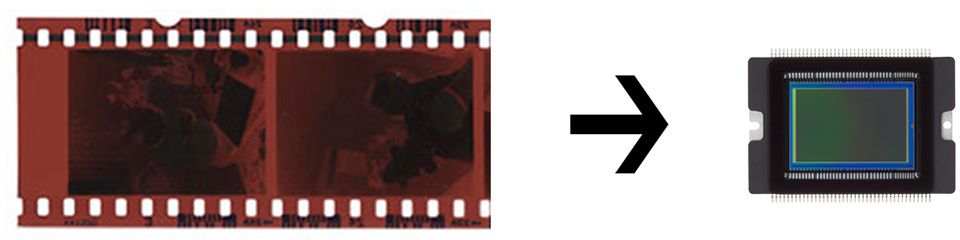
The larger the sensor, the higher the quality and the more of the image the camera can capture. The sensor in a camera determines, among other things, the image format, resolution, depth of field and dynamic range.
The larger the sensor, the less depth of field you can create in your photos. So if you want high-quality photos, choose a camera within your budget with the largest possible sensor.
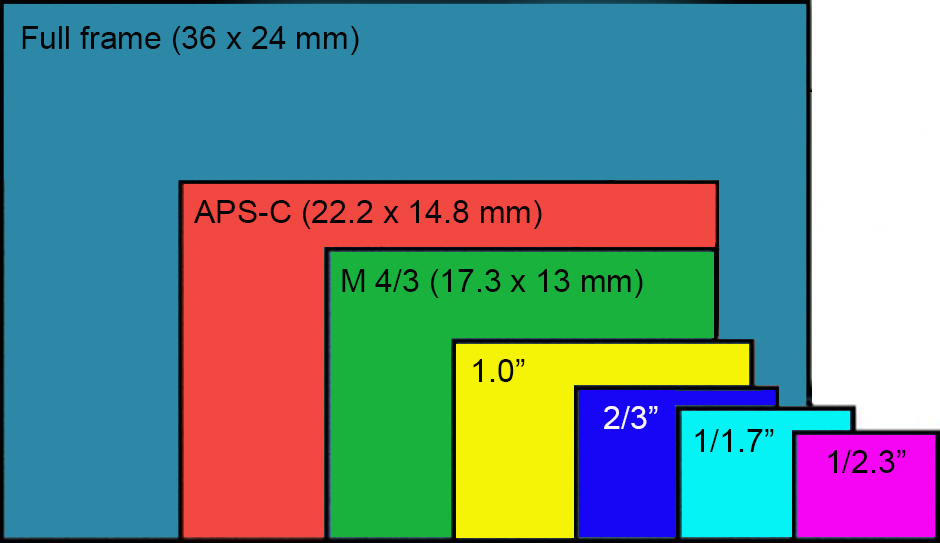
The professional standard for a sensor is the full-frame format (also called 35mm). More expensive cameras often have a full-frame sensor, which is relatively expensive to develop. They are often used in Canon, Nikon and Sony's professional flagship cameras.
Other sensor formats include APS-C (Canon, Nikon and Pentax DSLRs, Sony mirrorless cameras) and Micro Four Thirds or M4/3 (Panasonic and Olympus mirrorless cameras).
The M4/3 sensor is exactly half the size of a full-frame sensor, allowing the bodies to be even smaller than those of APS-C or full-frame mirrorless cameras.
The lenses for an M4/3 sensor camera are also considerably smaller than those for a full-frame camera, especially at longer focal lengths such as 200mm or 400mm (400mm and 800mm full-frame equivalent).
This smaller sensor format than full-frame results in a crop factor for lenses. As a result, less is captured than when using a full-frame sensor. You get a kind of zoomed-in effect: a 200mm lens on M4/3 is therefore comparable to a 400mm lens on full-frame and a 300mm lens on an APS-C camera.
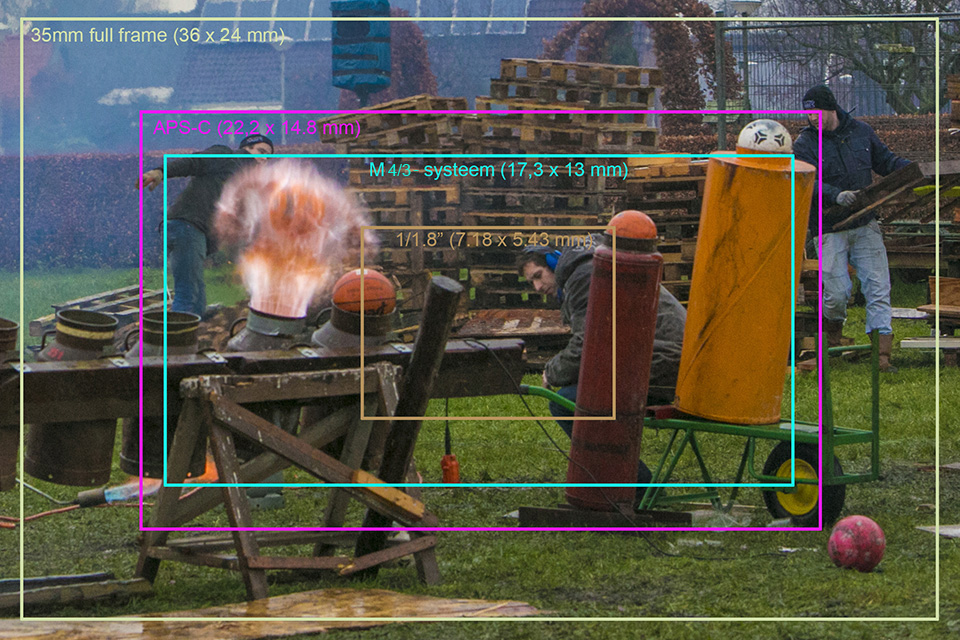
To calculate the actual focal lengths on the different sensors, you can apply the calculations below:
* Full-frame = focal length x 1
* APS-C = focal length x 1.5
* M4/3 = focal length x 2
With a crop factor of 1.5 or even 2, APS-C or M4/3 is a very interesting choice for sports or wildlife photographers, as you can bring the action closer more easily.
Megapixels
More megapixels does not always mean that you are getting a better camera. How many megapixels you need depends on what you are going to do with the photo. Will you only put your photos on your computer and share them on Facebook? Or do you want to make large prints?
In the latter case, it is better to choose a camera with more pixels. The resolution of an APS-C sensor often ranges from 16 to 24 megapixels. In any case, bear in mind that a 10-megapixel camera can produce a good A4 print.
More megapixels also mean larger files. So make sure you have large memory cards.
It is the surface area of the sensor that captures light and converts it into individual pixels. The larger this surface area (so the larger the sensor), the larger the individual pixels can be. The larger the pixels, the more information they can capture, which benefits image quality. You also get much less noise with larger pixels.
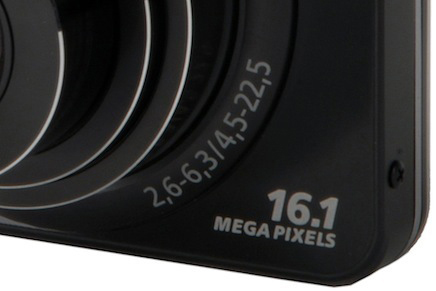
1. Compact camera
Compact cameras are the most handy and simple. They are mainly focused on ease of use and contain many pre-programmed settings. Taking photos with a compact camera is very accessible.
Unfortunately, you have no option to change lenses. The camera often does have a wide optical range, though. This is a major advantage over a smartphone, which you cannot really zoom with without losing quality.
A compact camera makes photography very easy. Some even automatically detect blinking eyes. With more expensive models, you can sometimes edit photos directly in the camera.
If you want to take photos in a simple way and go out with lightweight equipment, while having more zoom options than your smartphone allows, a compact camera is certainly a good choice.
Would you like to photograph animals or sport? In many cases, you need a compact camera with lots of zoom. Entry-level compact cameras have an optical zoom range of 3 to 5 times. That is fine for everyday use, but not for subjects at a distance (animals, athletes).
Choose a compact camera with 20 to 30 times zoom. These are often a little larger, but will still fit in your pocket or handbag.
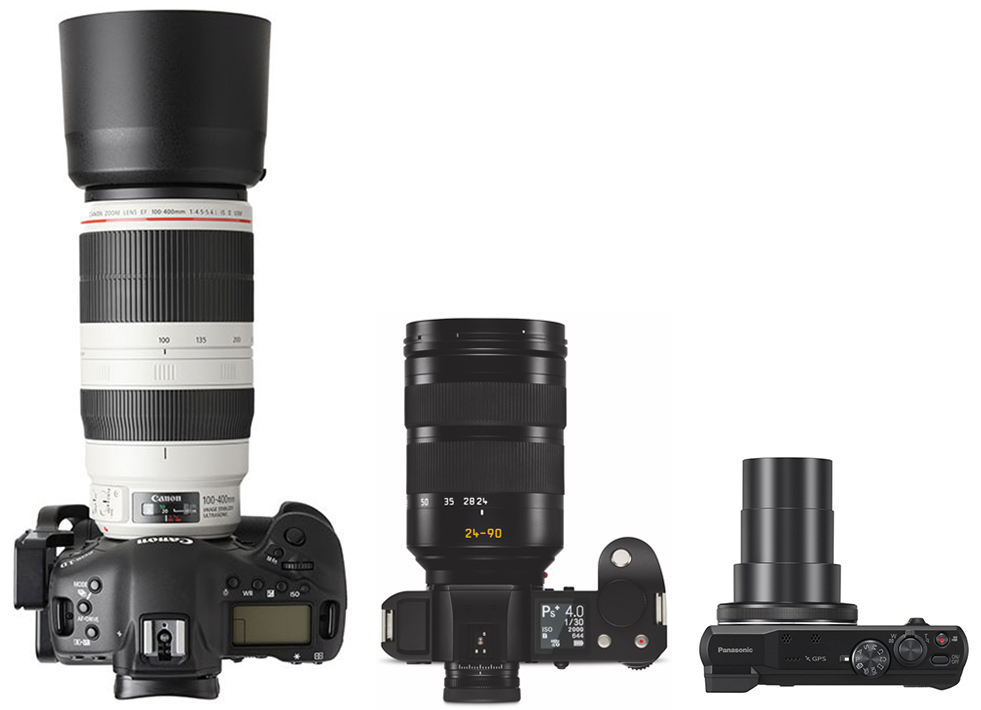
2. Mirrorless camera
This is essentially the compact version of a DSLR. With a mirrorless camera, you have many more options than with a compact camera when it comes to changing lenses.
And also when it comes to adjusting your settings. A mirrorless camera has a much larger sensor than a compact camera.
A mirrorless camera has no mirror box in the body. This is in contrast to a DSLR. As a result, the camera does not have an optical viewfinder, but an electronic viewfinder for looking through the lens.
The image therefore corresponds exactly to the final image in the camera (wysiwyg), unlike with a DSLR. You get a clear impression of the exposure, white balance and depth of field before you have taken the photo.
This can also be switched off in the studio. With a DSLR, you only see this afterwards, although you can check the depth of field using a button on the body.
Because there is no mirror, the camera is still reasonably small, compact and light. So you have to carry less weight with you when using a mirrorless camera. A heavier DSLR can, however, feel a little more comfortable in your hand.
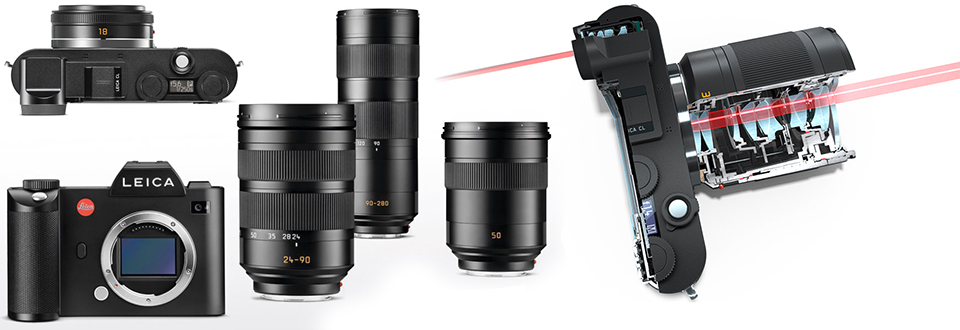
3. DSLR camera
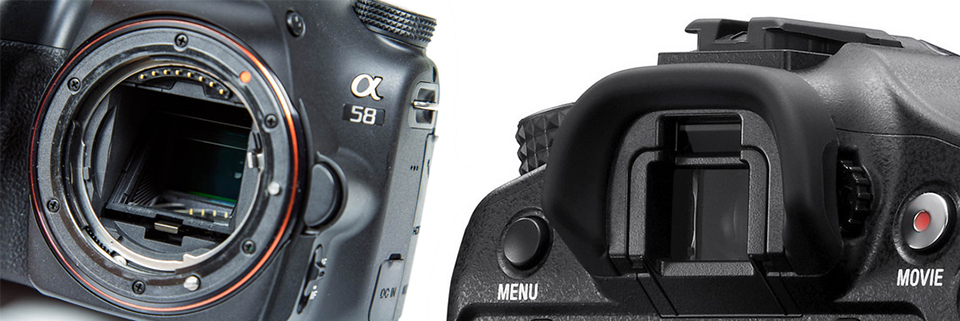
As the name suggests, a DSLR does use a mirror box. Because of the mirror in the body, these cameras are often larger and heavier than mirrorless cameras.
You look through the camera lens via a prism and a mirror (an optical viewfinder). This means that you see the actual image through the viewfinder. Because of the mirror box in the body, a DSLR is often larger and heavier than a mirrorless camera.
DSLRs have traditionally had a depth-of-field preview button. When you look through the viewfinder, you always see the depth of field at the widest aperture (smallest number).
Only when you take a photo does the aperture close to the set value. A DSLR therefore does not show what will ultimately be recorded by the sensor. A mirrorless camera does.
This is because the image becomes darker at a smaller aperture. The image gets darker, but gives you an impression of the actual depth of field in the photo you are about to take. You will usually find this button on the front of your camera, next to the lens.
Which lens?
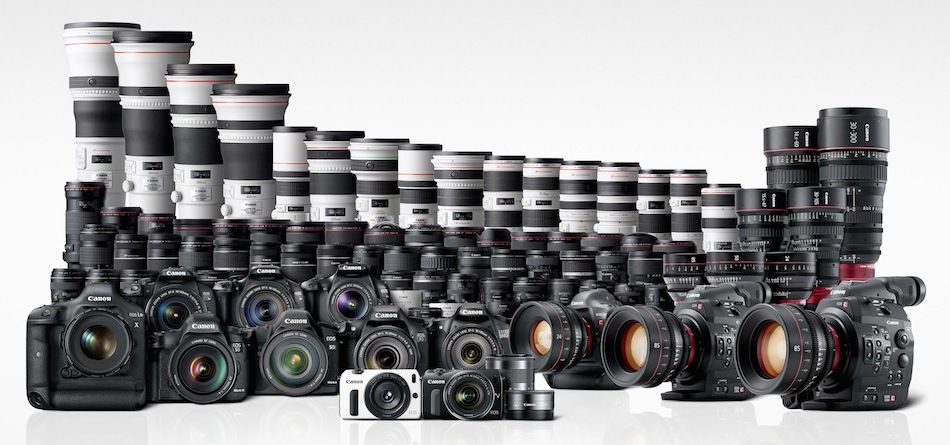
If you want to photograph landscapes, you need a wide-angle lens. Would you like to shoot portraits? Then buy a fast lens so you can photograph with a wide aperture and create a lovely shallow depth of field.
Would you rather photograph animals (birds, wildlife)? Then you could consider buying a telephoto lens.
It is therefore very important to think about what you want to photograph and which lens you should buy for your camera. Do you simply want to get started with holiday and family photos?
Then a kit lens (often supplied as standard with a mirrorless or DSLR camera) can be a good solution, with a range between 14mm and 55mm. You can take excellent landscapes and portraits with it. They are often not fast lenses, but they are fine for getting started.
An extra telephoto lens is useful for photographing nature or sport. You can also choose to buy a lens with a wide range, such as an 18-200mm.
Try it yourself
When you are buying a camera or looking for something new, also think carefully about the accessories that go with it. For example, are good lenses and flashes available for your choice?
And what lens mount does it have? The Sony E-mount, for example, is still fairly new, so not all lenses will fit it. These are things you need to take into account.
It is also essential to try out the camera before you buy it. Check how it feels in your hand, whether you have enough grip and whether it is not too heavy, whether you like the viewfinder, et cetera.
More tips?
If you would like to share more tips, experiences or buying arguments concerning your own digital camera, please let us know in the comments!
Want to learn more about the basics of photography?
At Photofacts Academy, our online learning environment for photographers, we have a complete basic photography course. You can follow this course for two weeks with a free trial membership.
About the author
Michelle Peeters is fotografe en oprichter van DeuxBleus Fotografie. Michelle herkent het bijzondere in het gewone en het gewone in het bijzondere. Ze heeft zich nooit willen specialiseren en is daardoor van alle markten thuis.
You might also like
-
 DSLR lenses are still perfect
by Nando Harmsen
-
 The DSLR is dead, long live the mirrorless camera!
by Elja Trum
-
 The battle between DSLRs and mirrorless cameras
by Michelle Peeters
-
 6 Reasons to Stick with a DSLR and One Reason Not To
by Nando Harmsen
-
 Is a DSLR still a good choice in 2026?
by Nando Harmsen
-
 Choose DSLR lenses for your mirrorless camera
by Nando Harmsen
38 comments
-

 hypofocus
wrote on Tuesday 9 January 2018 at 10:09
| reply
Nice informative article for people who are looking to choose a camera for the first time.
Translated from Dutch.
When it comes to megapixels, you can already get by with much less than 10MP and still print much larger than A4 in beautiful quality.
Back then, I had several prints in top quality, measuring 100 x 150cm, printed with just 6 megapixels.
Of course, modern cameras provide much more quality, better noise performance and higher dynamic range than a D70 from 2004. But even back then, it was perfectly possible.
For hobbyists, megapixels are actually something you don't need to pay attention to at all these days. All cameras on the market offer more than enough resolution to print perfectly at very large formats.
-
 Donald Willemsen
wrote on Tuesday 9 January 2018 at 10:47
| reply
@Michelle, you forgot a category of cameras. I don't blame you though. It's a category that is generally only used by professionals. Think of Hasselblad and Malta, for example. They have huge sensors with sizes like 36.8x49.1mm or 32.9x43.8mm, up to even 53x40.4mm. The prices reflect that, of course. But with a thick wallet or a well-filled credit card, you can get quite far. 😁
Translated from Dutch. -
 Michelle Peeters wrote on Tuesday 9 January 2018 at 11:02
| reply
@hypofocus: nice addition: thanks!
Translated from Dutch.
@Donald; That's indeed correct, I deliberately didn't add medium format cameras, it's still not financially feasible for most photographers.. -
 Emile Hermkens. wrote on Tuesday 9 January 2018 at 11:18 | reply
Good article, but I do think there’s rather too much Canon. Not right for an objective story.
Translated from Dutch. -
 jaak wrote on Tuesday 9 January 2018 at 11:25 | reply
with a mirrorless camera you look (as far as I know) through the lens TOO - the image that falls on the sensor is previewed on a little screen. So consequently also identical to what you get when taking the picture, right?
Translated from Dutch. -
Donald Willemsen
wrote on Tuesday 9 January 2018 at 11:27
| reply
@Michelle, for me, a Canon Eos 1Dxxx is already out of reach. Let alone those medium format cameras. In the context of the article, those could easily have been mentioned too. Such a medium format camera could also be a suitable camera for you. Even if you don't have the money for it.
Translated from Dutch. -
Michelle Peeters wrote on Tuesday 9 January 2018 at 11:33
| reply
@Jaak: with a mirrorless camera, you don't physically look through the lens. You see the image that falls on the sensor through the lens. That image is projected onto an electronic viewfinder sensor. With a DSLR, via the mirror you do look directly through the lens to the outside.
Translated from Dutch. -
Donald Willemsen
wrote on Tuesday 9 January 2018 at 11:33
| reply
@jaak, the viewfinder image can be smaller than the actual image. With a DSLR, that is more often the rule than the exception. With a mirrorless camera, that also seems possible to me. I could be wrong. I use a DSLR.
Translated from Dutch. -
 René Prevo wrote on Tuesday 9 January 2018 at 12:05 | reply
All effects can be visible directly in an electronic viewfinder. The image on the monitor can show more than with a reflex camera.
Translated from Dutch.
16 megapixels is more than enough for a very good print in any format, with the corresponding viewing distance, also from a M4/3 sensor. -
 Mark Vierin wrote on Tuesday 9 January 2018 at 13:42 | reply
Educational and clear explanation... But, after years of photography with decent digital cameras, I, just as nostalgia now makes CD buyers buy Long Playing records, have switched back to photography with film. Through auctions I bought a Hasselblad 500 and Leica M2. A remarkable observation: in second-hand sales you find digital cameras, even Leica, for 100€, but for my purchases I paid 1,500€ /piece + a few more lenses and I quickly end up paying 2,500€ per piece. So, if you are interested in an inexpensive top device, you still end up spending quite a few cents. But, if you want to buy the mentioned brands as digital today, you are almost 50x more expensive.
Translated from Dutch.
What is the result?
Film photography is a "ceremony". Adjusting everything yourself, as accurately as possible, and afterwards, after developing the film (in a lab), checking whether the hoped-for result has been achieved.
Is film photography "better" than digital? No, but on the old top brands you do find phenomenal lenses, which also still fit digital devices. For example, I bought the first digital Leica with a Summicron 35 lens for 200€, whereas today you pay 2,200€ for the same lens!
Hasselblad 500: 6x6 negatives. When enlarged, I get a painting as a result, viewed from a distance, the same photo viewed from 30 cm is a collection of spots and dashes where you would never think that anything decent could come out of it.
Finally: an enlargement on film next to an enlargement photographed digitally? A painting next to a print.
My digital photography and video today: with my iPhone. Nice little pictures and quite enjoyable with lots of light. My Canon with a prime lens (½ kilogram) looks at me reproachfully.
Finally: top devices with film are professionally cleaned up (a CLA) and work like new (and also look new at Leica) -
 Bob wrote on Tuesday 9 January 2018 at 14:50 | reply
Michelle, saying that with a mirrorless camera you cannot see the depth of field and other effects is too simplistic. All (almost) cameras have a preview in which you can see the effect at the chosen aperture. You can even see more. Any backlight effects at the chosen correction are also immediately visible, unlike with a DSLR, unless you switch on live view. But then you actually have a mirrorless camera.
Translated from Dutch.
In my opinion, the DSLR is slowly but surely disappearing, to the benefit of the mirrorless camera. Just look at the Sony A7, A9 development. Mirrorless cameras that the top DSLRs can only dream of !
Isn't it the case that the old guard (Nikon, Canon) are "suffering" from their legacy, namely their gigantic lens range, ALL of which is only suitable for their DSLRs. And it hurts to have to switch. Right ? -
 osten wrote on Tuesday 9 January 2018 at 16:15
| reply
A good summary.
Translated from Dutch.
Sadly Leica is so expensive
rgds.osten -
 Ben wrote on Tuesday 9 January 2018 at 16:22 | reply
Nice story but I do miss Fuji after all, not unimportant, enn. nice camera and even nicer photo,s especially in jpeg they are already so beautiful that post-processing isn't even necessary, seems to me also a plus for people who don't want the hassle of editing the photo,s.
Translated from Dutch. -
 Vincent wrote on Tuesday 9 January 2018 at 16:58 | reply
Jaak does have a point, by the way, not about looking through the lens, but that with an electronic viewfinder (EVF) you 'see what you get', and it also has other advantages as Bob points out. For example, with an EVF you always see 100% of the image (with the optical viewfinder of a DSLR it is often e.g. 95 or 99%) and it can often also display exactly what the photo will look like, indeed including depth of field, white balance etc. Electronic viewfinders are getting better, faster and more advanced all the time, and can also be adjusted more and more to personal preferences, an EVF can also display a lot of extra information. Of course it just depends on what you prefer working with, an optical viewfinder has other advantages and disadvantages.
Translated from Dutch.
These days you can make the camera possibilities as crazy as you want. Often the budget is mainly the limiting factor.
What I miss in the piece is the speed of autofocus. Generally speaking, DSLRs still have faster autofocus than mirrorless and compact cameras (especially those in the entry-level segment), which is particularly important in action and sports photography.
Mirrorless cameras are getting faster all the time, but they are not necessarily cheaper than DSLRs. For beginners, I still think an entry-level DSLR offers the most 'bang for your buck' - and you can easily 'upgrade' such a camera by buying a better lens for it. These cameras are usually not very big and heavy either and they are also widely available second-hand, so with a bit of searching you can find a decent camera for next to nothing. And in principle, the quality of the lens is often more decisive for the sharpness of your photo than the camera itself! The well-known 'nifty fifty' lens (50mm) from Canon, among others, is really highly recommended in that respect (bright and not expensive).
For the rest, roughly speaking, this still applies imo: the more demands you have, the more expensive it gets. There are also very good compact cameras for sale that do not fall short of a DSLR or mirrorless camera in terms of quality and speed (possibly even with a larger sensor), but they are also at least as expensive, often even relatively much more expensive. And there are even compact cameras with a fixed (very good) lens that are very nice, but they are certainly not cheap either - you also pay a bit extra for the design, of course...
The development of mirrorless cameras is currently progressing very quickly: where they were really still lagging behind DSLRs (including cheaper ones) a few years ago, for example in terms of autofocus, they can now really compete with them, especially the newest and more expensive models such as the Fuji X-T2 and a number of Sony models. There are major differences here too, just as with compact cameras, in terms of sensor size and autofocus etc, and you often soon end up in the more expensive segment if you have more demands. The same perhaps applies even more to the accompanying lenses.
Well, you can of course mention medium-format cameras in this article, but you can assume that information about such a camera is probably already well known to the photographer who is interested in one.
For most photographers, an APS-C sensor (or possibly full-frame) is more than enough, and indeed the cameras in smartphones are also getting better and better. There are professional photographers who take the most beautiful photos with them, in that respect it is still the photographer who takes the photo and not the camera. And the best camera is the camera you have with you...
Furthermore, I would advise: if you are interested in a particular camera, be sure to read lots of (extensive) reviews and tests about that camera, ask other photographers for information and above all look for points of criticism. No camera is perfect, the trick is to find a camera that matches your wishes - for a sports photographer, fast autofocus is very important, but if you photograph still lifes, fast autofocus is not that important. -
 Ben1250 wrote on Tuesday 9 January 2018 at 19:54 | reply
I think it is a nice and informative piece. And of course you can always add to it further, as here with cameras that hardly anyone can afford anyway. That is why I would rather point out that instead of always looking upwards, especially in these times you can also look downwards by asking yourself whether you really always need the very latest gadgets. If you can manage to do with one notch less, there are great opportunities. Remember that a beautiful photo is much more often created by the photographer's craftsmanship than by the price of the camera. Almost nobody starts all at once with a very expensive camera, but the showpieces and flagships are almost always bought as replacements for an already particularly good camera, which then quite often appear on the second-hand market and can, with a bit of luck, be very suitable for a beginning amateur and provide very good service for many years. Or another clever trick is to buy a new one that is being pushed off the market by even nicer newcomers and is often offered for very little. For example, you still quickly pay €750 for a bare Canon EOS800D body, while with a bit of searching you can still find a supplier who has a brand-new EOS700D somewhere in a forgotten corner for €350. Then forget the second-hand market, right. And that is how the even cheaper EOS1300D will soon go on sale because the recently introduced EOS200D will drop in price towards the EOS1300D after the initial saturation and will disappear from the market at rock-bottom prices of almost certainly under €300. And that applies no less to the lenses. Of course you can buy the most expensive branded lenses with your camera. And I certainly would not advise against it for anyone who has the means to do so. But there are also brands like Sigma and Tamron that build good-quality lenses that are many times cheaper but really not many times worse. It is wise to read as many reviews as possible carefully, because there may sometimes be a few weak brothers among them that really perform less well, something you almost never come across with the well-known branded camera bodies.
Translated from Dutch. -
 Free Hasselman wrote on Tuesday 9 January 2018 at 21:50 | reply
Nice informative article, enjoyed reading it, but I miss Fuji in your story. With the X/ APS-C sensor, they have raised the bar for APS-C cameras a bit higher again and brought them closer to Full-frame capabilities.
Translated from Dutch. -
 René Peterse wrote on Tuesday 9 January 2018 at 22:21 | reply
Following a few comments, Sony nowadays has SLR cameras with an electronic viewfinder. Then you see in real time what you are doing with your settings (approximately, with a minimal difference from the final photo). That works very conveniently.
Translated from Dutch. -
Michelle Peeters wrote on Tuesday 9 January 2018 at 22:32
| reply
I corrected a number of errors in the article. Thanks for your attentiveness! Among other things, the difference between an optical (DSLR) and electronic (mirrorless camera) viewfinder and the format of full frame.
Translated from Dutch. -
 Jef wrote on Tuesday 9 January 2018 at 23:28 | reply
I completely agree with Bob's opinion. From a purely technical point of view, it is a good article, but the emphasis is too strongly on Canon and Nikon. They are indeed getting quite a lot of headwind from the latest Sony cameras, which produce brilliant images. I would know, because in the meantime I am also the "happy" owner of a Sony A7 R II.
Translated from Dutch. -
 Kurt M wrote on Wednesday 10 January 2018 at 00:04 | reply
On a website of the camera brand I use ( seems to be bad according to users of another brand
Translated from Dutch. ) there are help routines that make choosing easier. Especially the lens tool is very practical. -
 M Foppen wrote on Wednesday 10 January 2018 at 10:17 | reply
Good morning.
Translated from Dutch.
Interesting article,my choice has been made.The article confirms that I made a good choice.It remains a choice. Rgds,G. -
Vincent wrote on Wednesday 10 January 2018 at 10:21 | reply
@Emile, Jef: I really don't see that, when I read through the text again what strikes me is that Michelle has tried to phrase it as neutrally as possible and has also used various camera brands in the photos. In an article like that it is almost inevitable that a brand will occasionally be mentioned as an example, but I don't read a clear preference for one or the other. In the reactions that follow below it you do see some brand preferences. Only the photo with the collection of Canon cameras and lenses is clearly an 'advertising photo' (very illustrative, by the way, to indicate the multitude of choices) but there are also photos of Leicas and Sonys etc. included.
Translated from Dutch.
By the way, I do think that a beginner (for whom this article is primarily intended) will often still end up with Nikon or Canon if the choice is a DSLR, simply because there is a lot of choice in affordable entry-level cameras and lenses from those brands (both new and second-hand). And someone who is just starting out and still needs to orient themselves I personally would not immediately advise to start with e.g. a Sony A7 RII but that is my personal line of thought on this. -
 Yannick wrote on Wednesday 10 January 2018 at 10:45 | reply
For me, the Leica M is still one of the better cameras. Quiet, small and inconspicuous, and there is plenty of top-quality glass available for it.
Translated from Dutch. -
 Fuji wrote on Wednesday 10 January 2018 at 11:57 | reply
too bad my camera brand isn't mentioned anywhere. A missed opportunity!
Translated from Dutch. -
 Herman wrote on Wednesday 10 January 2018 at 12:46 | reply
Great story! Use both DX and FX cameras. In addition, a mirrorless camera and the iPhone Plus. All cameras come into their own.
Translated from Dutch. -
 Casanova56
wrote on Wednesday 10 January 2018 at 13:31
| reply
Here then, clearly my opinion.
Translated from Dutch.
If someone asks which camera to buy.
Then make it clear to him not to buy any Entry Kits for sure, because then you fatten the retailer, but let that person then look at a body higher than those Entry Kit cameras.
The reason for that is: With those bodies you then do NOT have to pay attention anymore to whether the drive for the AF is in the lens, because it is already in the body, that is with Nikon in the D7xxx series and higher.
If that person buys such a second-hand body with a lens with a fixed aperture, he can be cheaper off than such a kit from the Entry series.
Yes ok, then he does not have a telephoto lens with it, he can buy that lens later according to his interest, birds in nature require a longer telephoto lens, but birds in a Zoo can therefore be done with a shorter telephoto lens.
Then also give him advice when he buys those lenses, to buy them as FullFrame, if he does want to switch from crop to FullFrame later after all, he already has the lenses for that.
Yes, I made my last Analogue photos in 2011, then switched to Digital, after having bought 4x Digital crop bodies, I am now the owner of a second-hand Nikon D750. -
Donald Willemsen
wrote on Wednesday 10 January 2018 at 14:26
| reply
@Casanova, I also have an urgent piece of advice for you: Read your story again and come to the realization that it is a muddled story that is impossible to follow. No one in the world can do anything with this, even with the best will in the world.
Translated from Dutch. -
Michelle Peeters wrote on Wednesday 10 January 2018 at 16:50
| reply
A classification of digital devices can be found at www.cameradecision.com. Very comprehensive with rankings and, as far as I can judge, objective. Mark Vierin.
Translated from Dutch. -
guest wrote on Wednesday 10 January 2018 at 18:07 | reply
Michelle, where can I find the term Mirrorless Camera on that website?
Translated from Dutch. -
Michelle Peeters wrote on Wednesday 10 January 2018 at 20:35
| reply
@guest: search for ILC or look at the mirrorless cameras!
Translated from Dutch. -
 Wil wrote on Thursday 11 January 2018 at 08:54 | reply
Yes I also miss the Fuji story, I have a Fuji X Pro 2, what an amazing camera, once you've tried it you don't want anything else.
Translated from Dutch. -
Mark Vierin wrote on Thursday 11 January 2018 at 14:43 | reply
Anyone who wants to consult an overview of all hobby digital cameras should surf to www.cameradecision.com.
Translated from Dutch.
An absolute must and in my opinion objective. Comparisons in figures. -
 José wrote on Thursday 11 January 2018 at 19:48 | reply
Hello Michelle
Translated from Dutch.
thank you for your informative article.
I am still just a beginner and have a question about your article.
It said somewhere:
The larger the sensor, the less depth of field you can create in your photos. So if you want photos of high quality? Get a camera within your budget with as large a sensor as possible.
First of all, I don't understand why a LARGER sensor creates LESS depth of field?
Can you explain that in not too difficult language?
Secondly, I think that the 2nd sentence contradicts the 1st. Do you understand what I mean?
I am very curious about your answer
kind regards
José -
Michelle Peeters wrote on Thursday 11 January 2018 at 20:29
| reply
@José: a really good question!
Translated from Dutch.
A smaller sensor has a smaller field of view (you can see that in the image of the carbide shooting). To get the same photo in that field of view as with a larger sensor, you automatically get a smaller image scale (after all, the photo is displayed smaller on a smaller sensor), and that smaller image scale is the cause of the increased depth of field here.
In principle, sensor size will have no influence on depth of field.But if you want to have a subject at the same size in the photo with a crop and a full-frame camera, the distance to the subject will have to change, in other words the focal length. As you know, distance and focal length have a very big influence on depth of field. Sensor size and crop factor therefore have indirect influence on depth of field.
It seems as if the focal length of a lens with a crop sensor is longer than on a full-frame. That is a great advantage for, for example, wildlife or sports photographers who photograph with a telephoto lens: you get the subject much larger in the photo and you have more depth of field throughout the entire image! -
Michelle Peeters wrote on Thursday 11 January 2018 at 20:33
| reply
@José: the larger the sensor, the more expensive the camera, is often the rule. If you have a limited budget, at least look for a camera with as large a sensor as possible.
Translated from Dutch. -
Vincent wrote on Thursday 11 January 2018 at 22:47 | reply
@José: for detailed information about depth of field and the influence of sensor size on it, you can also google 'nandoonline' and 'depth of field': Nando explains it all in great detail on his blog
Translated from Dutch. -
 Tinne wrote on Wednesday 15 August 2018 at 21:01
| reply
Until now, we had a very simple compact camera. I would like to buy a new (better) compact camera or a system camera. I would like to delve a bit deeper into this. But initially, it is important that I can take quality photos of holidays, children, parties, family,... (if I get the hang of it, I would also like to take communion photos myself) and that it can also be taken along somewhat easily. Moreover, it would be handy if it could be used by a (for now at least) layperson
Translated from Dutch. Which ones would you recommend to me ? -
Michelle Peeters wrote on Thursday 16 August 2018 at 11:30
| reply
@Tinne: I would definitely go for a camera with a larger sensor and zoom capabilities. It's difficult to determine what suits you best. Photo shops often provide good advice, and it helps if you have already been able to determine for yourself what your skill level is and how much creative freedom you want. I think it will then be either a mirrorless or DSLR camera. If you don't want to carry a lot of weight, a mirrorless camera is a better option.
Translated from Dutch.
Have your say
Please note: Articles older than a week can only be commented on by signed-in visitors.Would you still like to comment? sign in or create a free account.
Become a better photographer every week
A practical photography tip in your inbox every week.
38,836 photography enthusiasts already receive the tips! More about the weekly mail. Or keep up to date via  Facebook.

Elja Trum
Photofacts; everything to do with photography!
Would you like to take better photos and keep up with what is happening in photography? Photofacts publishes articles that teach you something about photography — from a product announcement to a practical shooting tip or a look at a website. Photofacts covers photography every day and is a hobby project of Elja Trum's that got out of hand. The articles are written by a team of volunteer authors. If you would enjoy writing one or more articles for Photofacts, do get in touch.More about PhotofactsPhotofacts is made possible in part by
