
The best camera is the camera you have with you!
Monday 1 March 2021, 20:10 by Laura van der Burgt | 6,505 views | 11 commentsThis article was translated from Dutch with the help of AI. Read the original.
Do you ever catch yourself wanting to know straight away what type of camera and lens were used when you see another beautiful photo?
A kind of subconscious check of whether you could take a photo like that too. And what do you find? The photo was taken with a much better camera and more advanced lens than the one you have.
See, you think to yourself, I simply don't have the right gear to take such beautiful photos. But is that really true?
Photography is an expensive hobby, or has become one. Have you just bought a new camera, and its successor is already in the spotlight. That can give you a pretty unpleasant feeling.
As if you bought your new equipment too soon. For example, I bought the Canon R at the end of 2019. It now seems like a toy compared with its successors, the R5 and R6. Can I still take myself seriously as a photographer when I don't have the best, meaning the latest, gear?
GAS
This focus on equipment may seem exaggerated, but there is a real term for it: 'GAS'. In other words, Gear Acquisition Syndrome. And every photographer suffers from it to some extent.
Whether it is a tripod, camera bag, type of lens or the camera itself. Commercial interests will always make you feel that you need to invest as much as possible in the very latest gear, because it will finally enable you to take that great photo.
Pretty frustrating, but are they right?
We can really fool ourselves that way. Because the best gear has actually been in your camera bag for a long time!
There is no camera or lens that will make you take better photos. No, really not. To take better photos, you need something else.
So don't let yourself be distracted any longer and focus on developing your photography, rather than your equipment.
What do you really need?
First of all, yourself. Because you take the photo, you decide what appears in the photo and how, not the camera.
So instead of spending time and money on false hope and expectations, you would be better off picking up your current camera or phone and trying to take the photos you like so much!
And what if you don't manage it the first time?
Well, there you have a challenge.
What are some of the ingredients for creating a beautiful, good or creative photo?
1) Knowledge, invest time in knowledge. About operating your camera and lens and their capabilities. About settings such as aperture, shutter speed and ISO. And how they relate to each other. Which settings do you need to create your photo?
2) Practice, thinking and reading about photography is different from doing it! Choose a photo you like, analyse it and recreate it. Keep going until your result comes close to, or even surpasses, the example.
3) Composition, arrange your subject in an interesting place and pay attention to balance in your photo. If you are not sure about the composition, rotating it 180 degrees on your screen can sometimes help.
4) Making mistakes, it sounds clichéd, but you learn most from making mistakes. So throw all your inhibitions overboard and try, try and learn.
5) Confidence, nothing is more damaging than thinking that your photos don't matter. Remember that nobody is born a top photographer, and before that one beautiful photo is made, many attempts have failed.
6) Self-knowledge, what are your pitfalls? Do you perhaps want to cram too much into the photo? Then try taking a minimalist photo.
7) Limitation, focus on one thing that you want to improve or learn. This could be a technique, a subject, a setting, a lens or a theme. But make a choice and get started. In der beschränkung zeigt sich den meister....
8) Editing, photo editing is important and comes in many degrees. From minimal to extreme editing. By learning about photo editing, you realise that what you see on social media did not simply roll out of the camera. Follow one of the many courses on Photofacts.
9) Feedback, find someone you can discuss photography with and who is willing to give honest and constructive criticism. These days, you can do that very well online.
Zoom offers 40 minutes of free discussion time. Flickr or Facebook are still free and you can create a private account there and share it with your buddies.
10) Enjoyment, enjoy what you do, and the rest will follow naturally.
And admit it, when you are taking photos, do you think about all that desirable, better-performing equipment?
Not at all. It is more likely that you are so absorbed in your subject that you don't even notice you are working with 'dated' gear. 
About the author
Natuurfotografie is voor Laura een samensmelting van het ongelooflijk genieten van in de natuur zijn en haar passie voor fotografie. Het fotograferen met een minimale scherptediepte is favoriet en ook trekt ze er vaak met de lensbaby op uit.
You might also like
-
 Review: Benro geared head
by Martin van Rooij
-
 Don't buy pointless camera gear
by Nando Harmsen
-
 The mirrorless camera and the looming lack of exposure knowledge
by Nando Harmsen
-
 PhotoShelter has made my life as a photographer more enjoyable
by Huub Keulers
-
 Review: Sirui L324F with KS-G3 geared tripod head
by Nando Harmsen
-
 10 Tips for Beginner Photographers
by Elja Trum
11 comments
-

 mousquito wrote on Tuesday 2 March 2021 at 10:23
| reply
mousquito wrote on Tuesday 2 March 2021 at 10:23
| reply
Very nice article, which I actually started reading because you took a Praktica MTL-3 as your featured photo. My first camera (when I was barely 12 years old) was an MTL-5, a great camera that is still in the cupboard. But back to the article, I had to discover what is described here through trial and error. Staying in the same place for years and eventually taking courses, when I now see what my photos are like compared to a year ago and that by putting 4 hours a week into a course, it is unbelievable, and still with the same camera as a year ago (EOS600D + kit lenses) and rest assured, further exploration is still to come... The tip of finding a group via Flickr or something similar to talk about our photos is something I will definitely get started with. I have a number of friends who also do photography and we only give a thumbs-up or Facebook when it is beautiful... maybe start a discussion group with them...
Translated from Dutch. -
 Rieke wrote on Tuesday 2 March 2021 at 10:31 | reply
Great article and absolutely true!
Translated from Dutch. -
 Ton wrote on Tuesday 2 March 2021 at 11:08 | reply
Don't think it matters which camera is used, I find the photo the most important thing. I myself did switch from an Olympus OMD to a Sony A7III full frame, more because I didn't like the noise that quickly appears with the Olympus and that is many times better with the Sony. It did take some getting used to that you lose the crop factor. I have three lenses with it here, the
Translated from Dutch.
24-105 F4 the 90 mm macro F2.8 and the Samyang 14 mm F2.8 and think I will enjoy those for years to come. And often it is also the case that with the newer ones the filming improves and I do that so little that it is not a plus for me. -
 PixelDude Raoul
wrote on Tuesday 2 March 2021 at 11:11
| reply
PixelDude Raoul
wrote on Tuesday 2 March 2021 at 11:11
| reply
What do you really need? The will and the courage to take photos. The rest is useful but secondary.
Translated from Dutch. -
 Donald Willemsen
wrote on Tuesday 2 March 2021 at 11:12
| reply
Donald Willemsen
wrote on Tuesday 2 March 2021 at 11:12
| reply
Great article with statements as obvious as the truth of a cow. Enjoyed reading it. I have been photographing for over 35 years and in the analogue era I photographed with the Ricoh KR5 and the Ricoh KR10. Not top cameras and mainly Tokina lenses. I achieved good results with them at the time. Later (around 2006) I switched to digital photography with a Canon Eos 400d. That one died fairly quickly and then I moved on to the EOS 600d. I noticed that the settings available to me were too limited and then switched to a mid-range model, the EOS 70d, and later bought an Eos 80d body as well. With 2 bodies, I hardly ever have to change lenses anymore.
Translated from Dutch.
I also started getting proficient in Photoshop and am still growing in that, mainly through self-study.
I am sticking with the crop camera for now, so I can continue using my lens collection.
When switching to digital photography, I did feel like I had to start all over again. It is going fairly well. -

-
 Egbert Fokkema wrote on Tuesday 2 March 2021 at 12:34 | reply
Nice what you’re saying. I’m in the Nikon Facebook group, where a woman has posted some amazing photos of a horse in the forest taken with... okay, a good lens, but a simple Nikon 3100. It really is possible
Translated from Dutch.
-
 4BYE
wrote on Tuesday 2 March 2021 at 13:30
| reply
4BYE
wrote on Tuesday 2 March 2021 at 13:30
| reply
Exactly my first camera too. 200.00 guilders, but with the Pentagon 1.8!
Translated from Dutch.
What I miss in your list is perseverance and effort. Especially with wildlife, for example, it's not the case that you immediately "get a bite". By going out more often, also at other times, and wanting to improve yourself, you will also achieve better results.
"There is namely no camera or lens that will let you take better photos. No, really not. Because for better photos you need something else" - is true to a certain extent and I understand what you mean. But one camera simply has different options than another and it just depends on what you need in certain areas of photography. But without knowledge and experience, you won't get anywhere. -
 André wrote on Tuesday 2 March 2021 at 15:31 | reply
Yes and no: it is not for nothing that professionals invest heavily in cameras and lenses. I once started with a Mamiya Sekor 1000DTL; met its demise in Paris in 1968 during the riots. Later a Canon AE1 and an A1, digitally with Minolta D5, Sony A700 (I still have it). But recently I traded in my A99 for an A7RIV. Not for the 60MB, but to be able to continue working with my Amount lenses by means of an adapter, as they are still worth a bit more. When I look back at my photos from the past, I mainly see a lot of progress due to digitization (you can now view the results immediately) and in studio work, now also with tethered shooting; furthermore, the new sensors help when working in low-light situations on location. In addition, good lenses are particularly important to me; sometimes old lenses are still perfectly usable. I have a Minolta APO 70-200 that is still like new and continues to deliver beautiful images. But new equipment often makes the work easier, although sometimes you can do too much with a new camera. But for some snapshots I also use my mobile; the same applies there, with the newer models you can take much better photos. On average, I buy a new camera every 7 years and I feel good about that. But indeed: a good photographer is more important, so I am still working on that...
Translated from Dutch. -
 Laura van der Burgt
wrote on Tuesday 2 March 2021 at 19:32
| reply
Laura van der Burgt
wrote on Tuesday 2 March 2021 at 19:32
| reply
In any case, thanks for all the responses, your experiences and tips!
Translated from Dutch.
It remains fun to talk and write about photography (gear). Precisely because they help us translate what our eye likes to see. A picture says more than many words. However, an image with words or sound is also a strong medium.
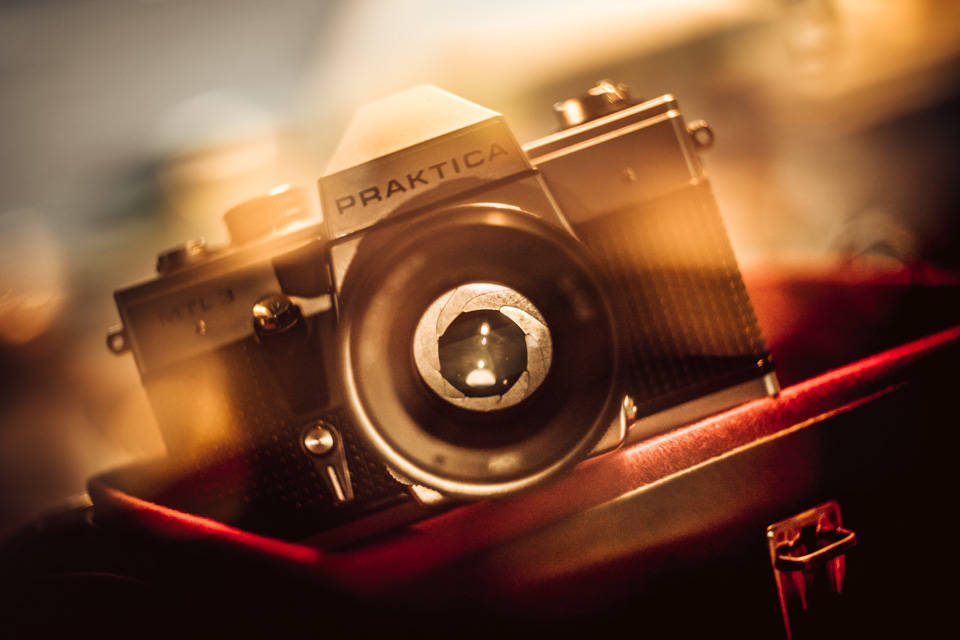
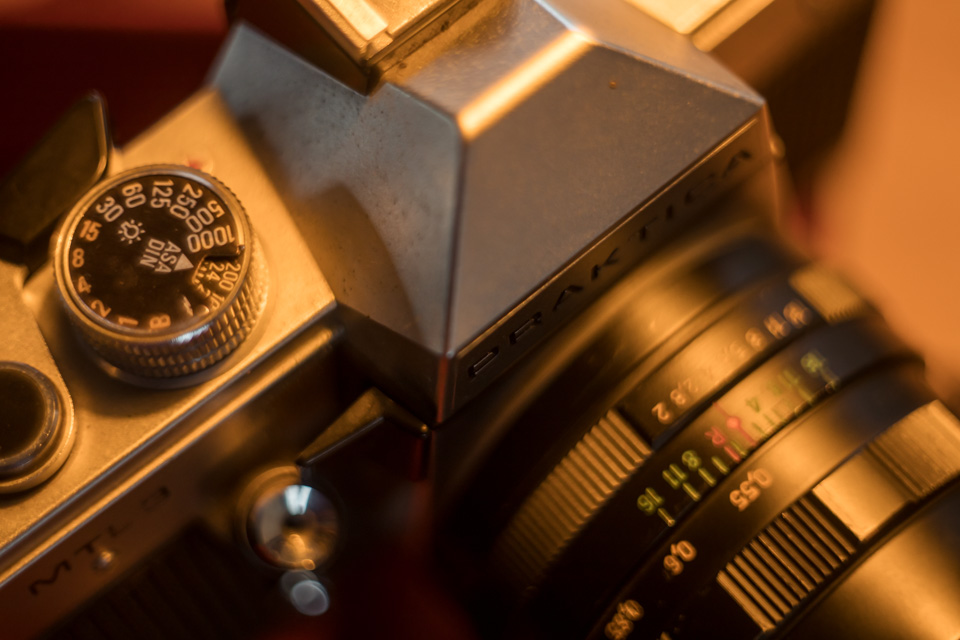
The MLT-3 in the photos above was attached to a Helios 44 lens that I really wanted to have. At Fotografica in Doesburg I got the camera with it and also a beautiful vintage case. I also bought the extension tubes there. If you are interested in the history of the camera, then this "shop" is definitely worth a visit! But that's beside the point....
Of course, technology does not stand still and cameras are getting better, faster and less (noisy). In addition, what you photograph also plays a part in your choice of camera and how often you upgrade or not.
The article is of course strongly autobiographical and I too am tempted by purchases, now mostly second-hand, of mainly manual (vintage & Lensbaby) little lenses.
I clicked on your links and ended up on all sorts of beautiful and interesting websites. Great to see so much diversity. And all of it shot with that one....little box
-
 L. Dekker wrote on Tuesday 2 March 2021 at 22:19 | reply
You don’t taken a Photograph, you make it.
Translated from Dutch.
The story above summarized in one sentence.
Have lots of fun taking photos.
Have your say
Please note: Articles older than a week can only be commented on by signed-in visitors.Would you still like to comment? sign in or create a free account.
Become a better photographer every week
A practical photography tip in your inbox every week.
39,080 photography enthusiasts already receive the tips! More about the weekly mail. Or keep up to date via  Facebook.

Elja Trum
Photofacts; everything to do with photography!
Would you like to take better photos and keep up with what is happening in photography? Photofacts publishes articles that teach you something about photography — from a product announcement to a practical shooting tip or a look at a website. Photofacts covers photography every day and is a hobby project of Elja Trum's that got out of hand. The articles are written by a team of volunteer authors. If you would enjoy writing one or more articles for Photofacts, do get in touch.More about PhotofactsPhotofacts is made possible in part by
