

Using a long exposure without an ND filter
Monday 4 December 2023, 16:32 by Nando Harmsen | 5,373 views | 1 commentThis article was translated from Dutch with the help of AI. Read the original.
To achieve long exposure times, you need to make sure that not too much light enters through your lens. In daylight, a small aperture is not enough, and you need an ND filter. Is it also possible to take multiple shots and combine them? Let's put it to the test.
This article was written in response to my question about what the readers of this blog would like to read. This subject, long exposures using multiple separate shots, was suggested by MacBigFoot, for which I am grateful.
If you want to use long exposure times, not too much light should enter through your lens. The less light gets through, the longer your shutter speed needs to be for a correctly exposed photo.
Why you would want to achieve long exposure times will be clear. To create movement in water, or to remove movement from it. Or to capture the movement of clouds as streaks in your photo.

A long exposure is possible by taking photos during the darker hours of the day. Twilight or evening is the perfect time for this. If you want to do this during the day, you need to block light with an ND filter.
Not everyone has an ND filter. Is there another way? The answer is yes and no. As you may know, some smartphones can simulate long exposure times by combining multiple photos. You can do this with your ordinary, real camera too. And Photoshop. This is called stacking.
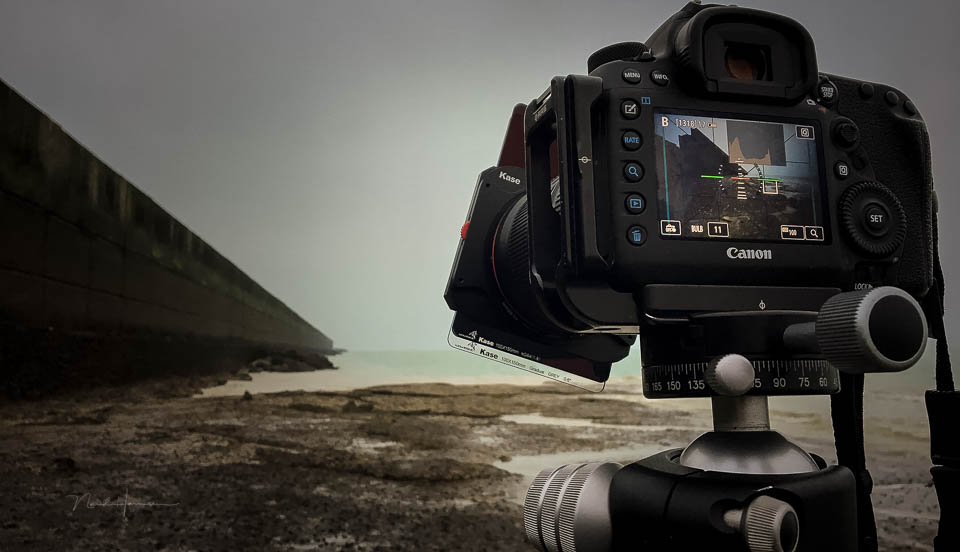
Stacking does have some limitations, as you will notice. A one-second photo may be possible to simulate, and perhaps ten seconds too. But a minute becomes difficult or even impossible. Unless you are very committed.
How does it work? Very simply. You choose the longest possible shutter speed. How long this is depends on the amount of light available. Choose ISO100, or even ISO50 if possible. Choose aperture f/22, or the smallest available aperture of your lens.

In the middle of the day, in full sunlight, you can get a shutter speed of 1/50 second at ISO 100 and f/22. If you want to simulate an exposure of one second, you have to take no fewer than 50 photos in succession.
For five seconds, you need 250 photos. For a full minute, that becomes no fewer than 3,000 photos.
Of course, you will need fewer photos at twilight or in heavy cloud, as there is less light. But it will be clear that you have to keep taking photos continuously until you reach your desired long exposure.
What does the result look like? I tried it for you. I used a situation in which I could achieve a maximum of 1/13 second without a filter. With a 10-stop ND filter, it is then possible to achieve a shutter speed of 1 minute. To achieve that minute without a filter at 1/13 second, I would have to take 780 photos.
I did not do that, though. I stopped after 37 photos, which when combined corresponds to only 2.84 seconds of exposure. Imagine if I had taken 780 photos. If you want to read more about this method, take a look at my extensive article about it there.


My advice, if you want to photograph with long exposure times, is not to make things difficult by taking hundreds or thousands of photos, but to invest in an ND filter. It is much simpler and makes the work much more enjoyable.
About the author
Nando Harmsen has been photographing for more than 40 years. He specialises in wedding photography and landscape photography. Nando also gives talks, workshops, masterclasses and photo trips, and regularly reviews new and interesting equipment.
You might also like
-
 Do not use a variable grey filter for photography
by Nando Harmsen
-
 Flash photography tip: Create blur with ND filters
by Elja Trum
-
 To stack or not to stack
by Erik Nevels
-
Which ND filters should you choose as a beginner?
by Nando Harmsen
-
 How does focus stacking work?
by Michelle Peeters
1 comment
-
 Gerard wrote on Tuesday 5 December 2023 at 16:08 | reply
Very interesting, especially now that I'm on Bonaire it seems fun to give this a try. Fortunately, I do have an ND filter, but I haven't really done anything with it so far.
Translated from Dutch.
Have your say
Please note: Articles older than a week can only be commented on by signed-in visitors.Would you still like to comment? sign in or create a free account.
Become a better photographer every week
A practical photography tip in your inbox every week.
38,981 photography enthusiasts already receive the tips! More about the weekly mail. Or keep up to date via  Facebook.

Elja Trum
Photofacts; everything to do with photography!
Would you like to take better photos and keep up with what is happening in photography? Photofacts publishes articles that teach you something about photography — from a product announcement to a practical shooting tip or a look at a website. Photofacts covers photography every day and is a hobby project of Elja Trum's that got out of hand. The articles are written by a team of volunteer authors. If you would enjoy writing one or more articles for Photofacts, do get in touch.More about PhotofactsPhotofacts is made possible in part by
