

Adventures with the Sony 200-600mm (week 1)
Wednesday 20 January 2021, 16:32 by Erik Nevels | 5,238 views | 3 commentsThis article was translated from Dutch with the help of AI. Read the original.
I really am lucky! I have the chance to try out a lens that has been on my wish list for some time, for three weeks. For me, this is the ideal opportunity to test whether the lens lives up to my expectations.
I am talking about Sony's SEL 200-600mm f/5.6-6.3 G OSS FE-Mount, which you can find many reviews of online. I could easily fill a day with the many review videos about this lens on YouTube.
In summary, I can say that they are generally very positive. I am not going to repeat that review in this blog. I will take you along on the adventures I have during those three weeks, starting with week 1.
In my own garden
As I quickly get used to the weight of this fairly large lens, on the suddenly even smaller-looking Sony system camera, I walk into my own garden.
One of the squirrels that regularly race through our pear tree is, unusually, waiting for me in that same tree. It keeps a curious eye on me as I get closer, step by step.
Because I expect it to run off at any moment, I want to act quickly and fumble awkwardly with the partly unfamiliar controls.
I cannot yet find the image stabilisation buttons by touch. Because I am shooting handheld, I check that they are set to 'on' and 'mode1' (this mode corrects movement in all directions).
Once I have found the zoom ring, zooming in to 600mm is quick because of the short rotation and easy too, as the ring moves very smoothly. But at 600mm, the widest aperture automatically becomes f/6.3, which is hardly fast.
The ISO therefore has to go up to 1600 in this case to get a somewhat acceptable shutter speed of 1/200 second. I leave the aperture fully open.
Because there are some twigs in front of it, the AF does not focus on the squirrel, so I use the camera functions DMF (direct manual focus) and focus magnification, which I have programmed under the AEL button.
I can happily keep clicking away for ten minutes. The squirrel barely moves. I know these will not be great shots, but the experience of getting so close with the help of this lens is brilliant and leaves me wanting more.
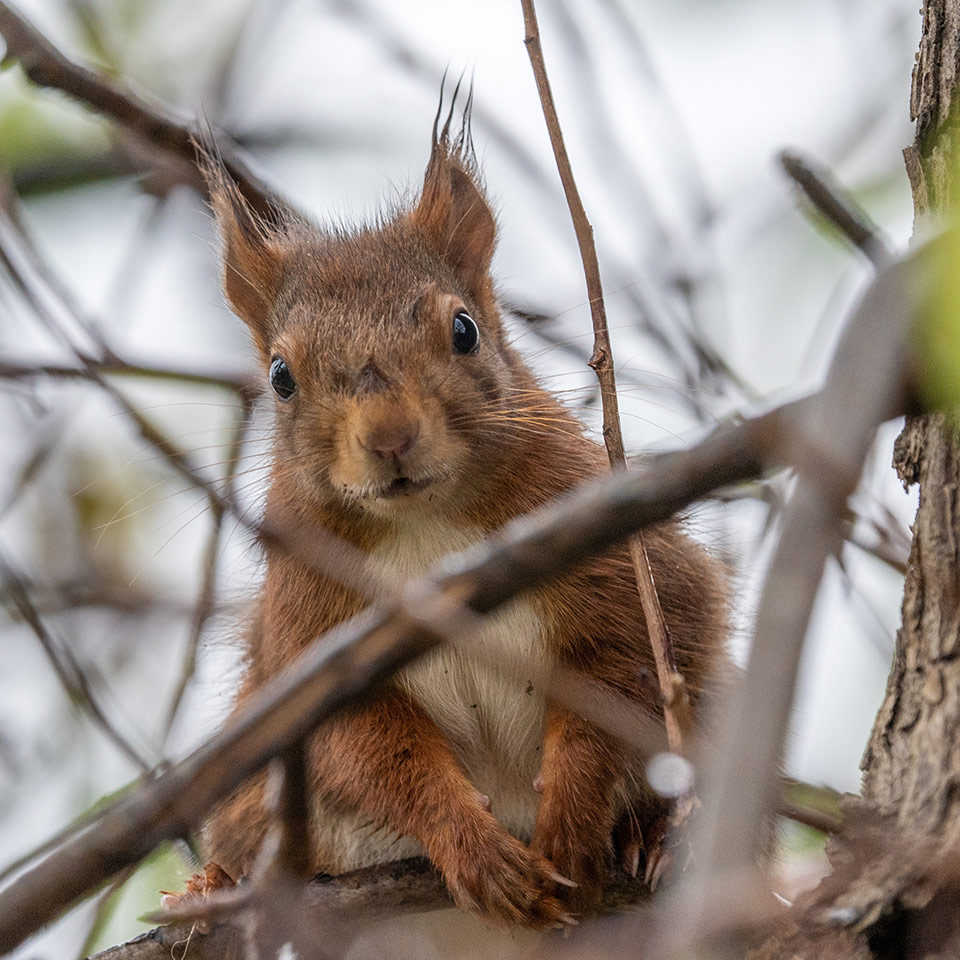
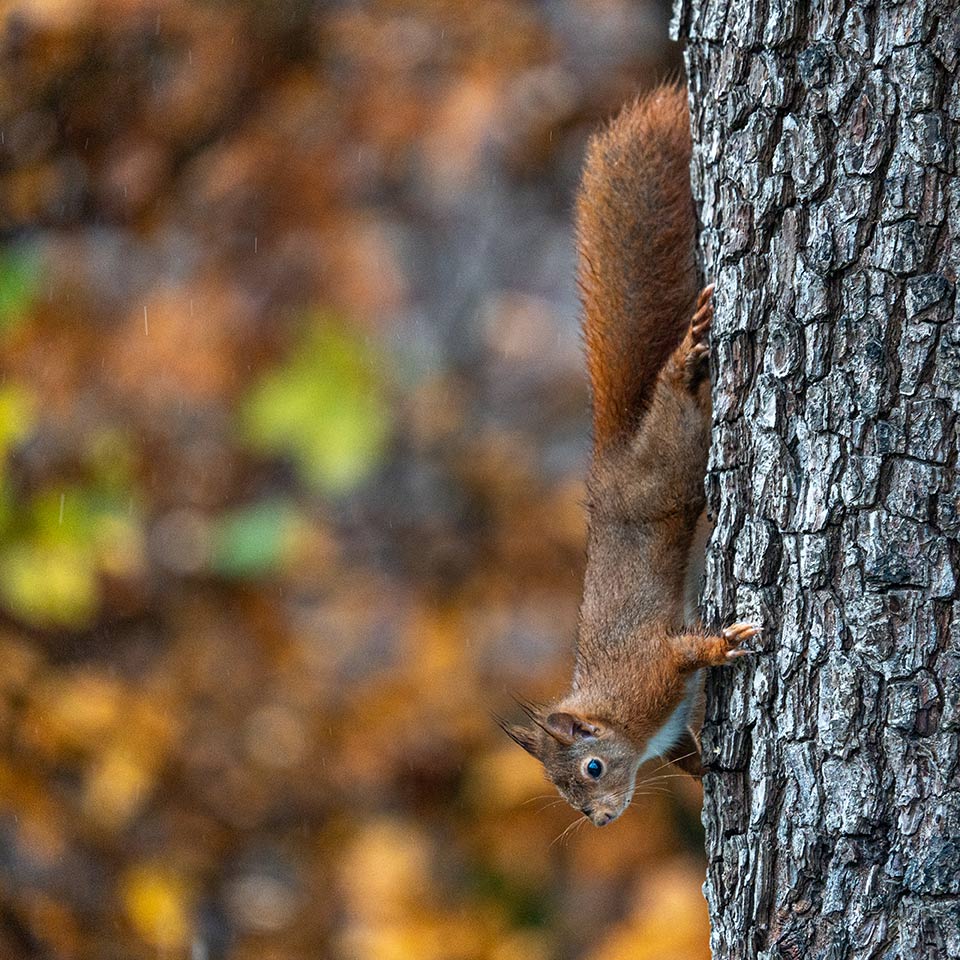
Then suddenly it takes off, running down the trunk, where it poses for a moment before heading into the neighbours' garden.
By the water
After my first adventure in my own garden, I am even more keen. Over the next few days, I head to the water's edge in search of birds. In recent weeks, I have regularly seen goldfinches sitting among the teasels. With their beautiful colours, they are very photogenic.
Too enthusiastically, I walk down the dike towards the Maasplas. I only see them when the whole group takes off. I walk after them more cautiously, but do not get them in my sights again that afternoon.
A little further on, I see one of my favourite birds hanging in the air. The kestrel. I am still too far away and walk in its direction. Just as the distance starts to look right, it flies 100 metres further away. I follow it again.
This game continues for a while until it disappears from view and I head back to the water's edge, somewhat disappointed. Bird photography is more difficult than I thought. My patience is really being tested.
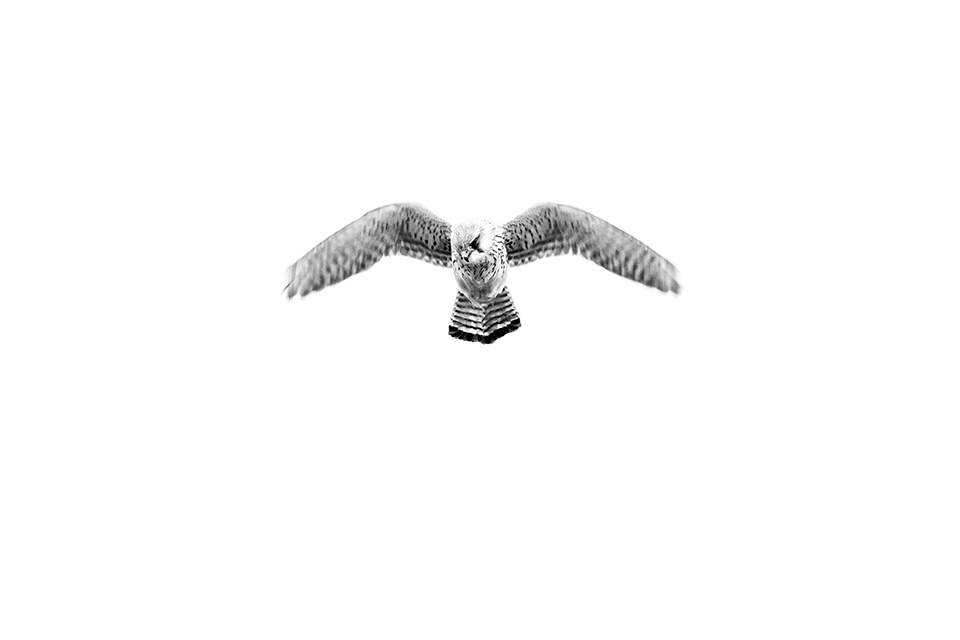
When I turn around a little later, it is suddenly hovering right behind me, staring down at the ground for prey.
There is no time for other settings. The AF does its job flawlessly and I can take a few photos. The shutter speed will not be fast enough to freeze the bird's movement, but perhaps that is actually a nice way to show the hovering action.
Back at the water's edge
The weather remains gloomy. No sun, grey skies, and I head back to the water's edge. The goldfinches are nowhere to be seen, but ducks, coots, geese and cormorants come into view.
Just like the day before, my patience is tested. I now understand why bird hides exist. The birds come to you there. This time it is the other way round, and then they fly away just when you almost have them nicely in frame.
That certainly does not spoil the fun. With 600mm, I can get a lot closer, and the excitement of sneaking around is simply enjoyable. Besides, I am already getting a little better at it.
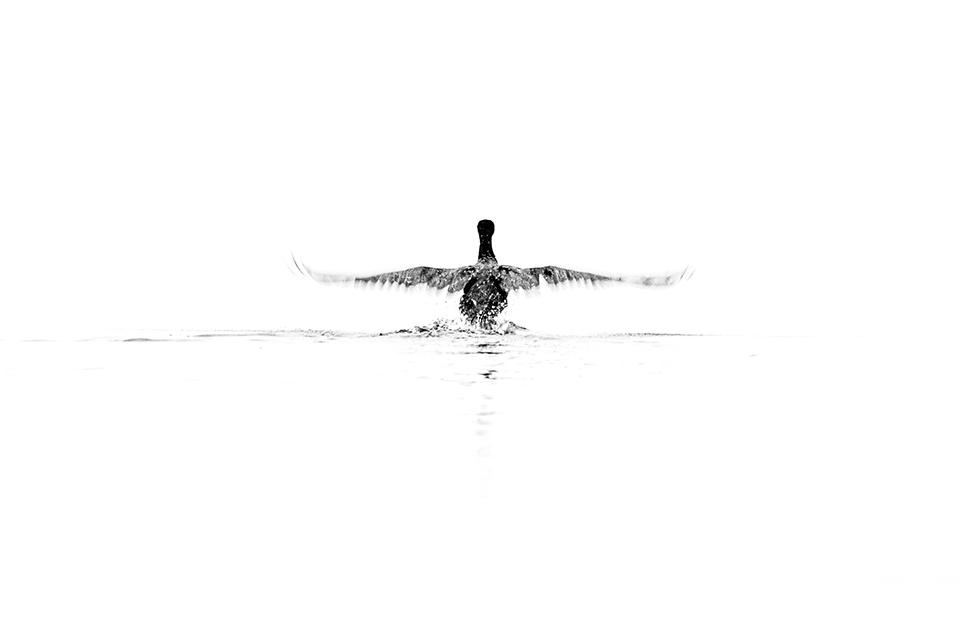
It is almost getting dark when I see a cormorant dive for a tasty fish. When it surfaces again, it has seen me and takes off. I press the shutter and take several photos with Continuous AF. Here too, I already know that my shutter speed will cause motion blur.
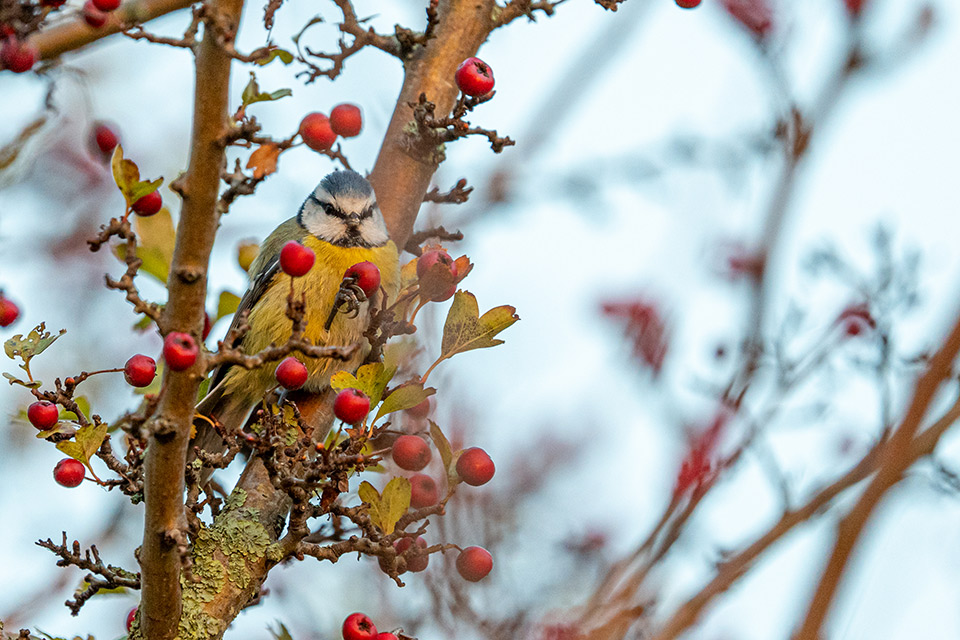
As I walk home, I hear and see a few blue tits in a bush full of red berries. Despite the little daylight that remains, I point my camera at them.
The AF once again does its job quickly and well, and I expect the same from the image stabilisation. As the closing act of the day, I add another 6 photos to my memory card.
Review and preview
Looking back on the first week, I am impressed. Despite the lens not being very fast, it is perfectly possible to take sharp photos handheld with relatively slow shutter speeds.
The image stabilisation does what it should, as does the autofocus. I also think the ease with which both the zoom and focus rings can be operated is excellent. I am already looking forward to the next adventures with this Sony 200-600!
In the next part, I will put the lens through its paces on the Zeeland coast. Together with my mate and partner, I will enjoy the many birds, including at the foot of the Brouwersdam.
About the author
Steeds weer boeiend en op zoek naar de essentie! Dat is wat fotograferen in de natuur voor mij is. Gefocust op het landschap of het onderwerp in diens omgeving tracht ik meer dan alleen te registreren. Een continue uitdaging waarvan ik elke keer volop geniet. Meer foto's? Volg mij op Instagram en/of kijk op mijn website
You might also like
-
 Review of the Canon RF 600 and RF 800 Telephoto Lenses
by Nando Harmsen
-
 Review: Sony A1 mirrorless camera
by Nando Harmsen
-
 Review: Canon EOS R5
by Nando Harmsen
-
 Review: Sony A7 IV
by Nando Harmsen
-
 A telephoto lens isn't just for birds
by Erik Nevels
3 comments
-

 4BYE
wrote on Tuesday 26 January 2021 at 14:36
| reply
4BYE
wrote on Tuesday 26 January 2021 at 14:36
| reply
One of the reasons I switched from Canon to Sony 18 months ago after 40 years. I was also able to make a comparison with the Canon 100-400 II on a 5D III. The Sony 200-600 was sharper at 400mm and showed more detail. Not the lightest, of course, but with an A9 a fantastic combination for BIF and (moving) wildlife. But also good results with the A7 III and A7R III. The Animal EyeAF helps tremendously here and there, but of course it can always be better. A major advantage is that you can always zoom back out.
Translated from Dutch. -
 Erik wrote on Tuesday 26 January 2021 at 20:44
| reply
Erik wrote on Tuesday 26 January 2021 at 20:44
| reply
@4BYE
Translated from Dutch.
Thanks for your response! I also switched from Canon to Sony, but had no previous experience with this long a telephoto range. The zoom range is indeed a great advantage. In my upcoming blog, I’ll show, among other things, a BIF result. New to me but really great to do. -
4BYE
wrote on Wednesday 27 January 2021 at 11:00
| reply
Yes, that’s certainly true! It does take some getting used to and finding the best AF options for different circumstances. After I got hold of a second-hand A9 it became absolutely amazing. By now I use two back-button focus options. Sometimes there’s simply very little time. It can sometimes be difficult to keep setting the distance limiter correctly, but on "10 meters-infinity" it picks things up so much faster. Difficult when there’s a beautiful little bird sitting closer afterwards. LOL I was able to experiment well at a bird of prey show in Austria in a castle garden, where they actually fly far away and around from the mountain. Did a total of three shows, during which I was able to fine-tune things further each time. I’m curious about your upcoming blog!
Translated from Dutch.
Have your say
Please note: Articles older than a week can only be commented on by signed-in visitors.Would you still like to comment? sign in or create a free account.
Become a better photographer every week
A practical photography tip in your inbox every week.
39,079 photography enthusiasts already receive the tips! More about the weekly mail. Or keep up to date via  Facebook.

Elja Trum
Photofacts; everything to do with photography!
Would you like to take better photos and keep up with what is happening in photography? Photofacts publishes articles that teach you something about photography — from a product announcement to a practical shooting tip or a look at a website. Photofacts covers photography every day and is a hobby project of Elja Trum's that got out of hand. The articles are written by a team of volunteer authors. If you would enjoy writing one or more articles for Photofacts, do get in touch.More about PhotofactsPhotofacts is made possible in part by
