

Photographing birds at the Brouwersdam in Zeeland with the Sony 200-600
Saturday 6 February 2021, 14:07 by Erik Nevels | 4,902 views | 4 commentsThis article was translated from Dutch with the help of AI. Read the original.
It is the second week of my adventures with Sony's telephoto lens when I drive to the Brouwersdam in Zeeland. There I meet my photography mate at the agreed spot.
Our partners, who are joining us too, are going birdwatching. We are going to photograph them as well. If you want to know where the special sandpiper posing for me today hatched, read on.
Busy
The Brouwersdam is busy. Several tripods with telescopes or cameras with telephoto lenses allow their owners to enjoy the many birds active near and above the water.
The weather has been kind for days now. Dry, not cold, with even a weak bit of sunshine. That bodes well for today! Once the lens is clamped to my tripod and my eye is at the viewfinder, the fun can begin.
From a tripod and handheld
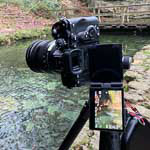
Last week I mainly photographed handheld, but today the tripod is ready. For better weight distribution, I attached the lens with its tripod collar to my tripod, rather than attaching the camera.
Before that, I did have to screw a long Arca-Swiss quick-release plate under the collar first. Sony could have made that collar Arca-Swiss compatible straight away. I can fine-tune my ball head so that I can move the camera and lens fairly smoothly without the whole thing immediately tipping over when I let go.
Even so, I often photograph handheld during the day. It provides the freedom of movement needed for birds that move quickly along the shoreline.
Settings
Assuming I do not want motion blur, I choose a shutter speed of 1/640 sec or faster. The aperture is fully open, f/6.3 at 600mm, or 1/3 stop smaller, f/7.1. That requires an ISO of 1000 or thereabouts.
By keeping a close eye on the light meter, I adjust the ISO or shutter speed where necessary. For the focus area, I choose 'wide' for birds in flight and 'flexible spot' for birds on the ground.
Finally, I use continuous AF with continuous shooting on Hi+. That is bound to fill a card today.
Turnstone
At first I stand on the upper side of the dike and need the maximum zoom range to bring the foraging turnstones somewhat closer.
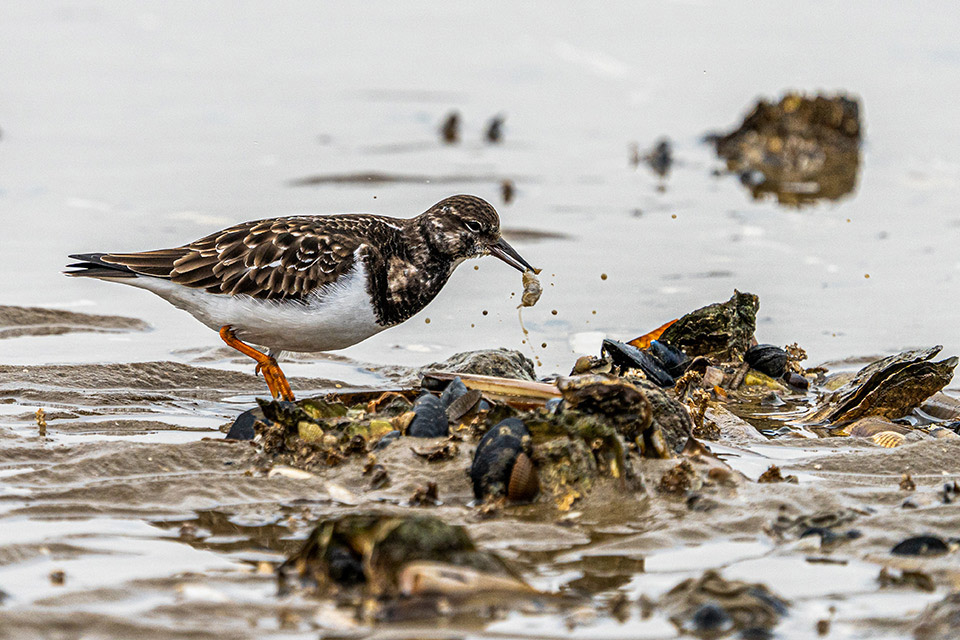
These nimble little birds certainly live up to their name. They deftly pick their way between the stones in search of something tasty. Since there is no large group to photograph, I want to get closer to capture an individual, preferably with a morsel in its beak.
While making sure I do not get in the way of another photographer or birdwatcher, I descend the dike and can approach the little bird to within about six metres. I leave the tripod behind because I now want to photograph as low to the ground as possible and also walk along with the bird.
Undisturbed, it rummages with its beak among sand, shells and stones. Suddenly it catches something and vigorously shakes its meal back and forth while the Hi+ function in the camera does its work.
Oystercatchers
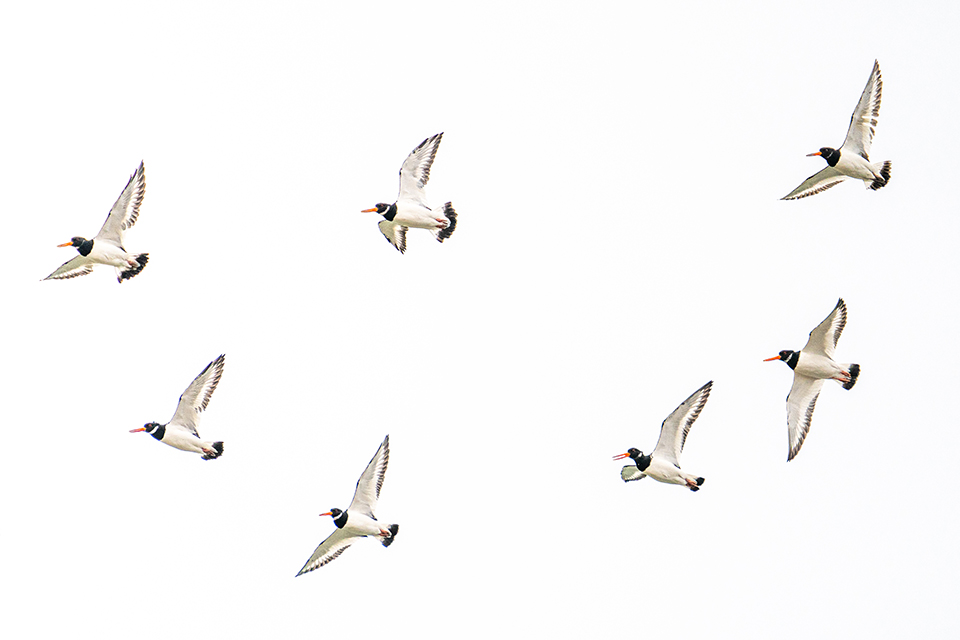
The oystercatchers are busy foraging too. Every now and then they take flight, only to land again quickly and carry on walking. Suddenly something happens. I have no idea what, but a whole group of them takes off at once.
I quickly point my camera and a fraction of a second later the autofocus has the group sharply in its sights. While I take several series of photos of the birds flying back and forth, the autofocus continues to focus accurately. A top performance from this lens.
A little later, calm returns and they go back to the most important order of the day, gathering food.
Later that day I hear that a sea eagle had been flying around there that morning, and I suspect that may have been the cause of the commotion.
Purple sandpiper
The morning is almost over when we drive on for a few kilometres along the Brouwersdam. Large slippery stones form the steep transition from the car park where we have stopped to the water. Along that water's edge, another small wader is moving between the stones.
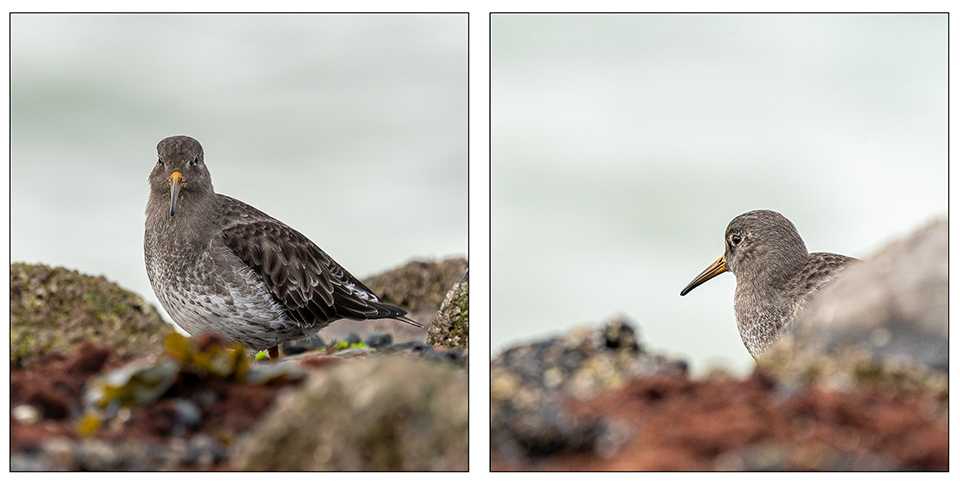
My mate and I descend the stone dike towards the bird with twice as much care. It continues undisturbed, and when we have approached to within three metres, we see a purple sandpiper busy looking for food.
Sitting on the large boulders, we wait until the bird sticks its head up above the rocks. It even seems to pose for us. At 600mm, the autofocus manages to focus accurately again at this distance, and I get the sandpiper fairly large in the frame.
What a fantastically beautiful bird!
More than satisfied
On the way back to Midden Limburg, I reflect on the remarkable day. Photographing birds is exciting and pure enjoyment. The Sony 200-600mm has once again done an excellent job, and I return home to Midden Limburg more than satisfied, with a full memory card.
Origin
A few days after getting home, my mate surprises me with the following. A photo of the purple sandpiper shows that it is ringed, and the code is readable too. That allows you to find out where it came from.
'Our' specimen turns out to have been ringed in Longyearbyen on Spitsbergen on 23 September 2012. Since then, it has only been observed at the Brouwersdam. Quite a nice fact to know!
About the author
Steeds weer boeiend en op zoek naar de essentie! Dat is wat fotograferen in de natuur voor mij is. Gefocust op het landschap of het onderwerp in diens omgeving tracht ik meer dan alleen te registreren. Een continue uitdaging waarvan ik elke keer volop geniet. Meer foto's? Volg mij op Instagram en/of kijk op mijn website
You might also like
-
 A telephoto lens isn't just for birds
by Erik Nevels
-
 Review: Sony A1 mirrorless camera
by Nando Harmsen
-
 Review: Sony A7 IV
by Nando Harmsen
-
 Review: Sony A9 mark III
by Nando Harmsen
-
 Review: Sony A7R V mirrorless camera
by Nando Harmsen
-
 Review: Sony Xperia 1 IV smartphone for photography
by Nando Harmsen
4 comments
-
 Cécile den Ouden wrote on Tuesday 9 February 2021 at 13:22 | reply
Herkenbaar verhaal, ik ben zelf ook superblij met de Sony 200-600! Kan er prima mee uit de hand fotograferen (de spierballen komen vanzelf....)
This comment was written in another language and has not been translated yet. -

 4BYE
wrote on Tuesday 9 February 2021 at 13:45
| reply
4BYE
wrote on Tuesday 9 February 2021 at 13:45
| reply
Zoals ik al melde bij je vorige verslag, één van de redenen dat ik met een gerust hart van Canon naar Sony ben overgestapt. Heerlijke lens voor o.a. wildlife en BIF. Gaat op trails waar wat te verwachten is altijd mee. Ik moet wel bekennen dat de tweedehands A9 nog beter is als het gaat om tracking vasthouden en oppakken dan mijn A7 III/A7R III. Ik gebruik twee soorten backbutton AF en gebruik ook 2-3 custom settings op dial om snel in te spelen op de situatie. Voor vele andere vormen van fotografie is dat minder een probleem omdat je vaak alle tijd hebt. Wat ik ook waardeer is de functieknop op de meeste Sony lenzen. Hier zet ik EyeAF onder.
This comment was written in another language and has not been translated yet. -
 Erik wrote on Friday 12 February 2021 at 22:08
| reply
Erik wrote on Friday 12 February 2021 at 22:08
| reply
@Cecile
This comment was written in another language and has not been translated yet.
Klopt helemaal! En bedankt voor je reactie! -
Erik wrote on Friday 12 February 2021 at 22:15
| reply
@4BYE
This comment was written in another language and has not been translated yet.
Herkenbaar wat je schrijft. Vanmiddag een blauwe kiekendief gefotografeerd. De lens pakt de vogel vrij gemakkelijk op en blijft volgen. Echt geweldig!
Ben nog bezig om custom settings uit te proberen; wat werkt in welke situatie het beste. Al doende leert men.
Have your say
Please note: Articles older than a week can only be commented on by signed-in visitors.Would you still like to comment? sign in or create a free account.
Become a better photographer every week
A practical photography tip in your inbox every week.
39,087 photography enthusiasts already receive the tips! More about the weekly mail. Or keep up to date via  Facebook.

Elja Trum
Photofacts; everything to do with photography!
Would you like to take better photos and keep up with what is happening in photography? Photofacts publishes articles that teach you something about photography — from a product announcement to a practical shooting tip or a look at a website. Photofacts covers photography every day and is a hobby project of Elja Trum's that got out of hand. The articles are written by a team of volunteer authors. If you would enjoy writing one or more articles for Photofacts, do get in touch.More about PhotofactsPhotofacts is made possible in part by
