

Up early to photograph banded darters
Friday 20 August 2021, 20:10 by Erik Nevels | 4,339 views | 0 commentsThis article was translated from Dutch with the help of AI. Read the original.
Unlike photography, getting up early is not my favourite hobby. Still, I regularly set my alarm because I want to head out early. That was also the case last week, when I travelled to Brabant with my photography buddy to photograph banded darters and got out of bed at 5 am.
Butterflies and dragonflies
From April to September, butterflies and dragonflies regularly get my photographic attention. That makes sense, as these are the months when they are most active.
Being active is not ideal for taking photos. Even when they sit still, they usually do not do so for long. That is why I head out early for these insects.
When the dew is still on their wings, they are too heavy to fly and I can get to work in peace. Besides, all those fine droplets on their bodies and wings are literally brilliant to photograph.
Banded darter
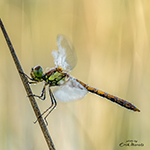
There are currently around 64 species of dragonfly in the Netherlands. One of them is the banded darter. It is a fairly small darter with unmistakable wing markings: a dark brown transverse band runs across the upper half of each wing.
It is still fairly rare and is mainly found in the eastern half of the Netherlands. Last year, I photographed this dragonfly for the first time. Now my buddy and I are heading back to the same place to look for this beautiful insect.
More photographers
When we park our car, we see that we are not the only ones here today. Two other cars suggest that other photographers are probably present.
We soon hear and see them working with sticks and clothes pegs. Apparently, they move dragonflies so they can place them in the open and against a chosen background.
That really goes too far for me. Opinions differ, but I think you are disturbing the creatures this way. Besides, it takes away the fun for me.
The photo no longer feels true to nature to me. We walk on and have to look carefully among the rushes and jointed rushes before we discover the first banded darter.
It is a female and she is still fairly covered in dew, as are the many spider webs sparkling among the greenery. For now, she does not fly away, so I can take my time.
A challenge
The dragonfly is not sitting with its side towards the sun, which occasionally breaks through the cloud cover. That means I cannot photograph it with its spread wings backlit.
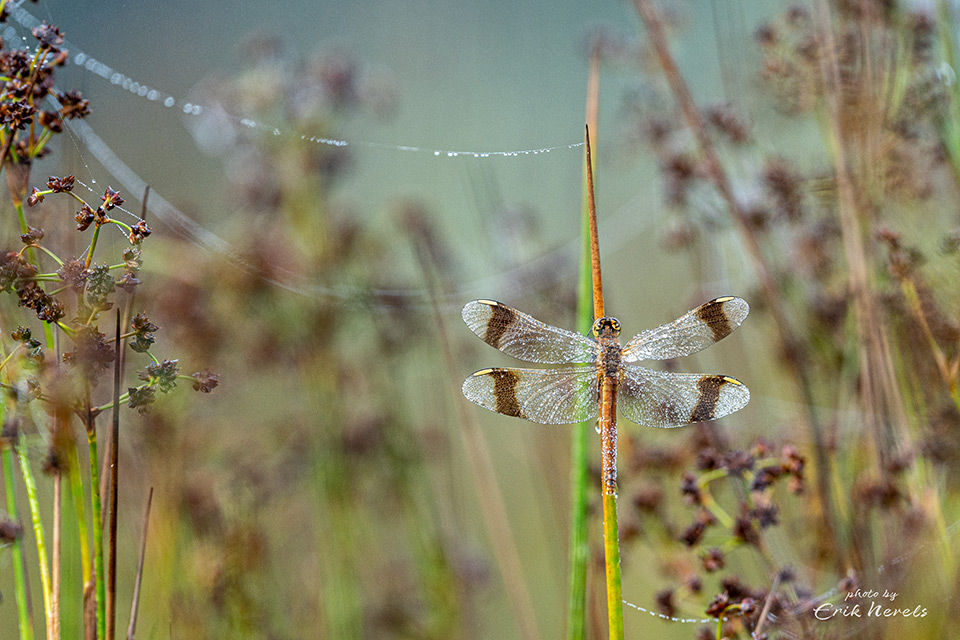
As far as the vegetation allows, I walk around the creature, challenging myself to look from different angles. I see several attractive images and start with a shot I like to make: the animal in its habitat.
For this, I use my telephoto zoom lens at 600mm, on a tripod. With the tripod legs spread wide, I position the camera at the right height and distance. I am now about 2.5 metres from my subject and take my time deciding on the composition and settings.
I turn off lens and camera stabilisation. Aperture at f/8, because I want the whole dragonfly sharp, as well as some of its habitat. Shutter speed at 1/320 second, because it is still a little windy and I am photographing at 600mm, even though I am using a tripod.
Finally, ISO 1000 is needed for a good exposure. To rule out any motion blur, I use the self-timer.
I take about ten shots, expecting that at least one will capture a moment when the wind dies down completely.
From above at an angle
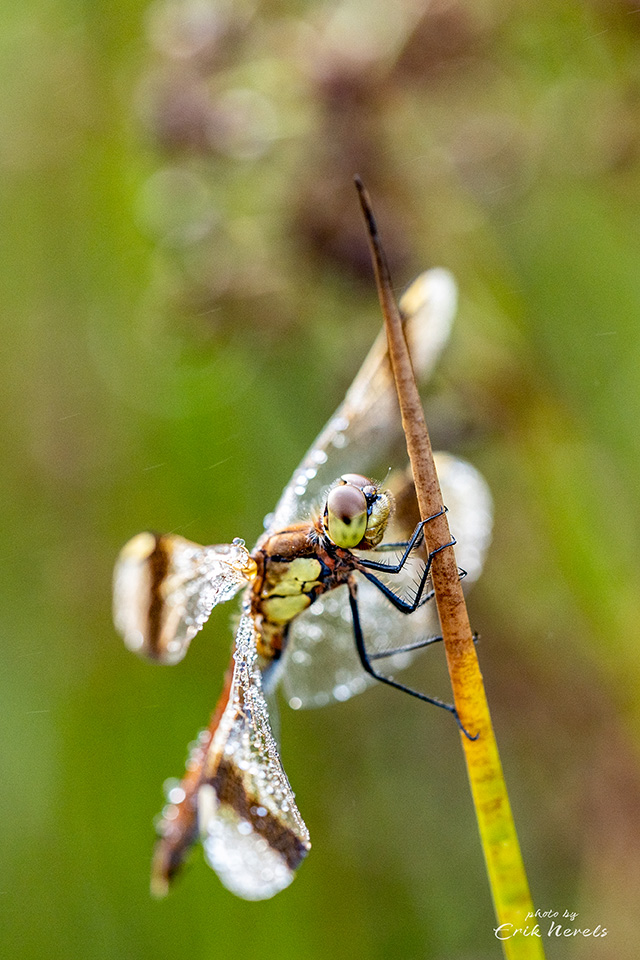
Half an hour later, I swap my telephoto lens for the macro lens. Placing the tripod without disturbing the dragonfly is not an option, so I photograph handheld. This time from the side, with backlighting.
I start from a position at eye level, but I am not happy with the background. I am when I look through the viewfinder from above at an angle.
The colours of the dragonfly are beautifully echoed in the background, while the wings still catch the light nicely. Focus on the front compound eye, hold my breath and press the shutter!
Almost black and white
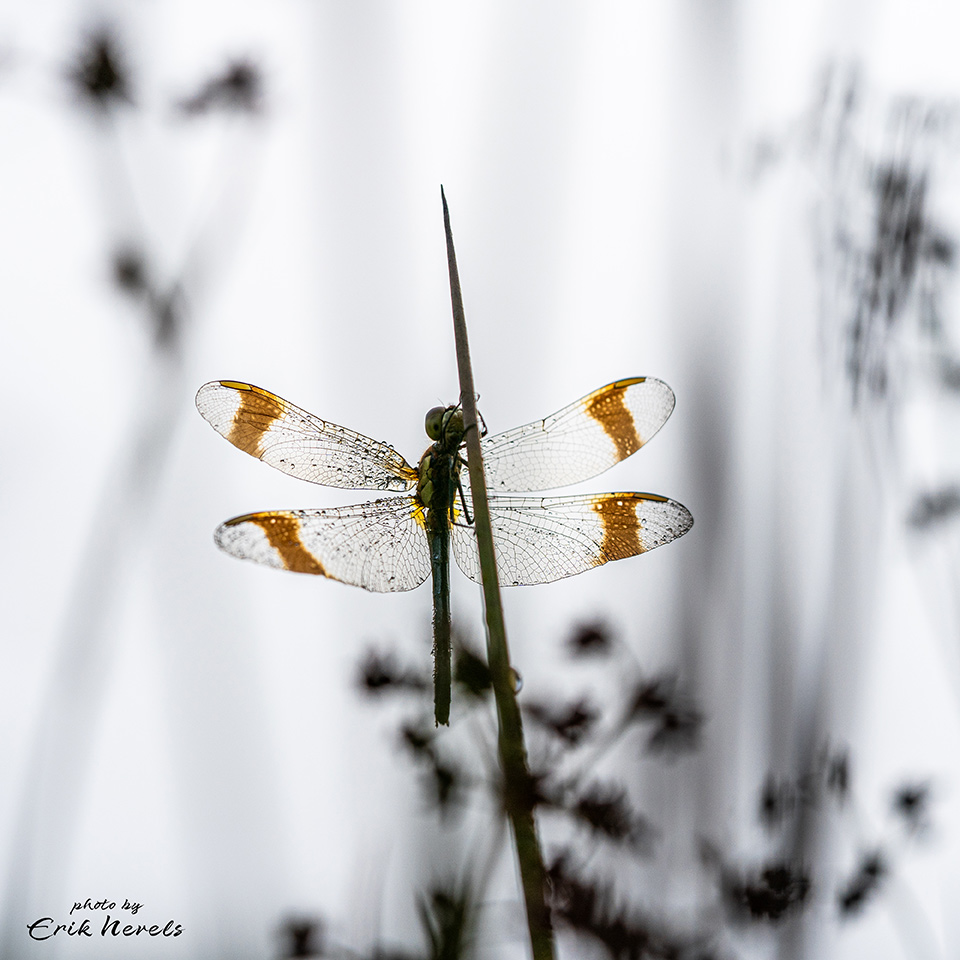
Well, if looking from above at an angle produces an attractive image, I should also see what looking from slightly below at an angle shows, with mainly sky in the background.
Wow, that is great! An almost black-and-white image with only the bands in the dragonfly's wings in colour.
The jointed rushes appear as silhouettes in the background. With an aperture of f/4.5, I want to get enough of the dragonfly sharp without making the background too sharp.
Now I just need to position the wings so they are not crossed by black lines, and the memory card gains several more shots.
Worth the effort
Heading out early pays off! Besides the beautiful light, butterflies and dragonflies are waiting for you covered in drops of dew. You only have to find them.
A search through nature while the sun makes the morning dew evaporate. Lovely, isn't it!
About the author
Steeds weer boeiend en op zoek naar de essentie! Dat is wat fotograferen in de natuur voor mij is. Gefocust op het landschap of het onderwerp in diens omgeving tracht ik meer dan alleen te registreren. Een continue uitdaging waarvan ik elke keer volop geniet. Meer foto's? Volg mij op Instagram en/of kijk op mijn website
You might also like
-
 Photographing with a purpose
by Erik Nevels
-
 7 Tips for Macro Photography
by Mike Muizebelt
-
 Review: Canon RF 100mm f/2.8L IS macro lens
by Nando Harmsen
-
 What is your favourite lens and why?
by Nando Harmsen
0 comments
Be the first to share what you think!
Have your say
Please note: Articles older than a week can only be commented on by signed-in visitors.Would you still like to comment? sign in or create a free account.
Become a better photographer every week
A practical photography tip in your inbox every week.
38,981 photography enthusiasts already receive the tips! More about the weekly mail. Or keep up to date via  Facebook.

Elja Trum
Photofacts; everything to do with photography!
Would you like to take better photos and keep up with what is happening in photography? Photofacts publishes articles that teach you something about photography — from a product announcement to a practical shooting tip or a look at a website. Photofacts covers photography every day and is a hobby project of Elja Trum's that got out of hand. The articles are written by a team of volunteer authors. If you would enjoy writing one or more articles for Photofacts, do get in touch.More about PhotofactsPhotofacts is made possible in part by
