

Are you going to photograph the solar eclipse on 25 October 2022?
Friday 14 October 2022, 13:31 by Nando Harmsen | 4,079 views | 3 commentsThis article was translated from Dutch with the help of AI. Read the original.
A solar eclipse will be visible from the Netherlands and Belgium on 25 October 2022. Unfortunately, it will not be a total eclipse, but a partial one. This gives you a chance to photograph it, provided you take the necessary precautions.
The solar eclipse will take place between 11:08 and 13:03. The exact times will vary depending on where you are. Around Den Helder, it will be a minute earlier, and in Liège, a minute later.
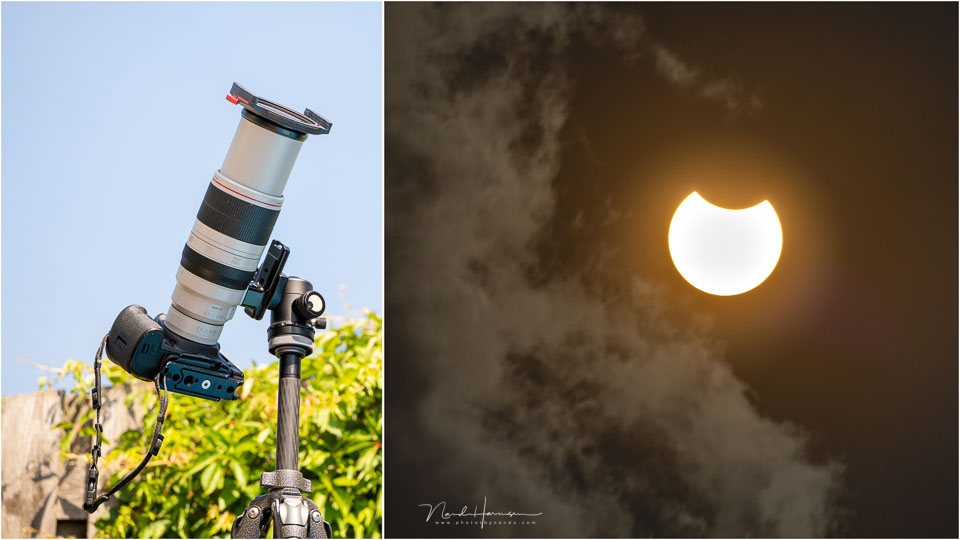
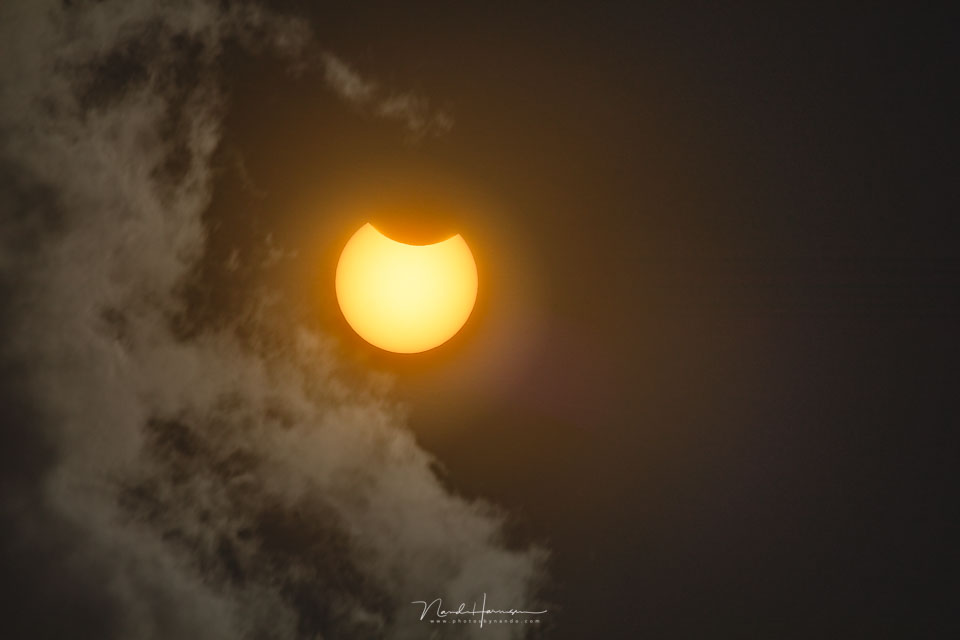
At its peak, between 19% and 25% of the sun will be covered, again depending on where you are. The further north you go, the greater the coverage will be.
During this eclipse, a significant bite will therefore be taken out of the sun. Although 19-25% is not enough for it to become dark, it will be clearly visible. Provided you protect your eyes properly.
Even during the maximum coverage of the sun by the moon, the light is bright enough to damage your eyes. This means that you should, for example, have a pair of eclipse glasses, which is the simplest solution.
Whatever you do, never look at the sun through binoculars or a powerful telephoto lens. You do this once and never again, as you will probably be blind afterwards.
For more information, it is best to look at the hemel.waarnemen.nl website.
If you do want to photograph this event, it is possible with a sufficiently strong ND filter. A 10-stop filter is absolutely not enough.
Two 10-stop filters will work, or you can choose a special 20-stop graduated ND filter. I have mentioned and reviewed the special Haida One Million X Edition filter for this type of photography before.
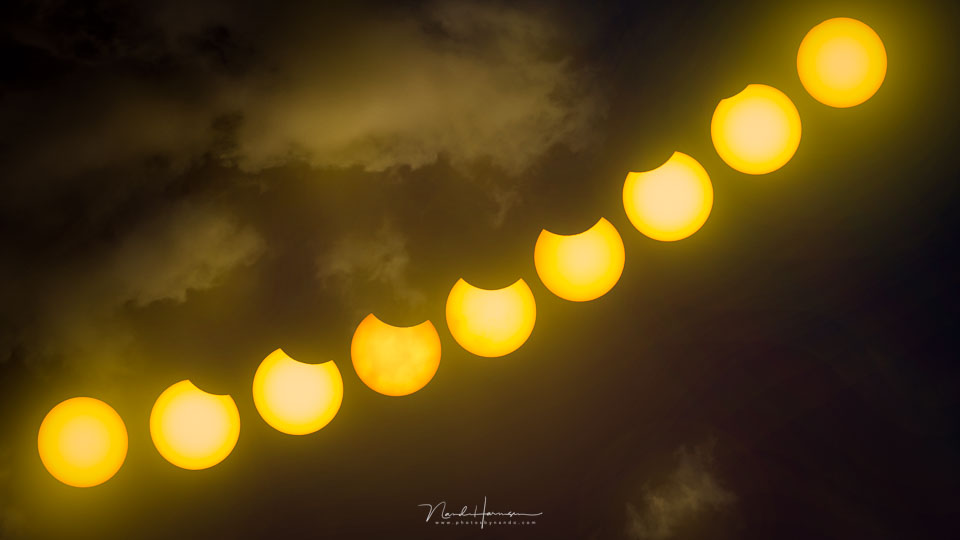
Are you planning to photograph the solar eclipse? Then start preparing now so you have the right filter (the special 20-stop filter is often only available to order).
Try it out by taking a photo of the sun first (entirely at your own risk, of course. Make sure it is done safely with the right equipment), and hope that the sky will be clear enough to see it on 25 October 2022.
Will you miss this solar eclipse, or will it be too cloudy to see it? The next one visible from the Benelux will not be until 29 March 2025. Unless you travel especially for it, of course.
About the author
Nando Harmsen has been photographing for more than 40 years. He specialises in wedding photography and landscape photography. Nando also gives talks, workshops, masterclasses and photo trips, and regularly reviews new and interesting equipment.
You might also like
-
 The 2026 solar eclipse
by Nando Harmsen
-
 Are you ready for the solar eclipse?
by Nando Harmsen
-
 Photography tips for the solar eclipse on 10 June
by Nando Harmsen
-
 The Partial Solar Eclipse as a Time-lapse
by Elja Trum
-
 A timelapse video of the solar eclipse
by Nando Harmsen
-
 Lunar eclipse on its way
by Nando Harmsen
3 comments
-
 Edwin Mathlener wrote on Saturday 15 October 2022 at 11:43 | reply
A safe and inexpensive way to protect your eyes and equipment is with special film for observing the sun. A well-known brand is AstroSolar film by Baader, also available from various dealers in the Netherlands. A piece of film costs 10-20 euros and you have to craft a holder for it yourself. The solar image in these kinds of filters does become somewhat bluish-white in color. This can be corrected beforehand with a color filter or later with image editing, but as an amateur astronomer I usually leave it that way. See also https://www.zonsverduistering.nl/fotograferen.html for tips.
Translated from Dutch.
I probably won't be taking photos that day myself because I will be operating telescopes for the public at sonnenborgh.nl. For details about this eclipse also see https://www.zonsverduistering.nl/eclips2022okt.html -
 guest wrote on Tuesday 18 October 2022 at 13:51 | reply
Mr Nando,I have bought the Haida holder and the expensive filter...
Translated from Dutch.
I would just like to know which aperture/speed you use.
Kind regards
Wencho -
Edwin Mathlener wrote on Tuesday 18 October 2022 at 16:19 | reply
If I may respond to the exposure advice:
Translated from Dutch.
- Test your equipment well before the eclipse to determine the settings.
- Don't choose ISO too low or too high (avoid noise). I go for 100 or 200 myself.
- Choose aperture 8.
- Now use auto exposure to find the exposure time. Because the sun is a bright disk against a dark background, the recommended time may be wrong. If the solar image is too bright, choose a shorter exposure time. You want to prevent limb darkening and sunspots from being overexposed.
- Make sure the exposure time doesn't become too long. You don't want motion blur either. In that case, choose a somewhat wider aperture or higher ISO.
- Before the eclipse on the day itself: take another test photo with the settings you determined earlier. The presence or absence of light cloud cover in front of the sun and the sun's altitude have an effect.
Have your say
Please note: Articles older than a week can only be commented on by signed-in visitors.Would you still like to comment? sign in or create a free account.
Become a better photographer every week
A practical photography tip in your inbox every week.
39,078 photography enthusiasts already receive the tips! More about the weekly mail. Or keep up to date via  Facebook.

Elja Trum
Photofacts; everything to do with photography!
Would you like to take better photos and keep up with what is happening in photography? Photofacts publishes articles that teach you something about photography — from a product announcement to a practical shooting tip or a look at a website. Photofacts covers photography every day and is a hobby project of Elja Trum's that got out of hand. The articles are written by a team of volunteer authors. If you would enjoy writing one or more articles for Photofacts, do get in touch.More about PhotofactsPhotofacts is made possible in part by
