

The 2026 solar eclipse
Saturday 7 February 2026, 21:42 by Nando Harmsen | 2,969 views | 13 commentsThis article was translated from Dutch with the help of AI. Read the original.
It is finally happening. In August 2026, a total solar eclipse will be visible from Europe. In the Netherlands, 88% of the Sun will be obscured. But if you travel to Iceland or Spain, that can be 100%. Who is going to see it?
On 12 August 2026, it will finally happen. You will not need to take a long-haul flight to see a total solar eclipse. You can simply go to northern Spain. You can even get there by car or train.
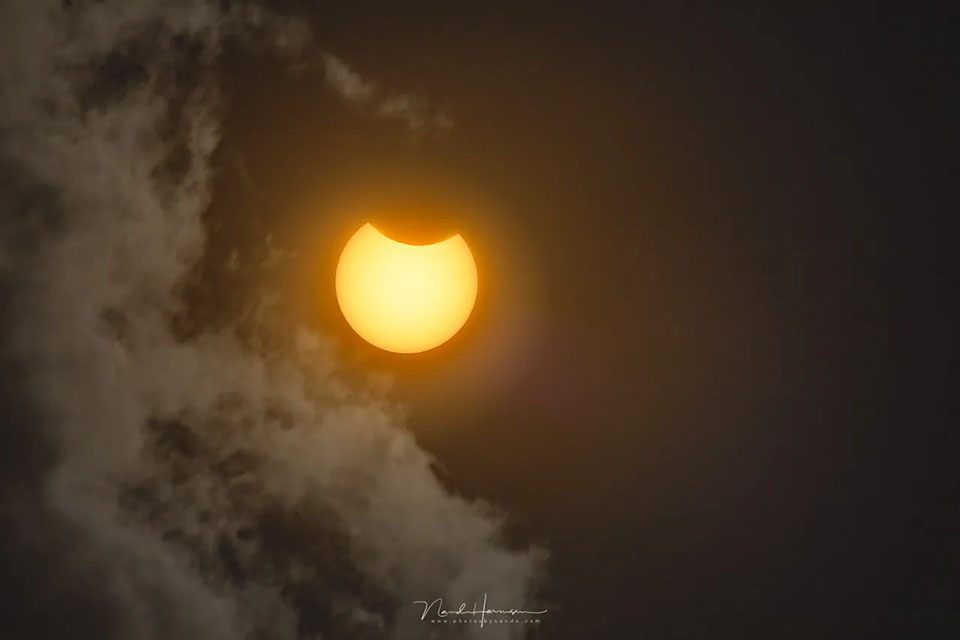
I started planning last year because I do not want to miss this one. At first I thought about Iceland, but I would rather go to Spain. I have a feeling that the chance of clear skies is greater there. And I can combine it with a summer holiday straight away.
If you would rather stay at home, the eclipse will be partial. Comparable to the one on 20 March 2015, for those who still remember it. The further south you travel, the more of the Sun will be covered.
Preparation is important. Think about the right focal length, a solar filter, and of course eclipse glasses to protect your eyes. It is better not to leave these things until the last minute.
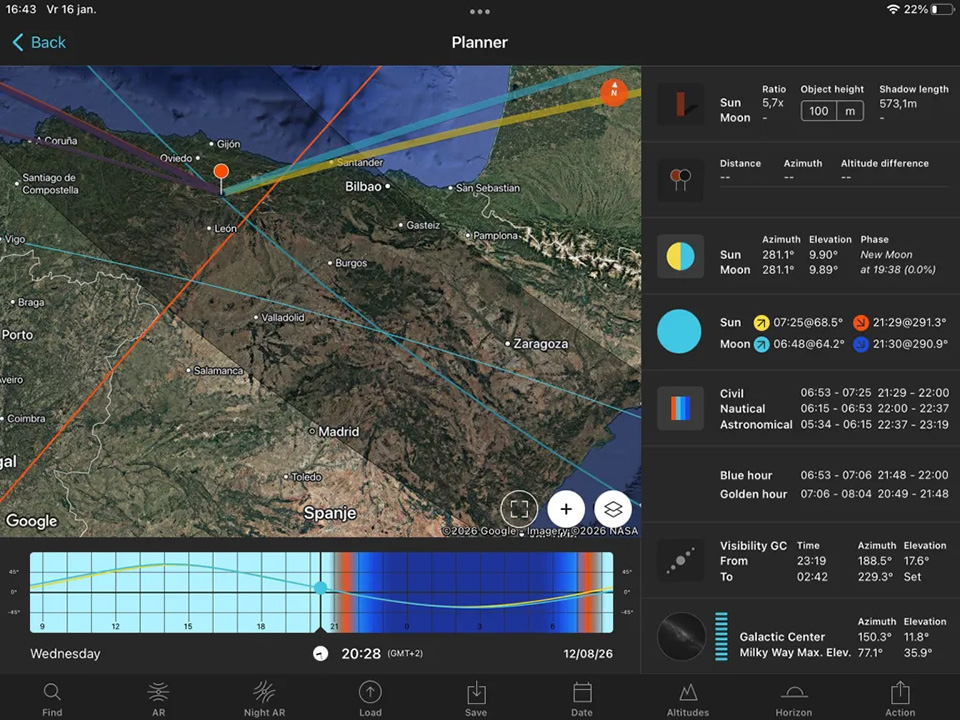
My accommodation in Spain has already been arranged. I am looking forward to finally seeing that total solar eclipse. Of course, I hope for clear skies. If that is not the case, I still have the whole width of Spain to find a clear patch.
Have a look at the detailed article I wrote on my own website. You can read more there about my plans and preparations. More will follow as the preparations progress.
Also have a look at the PhotoPills course on Photofacts Academy, where the solar eclipse is covered in the planner. As I said, it is best to set off well prepared.
Are you also planning to photograph the solar eclipse? If so, where and how? Share your plans in a comment below this post. I am curious to hear what you are planning to do.
About the author
Nando Harmsen has been photographing for more than 40 years. He specialises in wedding photography and landscape photography. Nando also gives talks, workshops, masterclasses and photo trips, and regularly reviews new and interesting equipment.
You might also like
-
 Are you ready for the solar eclipse?
by Nando Harmsen
-
 A timelapse video of the solar eclipse
by Nando Harmsen
-
 Making a Solar Eclipse Collage in Photoshop
by Nando Harmsen
-
 Are you going to photograph the solar eclipse on 25 October 2022?
by Nando Harmsen
-
 The Partial Solar Eclipse as a Time-lapse
by Elja Trum
-
 Photography tips for the solar eclipse on 10 June
by Nando Harmsen
13 comments
-
 Thijs wrote on Monday 9 February 2026 at 15:27 | reply
This year, because of the eclipse, we are going on holiday to Northern Spain this summer. At the time of the Eclipse we will be staying in a little apartment on the northern side of the Picos (in Cangas de Onis). It is a family holiday, so I do not have an extensive amount of time to prepare things on location. My plan at the moment is to drive south that day to the plateau, because I do not want to be surprised by incoming clouds at the last minute. The disadvantage of this approach is that I will not be able to scout extensively in advance where I want to take photographs (although I am trying to figure some things out with Google Street View).
Translated from Dutch.
The one photo I would really like to take:
A properly exposed landscape from just before the eclipse (so that you can still see some of the landscape), blended with the sun during its total eclipse.
I am just wondering how many mm I can photograph that with. The more mm, the larger the eclipse in the image, but that is only possible if the sun is low enough near the horizon. Is there a way to calculate how many mm I can use? -

 Nando
wrote on Tuesday 10 February 2026 at 09:53
| reply
Nando
wrote on Tuesday 10 February 2026 at 09:53
| reply
Do you have experience with clouds building up there in Spain? You sound like it happens often.
Translated from Dutch.
As for your question about focal length and the height of the sun; that’s what you can use PhotoPills for. It provides all the information you need to know whether you can take the desired photo, including focal length and depth of field, if you want. -
 Edwin Mathlener wrote on Tuesday 10 February 2026 at 10:37 | reply
This will be my 5th total solar eclipse. Because of the weather, I prefer to remain mobile on the day of the eclipse. This one is in Spain in the evening, so you still have time that day to find a better spot. As an amateur photographer I enjoy photographing the surroundings and fellow travelers, but as an amateur astronomer I try to capture the corona in as much detail as possible and also capture the diamond ring and Baily's beads. May I also refer people to zonsverduistering.nl for tips about solar eclipses? I have been managing that website since 1999
Translated from Dutch.
-
-
 donald Willemsen wrote on Wednesday 11 February 2026 at 00:30 | reply
A quick question Nando. Does Haida have a suitable filter for the M10 filter system? I haven't been able to find it yet.
Translated from Dutch. -
-
Edwin Mathlener wrote on Wednesday 11 February 2026 at 10:53 | reply
Nando indicates on his own site that he uses a Haida One Million X filter, in combination with other filters. I would like to have more information about that (which other filters?). In astronomy, we use foil or glass with vapor-deposited aluminum to achieve the right filtering. Baader AstroSolar foil is cheap and easy to use. The only disadvantage is that the sun gets a bluish-white color, while we often find yellow more beautiful. This has an optical density of 5, or in other words 0.00001 absolute transmission. There is also a less dense filter for photographic use, but I do not recommend it because of the risk that you might accidentally look through it after all.
Translated from Dutch. -
Nando
wrote on Wednesday 11 February 2026 at 11:36
| reply
I indeed use the Haida One Million X, which is basically a 20-stop filter (optical density 6, or ND6). But I don't use this in combination with other filters.
Translated from Dutch.
I also have a Baader solar filter with an optical density of 5.
Both work perfectly for photographing the sun. There is always a color shift, but the yellow color of the sun can only be achieved in post-processing. Sunlight is not yellow, but white. If it were yellow, the world would look yellow.
As far as I understand, it is not advisable to look through either the Baader filter or the One Million X with the naked eye. They block visible light, but not UV and IR. It is better to use a good pair of eclipse glasses. And even simpler too. Unfortunately, there is also a lot of cheap junk of those on the market. -
Edwin Mathlener wrote on Wednesday 11 February 2026 at 12:05 | reply
That's fine. Some pages are rather long by today's standards and I'm still thinking about how to modernize that.
Translated from Dutch. -
Edwin Mathlener wrote on Wednesday 11 February 2026 at 12:20 | reply
Ah, it seems that the rules have become somewhat stricter. In the past, Astrosolar film was also used to look with the naked eye, but with the advice to look briefly each time and then give your eye a rest. We used to say that about eclipse glasses too, but apparently this is no longer necessary with the current ISO-certified glasses, although I still think it is better. Astrosolar film is safe for visual observation through a telescope. The optics of the telescope apparently filter IR and UV sufficiently, but even then you should not use an opening larger than 10 cm. So you have to stop down the aperture of a larger telescope. For photography, this is not necessary.
Translated from Dutch. -
Donald Willemsen wrote on Wednesday 11 February 2026 at 12:46 | reply
Nando, the Haida one million x for the M10 system is not available from stock. I can't even find it on Omnifoto's site. It's noticeable that solar filters are hardly ever available from stock. If one happens to be available, it has a filter size that I can't use. The advantage of the system is that I can use it on all my lenses.
Translated from Dutch.
When, for example, Omnifoto has to get such a filter from Asia, it can take a very long time. Sometimes too long. Sometimes the delivery time is more than a year. I've experienced that before. -
Nando
wrote on Wednesday 11 February 2026 at 13:20
| reply
Oh yes, the filter is simply on the website under Drop-in filters and then look under ND filters. You can find the ND6 in the pull-down menu.
Translated from Dutch.
Not available immediately, but well... then you just have to be patient for a bit. -
Donald Willemsen wrote on Wednesday 11 February 2026 at 15:04 | reply
Thank you Nando. It's taken care of.
Translated from Dutch.
Have your say
Please note: Articles older than a week can only be commented on by signed-in visitors.Would you still like to comment? sign in or create a free account.
Become a better photographer every week
A practical photography tip in your inbox every week.
39,079 photography enthusiasts already receive the tips! More about the weekly mail. Or keep up to date via  Facebook.

Elja Trum
Photofacts; everything to do with photography!
Would you like to take better photos and keep up with what is happening in photography? Photofacts publishes articles that teach you something about photography — from a product announcement to a practical shooting tip or a look at a website. Photofacts covers photography every day and is a hobby project of Elja Trum's that got out of hand. The articles are written by a team of volunteer authors. If you would enjoy writing one or more articles for Photofacts, do get in touch.More about PhotofactsPhotofacts is made possible in part by
