

How do you capture a solar eclipse?
Wednesday 30 August 2017, 17:34 by Michelle Peeters | 5,861 views | 1 commentThis article was translated from Dutch with the help of AI. Read the original.
The total solar eclipse in the United States last week gave photographers and filmmakers a great chance to capture a special cosmic event. In this video on Fstoppers, Daniel Dean shows you how to record this phenomenon properly.
Daniel Dean knew that the total solar eclipse would be a great opportunity for him to capture something very special. On the news, he had seen that the first solar eclipse visible in the United States in 1979 would return in August that year.
Here is the story of how this great time-lapse eclipse video came about.
Practising
In the months leading up to the eclipse, he began practising for his eclipse shot by following the path of the sun in his back garden. I would get about 30 minutes of sun on my screen before the camera or focal length would need to be adjusted, he said.
Rather than zooming out to a shorter focal length to capture a longer eclipse period, he decided that it would be best to cover the 25 minutes before totality at least, followed by the total eclipse phase itself.
With his Canon C300 Mark II, with its Super 35 crop sensor and a focal length of 200 mm, he got a 300 mm field of view.
He experimented with different exposures and focus points and tried all kinds of settings, so he had a good idea of which settings he should use on the day itself.
On the morning of the eclipse, he drove the 120 kilometres to his viewing location in Excelsior Springs, Missouri. He had researched the area beforehand so he could anticipate both the traffic and the weather, ensuring that he could shoot his time-lapses without any problems.
During his drive to Excelsior Springs, the weather kept getting worse and he had to deal with heavy rainfall the entire time. But he had checked the weather forecasts and was convinced that the weather would improve just before the eclipse began.
Execution
He used Sky Guide, a useful app, and set up his two cameras in a spot where he thought he would get a good view of the sun once the clouds had cleared.
He wanted to make both a time-lapse of the eclipse and a photo of the eclipse as a whole.
So he decided to shoot frames at one-second intervals while the output, a 4K ProRes HQ 29.97 signal, was sent to his Shogun Inferno, a monitor and recorder for 4K video recordings. This setup would give him more options in post-production.
He started recording an hour before the total solar eclipse. He followed the sun on his screen through the clouds for 30 minutes.
He then reframed the sun in the bottom right corner of his screen, so that it would be in the upper right third of his screen by the time of the actual eclipse.
The cloud cover was very dark through the solar filter. To prevent damage to his sensor, he used an aperture of f/4.5 and an ISO of 2000.
As well as his C300, he set up a C100 Mark II to capture a wide-angle shot of the eclipse. He fitted it with a Canon EF 14mm f/2.8L II USM wide-angle lens. At such a wide angle, you do not need a solar filter.
During totality, he removed the filter from the C300 and took photos with the 5D, which he had fitted with an EF 70-200mm lens.
Post-processing
His plan to make both time-lapse and real-time footage was important because it meant that his family could also enjoy this special phenomenon through his images.
His family stayed at home during the eclipse and could not experience totality in the same way he had.
In Final Cut Pro X, he started with the footage from the C300 to create a time-lapse, switching to the real-time footage during totality. At the end of the video, you can see time-lapse footage of the eclipse made with the C100.
About the author
Michelle Peeters is fotografe en oprichter van DeuxBleus Fotografie. Michelle herkent het bijzondere in het gewone en het gewone in het bijzondere. Ze heeft zich nooit willen specialiseren en is daardoor van alle markten thuis.
You might also like
-
 Are you ready for the solar eclipse?
by Nando Harmsen
-
 The 2026 solar eclipse
by Nando Harmsen
-
Are you going to photograph the solar eclipse on 25 October 2022?
by Nando Harmsen
-
 The Partial Solar Eclipse as a Time-lapse
by Elja Trum
-
 Making a Solar Eclipse Collage in Photoshop
by Nando Harmsen
-
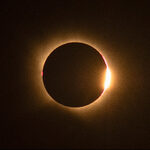 A timelapse video of the solar eclipse
by Nando Harmsen
1 comment
-

 hypofocus
wrote on Thursday 31 August 2017 at 09:08
| reply
It's a shame that the next opportunity to use these new "skills" won't be for another 2 years. And only with a fat wallet, because you'll have to sail to the Pacific Ocean to be able to see it.
Translated from Dutch.
The next total solar eclipse in the Netherlands is still so far away that everyone alive now will have been dead for a long time by then.
Have your say
Please note: Articles older than a week can only be commented on by signed-in visitors.Would you still like to comment? sign in or create a free account.
Become a better photographer every week
A practical photography tip in your inbox every week.
38,838 photography enthusiasts already receive the tips! More about the weekly mail. Or keep up to date via  Facebook.

Elja Trum
Photofacts; everything to do with photography!
Would you like to take better photos and keep up with what is happening in photography? Photofacts publishes articles that teach you something about photography — from a product announcement to a practical shooting tip or a look at a website. Photofacts covers photography every day and is a hobby project of Elja Trum's that got out of hand. The articles are written by a team of volunteer authors. If you would enjoy writing one or more articles for Photofacts, do get in touch.More about PhotofactsPhotofacts is made possible in part by
