

The Entire Starry Sky in One Photo
Monday 11 March 2024, 15:51 by Nando Harmsen | 3,746 views | 9 commentsThis article was translated from Dutch with the help of AI. Read the original.
Panoramic photography lets you capture everything around you in one photo. This can produce very unusual results. What happens when you take 240 of these photos in succession at night and combine them? Something special appears.
You can create a panoramic photo by combining three, four or five photos. This can give you a field of view of as much as 180 degrees. That is half a circle. If you go all the way around, you end up with a panorama where the left side of the photo connects to the right side.
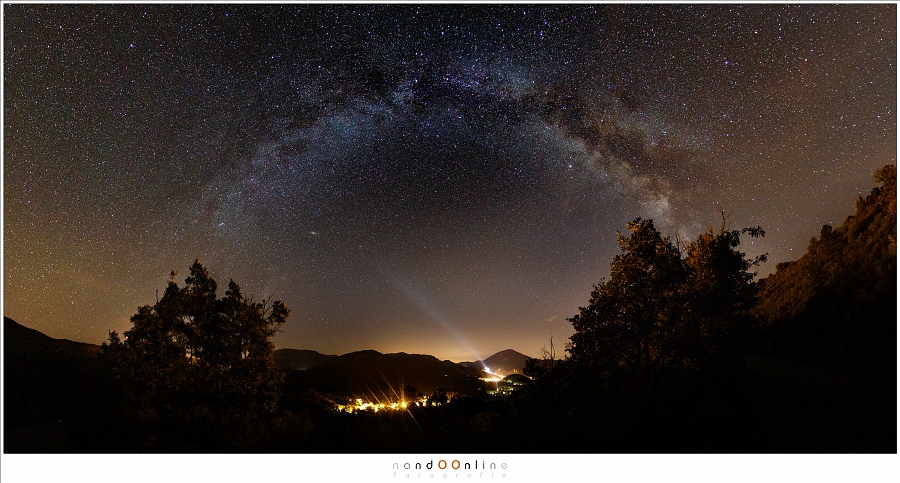
A 360-degree panorama offers many possibilities. But it is only photographed all the way around in one direction. What if you also go all the way around vertically? Then you have a 360/180-degree photo. You sometimes see these in property photography, where you can virtually look all the way around the photo.
I took a 360-degree camera outside with me on a clear evening. In a dark location, I photographed everything around me, including the stars in the sky. But instead of taking one photo, I took no fewer than 240.
Each exposure was 15 seconds long. The time between the individual photos was 1 second, as any shorter was not possible. During that hour (240 times 15 seconds), the stars rotated 15 degrees around the Pole Star.
This is star trails photography, but now with a 360-degree camera instead of a standard wide-angle lens. I edited and combined these photos. That produced the photo below.
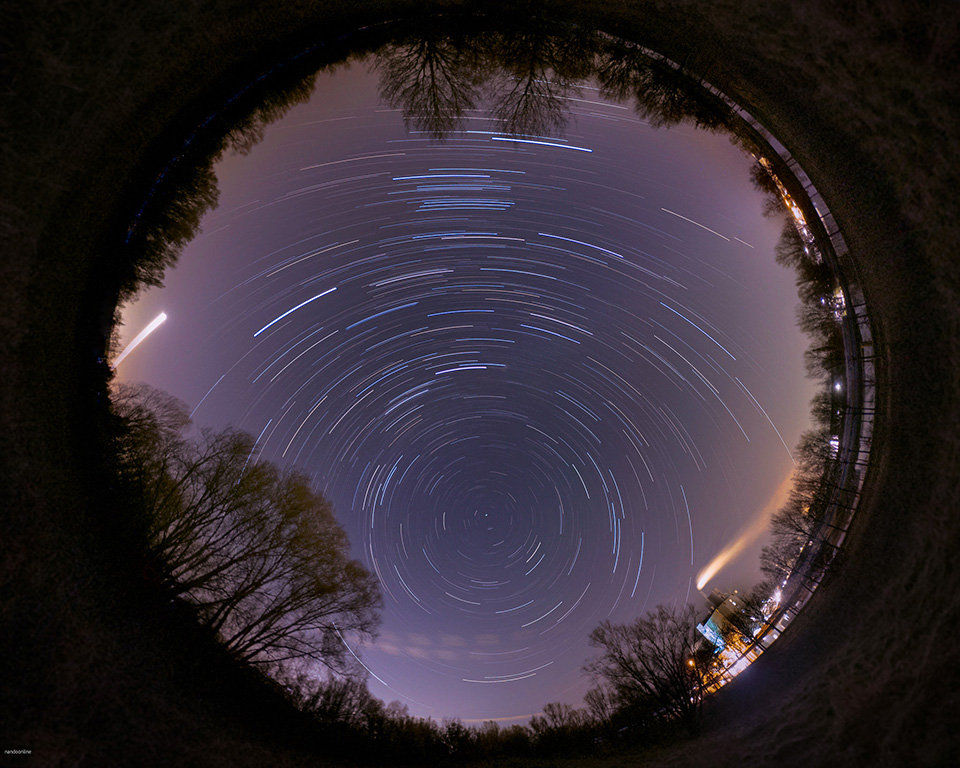
A 360/180-degree photo means that you can project it onto a flat surface in different ways. It can be a sky dome, like the photo above. Or it can be a so-called Little Planet. I created both versions. It is the same photo, but presented in a different way.
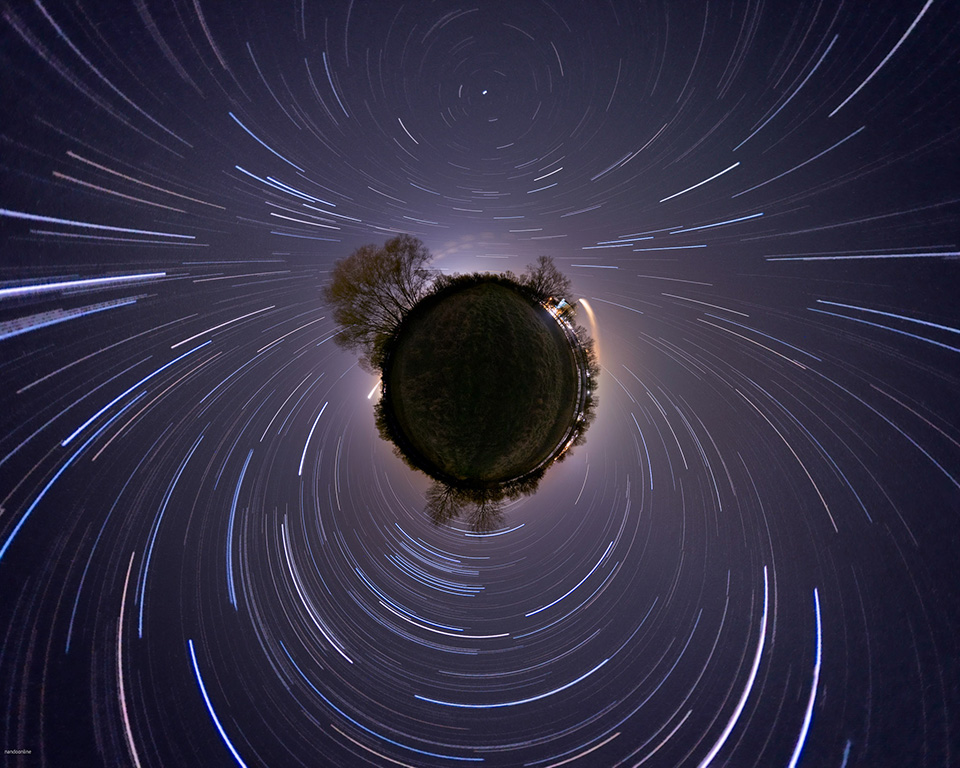
I have caught the bug and will be doing this more often. Now all I have to do is wait for another night with a clear sky. I only need two hours.
Are you interested in panoramic photography or photographing star trails? At Photofacts Academy I have an in-depth course on both. As you can see, you are not limited to one particular type of photography. Be creative and combine things wherever possible. Did you know that my new book on photographing star trails will be published in 2024?
About the author
Nando Harmsen has been photographing for more than 40 years. He specialises in wedding photography and landscape photography. Nando also gives talks, workshops, masterclasses and photo trips, and regularly reviews new and interesting equipment.
You might also like
-
 6 Tips for Creating Star Trails
by Nando Harmsen
-
 Combine star trails in Photoshop with an action
by Nando Harmsen
-
 Ricoh announces the new THETA SC2 360° camera
by Nando Harmsen
-
.jpg "Night photography on Schiermonnikoog (part 2)") Night photography on Schiermonnikoog (part 2)
Night photography on Schiermonnikoog (part 2)by Erik Nevels
-
 Getting started with a trail camera, what you need to know
by Stijn Madou
-
 Use a foreground for star photos
by Nando Harmsen
9 comments
-
 Donald Willemsen wrote on Tuesday 12 March 2024 at 10:37 | reply
Now I'm curious whether you can also get both photos as a result without the trails, simply with stars as dots in the sky. That's ultimately what the human eye perceives.
Translated from Dutch. -

-
Donald Willemsen wrote on Tuesday 12 March 2024 at 11:15 | reply
Nando, if I understand correctly, you only need to take one photo instead of 240? Naturally, with a 360° camera. Because indeed, with a total exposure time of an hour, you get star trails.
Translated from Dutch.
I myself am not too fond of star trails. I prefer a starry sky with dots. -
-
 Roofthooft wrote on Wednesday 13 March 2024 at 09:55 | reply
Beautiful. Which camera did you use?
Translated from Dutch. -
-

-
 Marc Roofthooft wrote on Saturday 30 March 2024 at 10:54
| reply
Marc Roofthooft wrote on Saturday 30 March 2024 at 10:54
| reply
What program did you use to merge those photos? I think the end result is fantastic and I have now bought an Insta 360 1 inch camera myself.
Translated from Dutch. -
Have your say
Please note: Articles older than a week can only be commented on by signed-in visitors.Would you still like to comment? sign in or create a free account.
Become a better photographer every week
A practical photography tip in your inbox every week.
38,982 photography enthusiasts already receive the tips! More about the weekly mail. Or keep up to date via  Facebook.

Elja Trum
Photofacts; everything to do with photography!
Would you like to take better photos and keep up with what is happening in photography? Photofacts publishes articles that teach you something about photography — from a product announcement to a practical shooting tip or a look at a website. Photofacts covers photography every day and is a hobby project of Elja Trum's that got out of hand. The articles are written by a team of volunteer authors. If you would enjoy writing one or more articles for Photofacts, do get in touch.More about PhotofactsPhotofacts is made possible in part by
