

Are manufacturers relying more and more on digital image correction?
Monday 25 November 2024, 16:08 by Nando Harmsen | 2,946 views | 13 commentsThis article was translated from Dutch with the help of AI. Read the original.
Cameras have built-in image correction. Chromatic aberration, vignetting and distortion are corrected automatically. It almost seems as though manufacturers are making grateful use of this for new lenses.
I was shocked when I tested a new Sony lens. It was the FE 20-70mm. With image correction switched off in the camera, it simply didn't look right. It was so bad that the image was of limited use without correction.
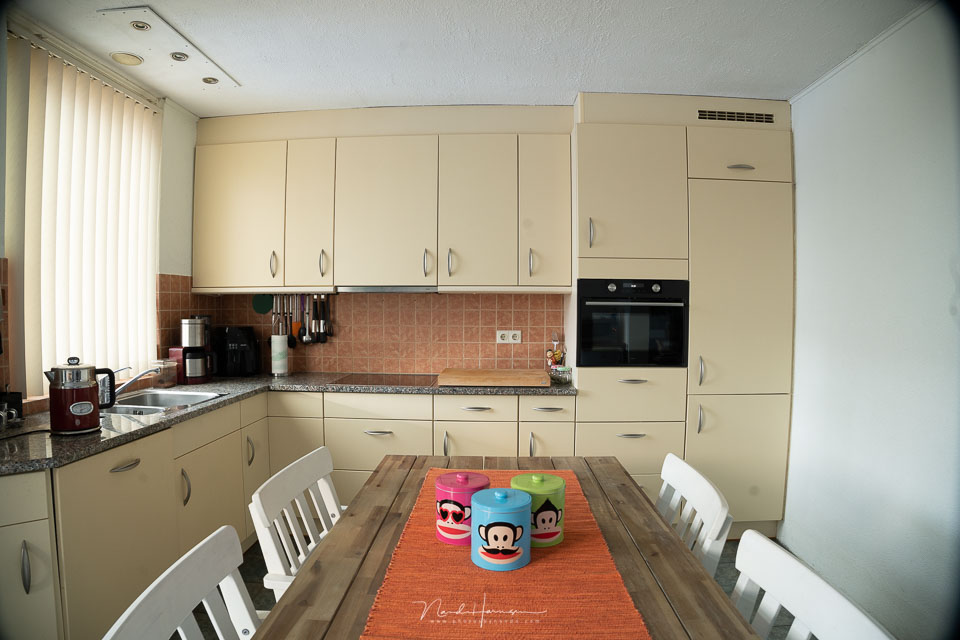
This is not the only lens affected. The Sony FE 16-25mm and FE 24-50mm also require image correction for a good result. Sony has a lot of image correction built into the raw file anyway, perhaps even for this purpose.
But Sony isn't the only manufacturer making lenses that depend on image stabilisation. I am now seeing this happen more and more with Canon too. First with the RF 10-20mm, and now with the latest L primes.
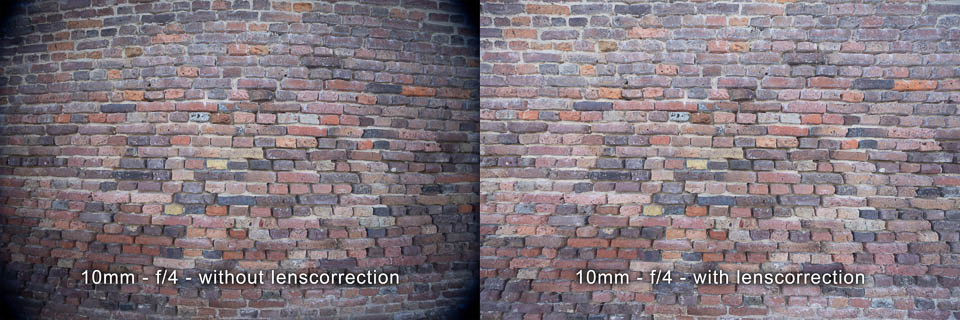
The new RF 24mm, RF 35mm and RF 50mm with the VCM motor show considerable distortion when image correction is switched off. This means that the lenses are designed to be used with image correction enabled. Just like with Sony.
On the one hand, I understand it, because there is a desire to make lenses compact, lightweight and fast at the same time. If you want the image to be as perfect as possible, the lenses become large, heavy and expensive.
That is what stands out about these lenses. Although you cannot call the price low, it is lower than that of lenses that do produce an almost perfect image. You have to give something up to be small and relatively affordable.
That is why image correction is needed. It corrects lens errors in a very clever and effective way. As a result, a lens from Canon now costs 1,600 euros instead of 3,000 euros, for example. And the lens weighs 700 grams instead of 1,000 grams.
However, image correction comes at a price. Correcting vignetting means that the shadows have to be lightened, sometimes by two stops or more. That is not a problem at ISO 100 to ISO 1600, but at higher ISO settings noise can become an issue.
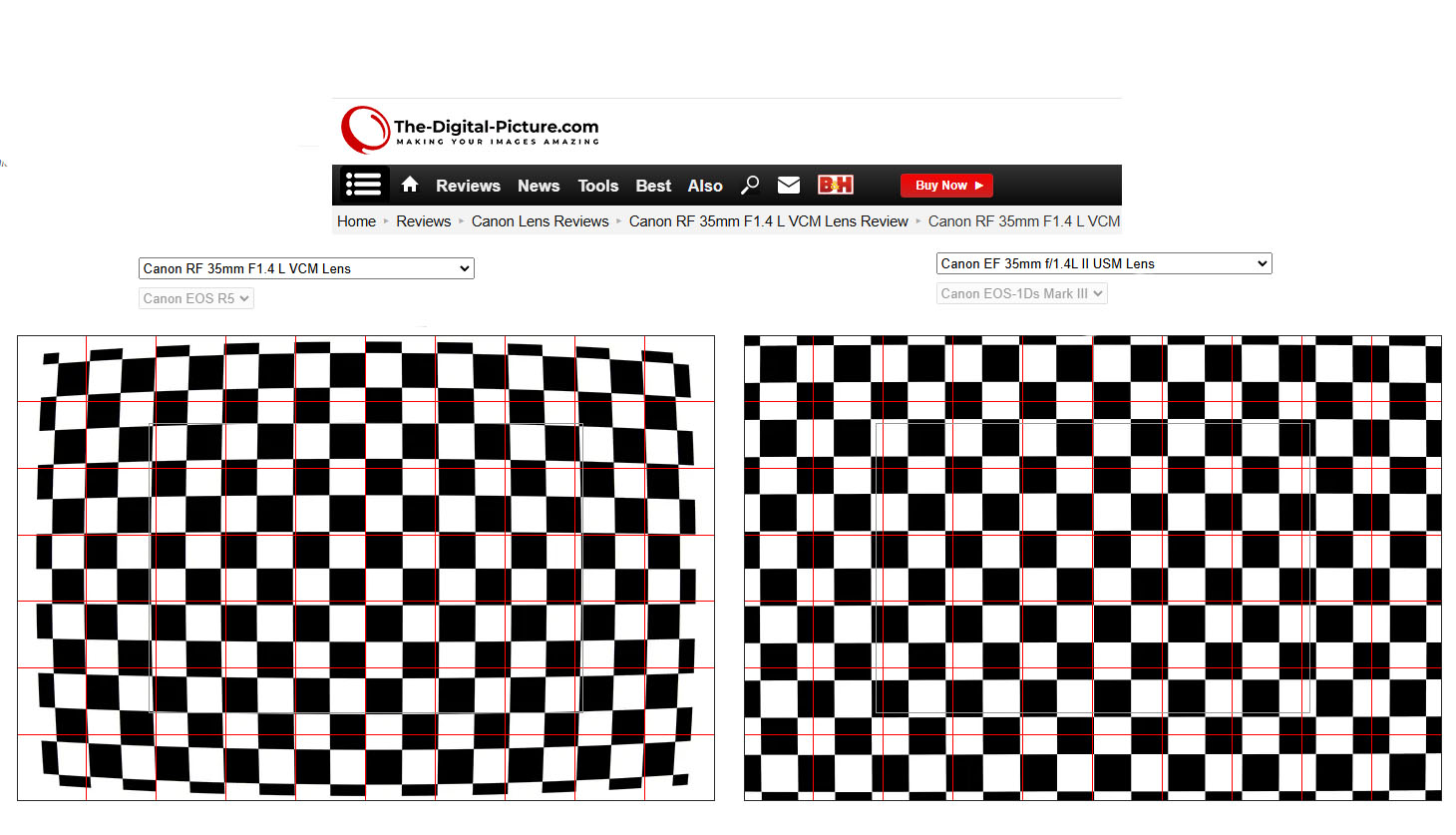
Another thing is distortion. Correcting it means that the canvas has to be distorted. The image is stretched to make straight lines straight again. This often works quite well, but it can cause a loss of sharpness that becomes noticeable if you look closely.
In many cases, none of this is very important. A portrait photographer will be less interested in the edges of the photo, because the subject is usually in the centre. But a landscape photographer does consider that important.
A large aperture is not needed for a landscape photographer anyway, but it is for an astrophotographer. And then that image correction is a real nuisance. That photographer would be better off avoiding these lenses.
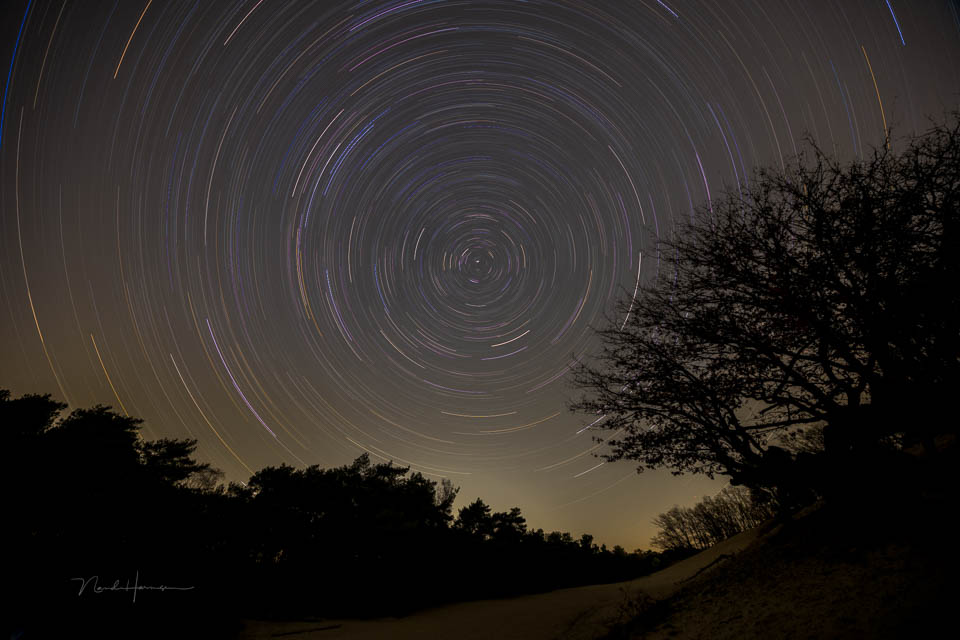
I think manufacturers are relying too much on image correction, perhaps because of the pressure from the photography world, which is quick to complain when something becomes too large or heavy. The laws of physics cannot be bent, but software can correct a lot.
I would love a 24mm lens with an f/1.4 aperture that I could also use for astrophotography. The new Canon RF 24mm f/1.4L VCM is therefore not suitable for this type of photography. That is frustrating, and I hope a version will also be released with a much better image without in-camera correction. I fear the worst, though.
What do you think? Is in-camera image correction a good way to have relatively affordable lenses? Let us know what this means for you in a comment below this article.
About the author
Nando Harmsen has been photographing for more than 40 years. He specialises in wedding photography and landscape photography. Nando also gives talks, workshops, masterclasses and photo trips, and regularly reviews new and interesting equipment.
You might also like
-
 Healthy scepticism about manufacturers' promises
by Nando Harmsen
-
 Review: Pro Line photobook by Saal Digital
by Erik van Rosmalen
-
 Sony FE 8-14mm f/3.5 Fisheye G lens
by Elja Trum
-
 Do you need the perfect lens for your photography
by Nando Harmsen
-
 Digital film roll for your analogue camera
by Elja Trum

13 comments
-

 peterheins
wrote on Monday 25 November 2024 at 16:38
| reply
peterheins
wrote on Monday 25 November 2024 at 16:38
| reply
Oh , so that's it . I recently got a Canon EOS-R with the RF 15-30mm f4.5-6.3 IS STM , also not a cheap lens €600 and the RF 24-105mm f4-7.1 and I had already noticed it there too , when I didn't have the profile correction turned on , that I could even see the corners of the lens hood. After correction this was gone. I also have the 5D Mark IV with 2 L lenses ( 16-35mm and 24-105mm ) I don't think it's like that there at all . There you can hardly see whether you turn the correction on or off.
Translated from Dutch. -

-
 ifiamminghi wrote on Tuesday 26 November 2024 at 10:59
| reply
ifiamminghi wrote on Tuesday 26 November 2024 at 10:59
| reply
Is that correction also applied to RAW images or only to the jpgs ?
Translated from Dutch. -
Nando
wrote on Tuesday 26 November 2024 at 11:08
| reply
For some, yes, for others, no. When it is built into the raw file, in Lightroom Classic under lens corrections you see the message "built-in lens profile applied."
Translated from Dutch.
There are raw editors that can get around this (RAWTherapee, for example), but Lightroom cannot. -
 Donald Willemsen wrote on Tuesday 26 November 2024 at 12:57 | reply
No matter how you look at it, lens corrections will always remain necessary. No lens is perfect without lens aberrations, whether it is made of glass or plastic. At least if you want to keep a lens affordable for both amateurs and professionals.
Translated from Dutch.
The question remains whether it will remain technically feasible to correct every lens aberration through software without compromising the photo. -
Nando
wrote on Thursday 28 November 2024 at 09:54
| reply
There are lens corrections and lens corrections. Until now it was lens corrections. Now it is more than that, because I get the impression that smaller image circles are being used.
Translated from Dutch.
This does have the consequence that lenses can be made cheaper.
Moreover, for most people this is not a problem or noticeable. -
 Henk wrote on Tuesday 26 November 2024 at 16:24 | reply
It wouldn't surprise me if there's also an extra sales motive involved there. The firmware with all those correction smarts is of course mainly (exclusively?) for the new camera models, so if you want to be able to use that nice new lens optimally...
Translated from Dutch. -
 Jos wrote on Wednesday 27 November 2024 at 15:56 | reply
I don't just think it's a disgrace that lenses such as the Canon RF 24mm f/1,4L VCM perform poorly. I will probably get it thrown at my head that it doesn't perform poorly, but for those 1800 euros for a prime, I would expect better performance than what Korean or Chinese primes can offer me for a fraction of that price. That is not the case. The proof of that is that astrophotographers buy the "Asian" lenses. No distortion on full frame; excellently sharp stars right into the corners and virtually no vignetting.
Translated from Dutch.
If I want to know how good my lens is, I view the photo via IrfanView at full size. That only reads the RAW file, without any correction whatsoever.
That quickly shows me that Olympus lenses generally score the best. I have no values for the new lenses for Canon RF or Nikon Z and that is why it surprises me that Olympus does manage to make even a Zuiko Digital 14-54mm (very old) of limited price perform better. I was therefore convinced that lenses for mirrorless cameras would always be better than their predecessors. That being said: give me the Nikkor 85mm 1.8G or the 35mm 1.8G, those do perform excellently. -
Nando
wrote on Thursday 28 November 2024 at 09:58
| reply
I think it’s too simplistic to say that those new lenses perform poorly. They don’t. But they are dependent on lens correction. That doesn’t make them bad lenses, just unsuitable in specific cases.
Translated from Dutch.
It wouldn’t surprise me if the choice for this kind of lens design is purely a cost consideration. After all, there is a market for it. -
Jos wrote on Wednesday 27 November 2024 at 16:00 | reply
Moreover, you can only use these lenses on those cameras. So the manufacturer thinks: who will notice if the RAW files are also corrected (and in Lightroom are even corrected to optimal as well before you get to work yourself).
Translated from Dutch. -
Donald Willemsen wrote on Thursday 28 November 2024 at 10:51 | reply
Nando, if your assumption is correct, then it could mean that the image circle is smaller than the size of the sensor in most cases. In the case of, for example, RF-S and EF-S lenses, the image circle is considerably smaller than with lenses for a full-frame sensor. Does that mean, in your view, that the quality standards of RF-S and EF-S are also lower than those of the lenses in the L line, Canon's top segment? After all, RF-S and EF-S were designed for the crop sensor.
Translated from Dutch. -
Nando
wrote on Thursday 28 November 2024 at 11:44
| reply
In this case, I'm talking about lenses that are designed for full-frame sensors. I don't know how it is with lenses for APS-C sensors.
Translated from Dutch.
So I'm absolutely not claiming that those lenses have a lower quality standard. I absolutely don't believe that either. -
Donald Willemsen wrote on Thursday 28 November 2024 at 12:08 | reply
That's right Nando, you didn't claim that either. But as you know, Canon divides its lenses into 3 price classes. The cheapest class has no colored ring. The mid-range class has a gray-colored ring and the top class (L lenses) has a red-colored ring. You also see such differences with other brands. No doubt that also has to do with the quality and quality standards that a lens must meet in a certain price class. It's not only about budget-friendliness. I have the idea that the cheaper the lens, the more dependent the lens becomes on software corrections.
Translated from Dutch.
Have your say
Please note: Articles older than a week can only be commented on by signed-in visitors.Would you still like to comment? sign in or create a free account.
Become a better photographer every week
A practical photography tip in your inbox every week.
39,020 photography enthusiasts already receive the tips! More about the weekly mail. Or keep up to date via  Facebook.

Elja Trum
Photofacts; everything to do with photography!
Would you like to take better photos and keep up with what is happening in photography? Photofacts publishes articles that teach you something about photography — from a product announcement to a practical shooting tip or a look at a website. Photofacts covers photography every day and is a hobby project of Elja Trum's that got out of hand. The articles are written by a team of volunteer authors. If you would enjoy writing one or more articles for Photofacts, do get in touch.More about PhotofactsPhotofacts is made possible in part by
