

The ideal choice for primes
Sunday 21 September 2025, 15:51 by Nando Harmsen | 2,534 views | 17 commentsThis article was translated from Dutch with the help of AI. Read the original.
When you choose to use prime lenses, you need three lenses. A wide-angle, a standard and a telephoto lens. Which focal lengths should you choose?
The choice of prime lenses is best based around a fixed foundation. That foundation is not very difficult to choose. It is the standard focal length, or a standard lens, 50mm.
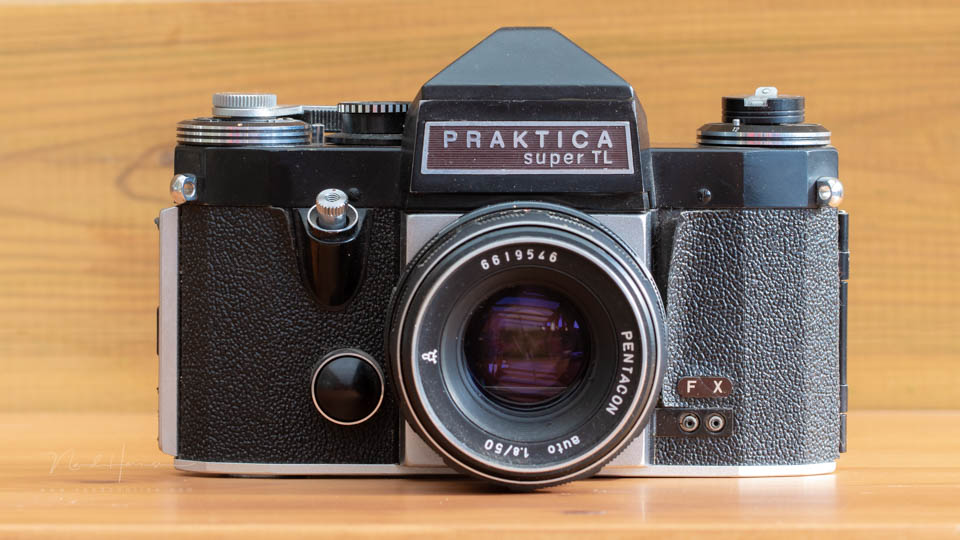
The 50mm focal length produces a very natural image on a full-frame sensor. There is hardly any distortion, unless you get very close, and proportions are correct. The world is shown as you see it with the naked eye.
You can then choose the other two prime lenses around it. One with a longer focal length and one with a shorter focal length.
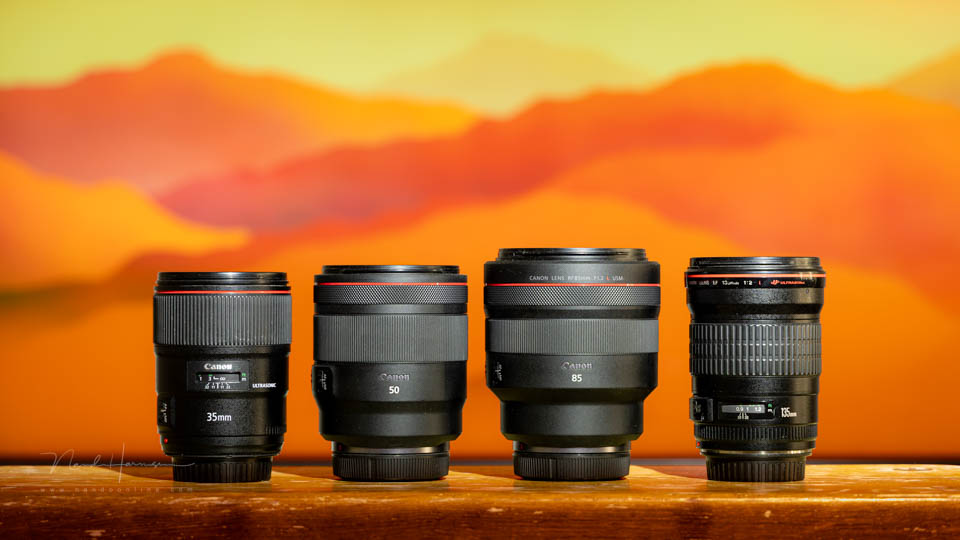
For a shorter focal length, the wide-angle lens, I recommend a focal length that is roughly half as long, 24mm. This gives you a huge angle of view without producing extreme wide-angle distortion. To put it in numbers, you get four times as much in the frame.
For telephoto, you can choose a focal length that is twice as long in the same way. However, I would recommend taking just that little bit extra. In my opinion, a 135mm lens is a better choice.
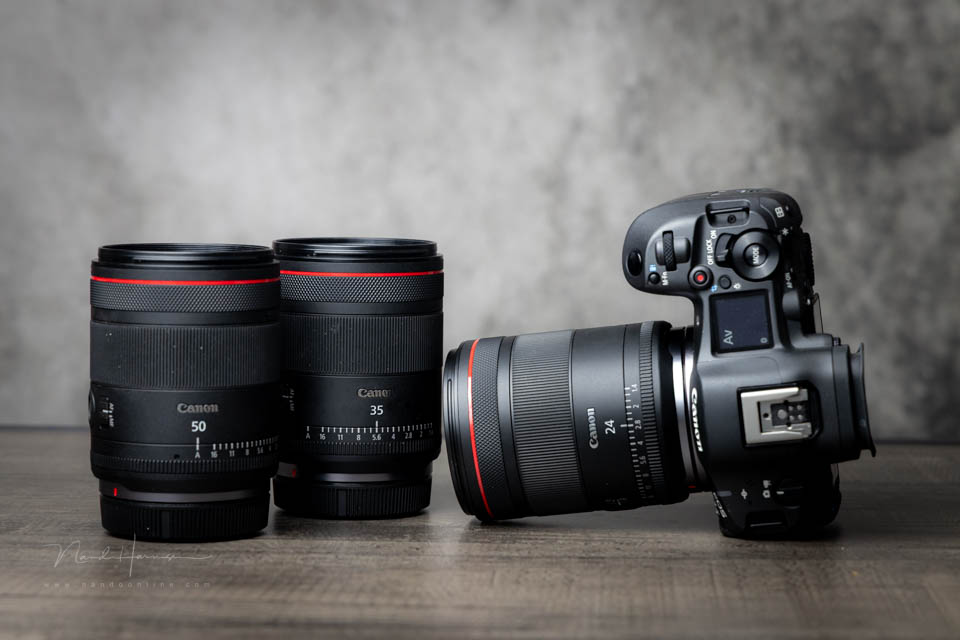
Can you photograph everything with a 24mm, a 50mm and a 135mm? Of course not, but you can photograph a lot. You can of course choose other focal lengths based on what your goal is.
For street photography, this trio could work well, depending on your preferences, of course. If you photograph portraits, then 35mm, 85mm and 135mm or 200mm would be a good choice.
If you are going to photograph animals, you could shift your choice to a 135mm, a 300mm and a 600mm lens. Provided you like using prime lenses.
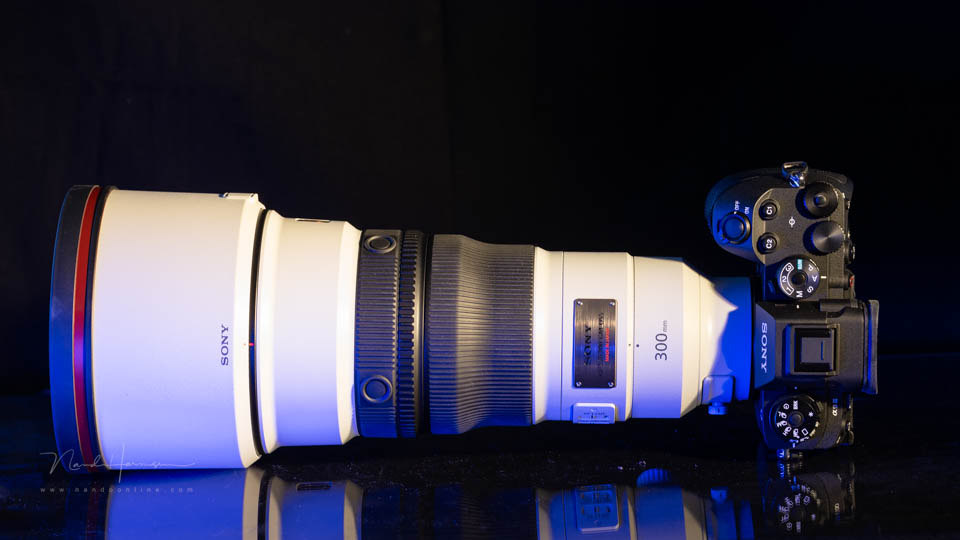
Quite a few focal lengths have been mentioned. You can think of even more variations. Do you always need to have three? No, you don't. Start with one lens and see what you often find yourself missing. Expand in that direction.
Of course, it is also possible to use a combination of primes and a zoom. I have gone on holiday several times with a 24mm, a 50mm and a 100-500mm zoom. That worked perfectly.
I also went to the Tarn with three primes. You can read more about it in this article.
What you would choose is very personal. It depends on your style, your preference, but also on the type of photography you do. Do you work with prime lenses? Let us know which set you prefer to use and why. You can leave a comment below this post.
About the author
Nando Harmsen has been photographing for more than 40 years. He specialises in wedding photography and landscape photography. Nando also gives talks, workshops, masterclasses and photo trips, and regularly reviews new and interesting equipment.
You might also like
-
 Photographing with Canon's cheap primes
by Nando Harmsen
-
 Landscape photography tip: try going out with a prime lens
by Nando Harmsen
-
 Landscape photography with a telephoto lens
by Erik Nevels
-
 A tip for using telephoto lenses on a ball head
by Nando Harmsen
-
 Review of the Canon RF 600 and RF 800 Telephoto Lenses
by Nando Harmsen
-
 Why zooming with your feet is not the same as zooming with a lens
by Nando Harmsen
17 comments
-

 Elja Trum
wrote on Sunday 21 September 2025 at 15:46
| reply
Elja Trum
wrote on Sunday 21 September 2025 at 15:46
| reply
When I use primes, they are usually the 35mm or the 85mm. I like those best. My 135mm usually stays in the cupboard (but it isn't that fast either).
Translated from Dutch.
Only in practice I notice that I actually manage better with zooms (the 24-70mm and the 70-200mm).
-
 Mac wrote on Monday 22 September 2025 at 08:36 | reply
A 50 mm lens does not show the world the way you see it with the naked eye. There is a small (very small) telephoto effect. The most natural (on FF) is a 43mm lens. Pentax was renowned during the film era for its 43mm lens that it had (and still has) in its range, because of the angle of view.
Translated from Dutch.
so much for the technical side.
but during the film era, I indeed often went out with only a 50mm lens. You learn to think much more, instead of changing lenses every time.
these days, I vary more. And depending on what I feel like (and thus only want to take 1 lens with me). I take 1 with me between 15mm and 70mm (crop sensor) -
 Marcel van den van den Heuvel wrote on Tuesday 23 September 2025 at 13:17 | reply
Is there still a difference between full-frame and medium-format cameras in this regard? Any other advice??
Translated from Dutch.
Kind regards
Marcel -

-
 A.Gooier wrote on Tuesday 23 September 2025 at 13:29
| reply
A.Gooier wrote on Tuesday 23 September 2025 at 13:29
| reply
Searched on the internet: https://www.oogartsen.nl/onderzoeken/gezichtsveld-onderzoek/ . A human's field of view is 15 degrees.
Translated from Dutch.
I don't know which lens this corresponds to. -
-
A.Gooier wrote on Tuesday 23 September 2025 at 13:54
| reply
I'm talking about the standard lens that corresponds to the field of view of a human. It used to be 50mm. Now it's 35mm or 40mm.
Translated from Dutch. -
Nando
wrote on Tuesday 23 September 2025 at 14:07
| reply
What has changed that it used to be 50mm and now is different? The angle of view of 50mm is the same as what it used to be. The human field of view has not changed either.
Translated from Dutch.
If we are going to look at the numbers, we have to do it properly.
Central field of view: The part in the middle (approximately 10 degrees for one eye, 15 degrees for two eyes) where we see most sharply.
Peripheral field of view: The wider area at the sides, which is blurry, but essential for noticing movement and orientation. (approximately 150 degrees for one eye, 180 degrees for two eyes)
The angle of view of 50mm on full frame is approximately 40 degrees horizontally and 27 degrees vertically. Diagonally it is approximately 47 degrees (PhotoPills)
The field of view of the human field of vision therefore does not correspond to that of a 50mm lens, or 40mm lens, or 35mm. -
Marcel van den van den Heuvel wrote on Tuesday 23 September 2025 at 14:22 | reply
Ah yes, found it, Nando!
Translated from Dutch.
For my camera this is x 0.79
(https://budgetcam.nl/nl/blog/reviews/klantreview-fujifilm-gfx-50s-de-stap-van-fullframe-dslr-naar-middenformaat-met-elektronische-zoeker) -
A.Gooier wrote on Tuesday 23 September 2025 at 14:23
| reply
What you write is also on the site I linked in my comment https://www.oogartsen.nl/onderzoeken/gezichtsveld-onderzoek/ . I had already read that.
Translated from Dutch.
What I mean by standard lens is that "back in the day" you got a 50mm standard lens with the camera. Nowadays that is different, as people now consider 40mm to be the standard lens. The 50mm is no longer in fashion.
https://en.wikipedia.org/wiki/Normal_lens -
Nando
wrote on Tuesday 23 September 2025 at 14:27
| reply
Yes indeed. These days everything has to be different.
Translated from Dutch.
My advice: don't worry too much about what others think and choose the focal length you feel comfortable with. If that's 50mm, choose that. If that's 35mm, choose that. But don't buy a 40mm because people say that this is supposed to be standard nowadays. -
A.Gooier wrote on Tuesday 23 September 2025 at 14:30
| reply
I'm not worried about anything, but I just wanted to point it out to you.
Translated from Dutch.
I've been photographing with a 40mm on full frame for a few years. -
Nando
wrote on Tuesday 23 September 2025 at 14:41
| reply
Unfortunately, many other photographers do get worked up about these kinds of proclaimed 'truths.'
Translated from Dutch.
You choose the angle of view based on what you want to photograph and how it appears in the frame.
I've been using 35mm for decades when I want to show a relatively large part of the surroundings around my subject. I use 50mm when I want to show less.
That should be the criterion for your choice. Not because it supposedly corresponds to what the eye sees. -
A.Gooier wrote on Tuesday 23 September 2025 at 14:53
| reply
I have been taking photographs since the early 1980s, and back then people didn't worry about lenses that matched what the eye saw. People bought and used lenses they found pleasant to use.
Translated from Dutch.
Now people worry far too much about the latest lenses, and especially about bokeh, the modern hype. -
-
guest wrote on Tuesday 23 September 2025 at 16:33 | reply
Absolutely right!
Translated from Dutch.
I'm currently digitizing my old negatives and slides, 35mm and medium format. From the 80s and 90s of the last century. Fortunately, there were only 36 exposures on a 35mm film roll and only 6 or 15 on a roll of film. -
Donald Willemsen wrote on Tuesday 23 September 2025 at 16:18 | reply
I have 3 primes, a 50mm, a 105mm and a Lensbaby Composer Pro 35mm. I mainly use those for portrait, close-up and macro photography. The Lensbaby Composer Pro mainly for special effects.
Translated from Dutch.
Have your say
Please note: Articles older than a week can only be commented on by signed-in visitors.Would you still like to comment? sign in or create a free account.
Become a better photographer every week
A practical photography tip in your inbox every week.
39,079 photography enthusiasts already receive the tips! More about the weekly mail. Or keep up to date via  Facebook.

Elja Trum
Photofacts; everything to do with photography!
Would you like to take better photos and keep up with what is happening in photography? Photofacts publishes articles that teach you something about photography — from a product announcement to a practical shooting tip or a look at a website. Photofacts covers photography every day and is a hobby project of Elja Trum's that got out of hand. The articles are written by a team of volunteer authors. If you would enjoy writing one or more articles for Photofacts, do get in touch.More about PhotofactsPhotofacts is made possible in part by
