

Review: Canon EOS R8 full-frame mirrorless camera
Friday 28 April 2023, 15:30 by Nando Harmsen | 6,907 views | 6 commentsThis article was translated from Dutch with the help of AI. Read the original.
Canon has brought a very attractive full-frame mirrorless camera to the market. This camera gives you professional capabilities for an attractive price. Are you looking for a full-frame camera but don't want to compromise on features? Then the Canon EOS R8 might be the camera for you. I was given a sample for review.
The first full-frame mirrorless cameras Canon brought to the market were the EOS R and EOS RP. Although these are excellent cameras, they are missing a number of important features. As a result, they cannot compete with the other brands.
However, don't forget that these are now older models. Most of these small and large drawbacks have been resolved with the EOS R5, EOS R6 and EOS R3 full-frame models. But these are relatively expensive cameras that are not within everyone's financial reach.
The Canon EOS R8 finally provides a replacement for those EOS R and EOS RP models. And what a replacement it is. In terms of features, this camera is no less capable than the more expensive models.
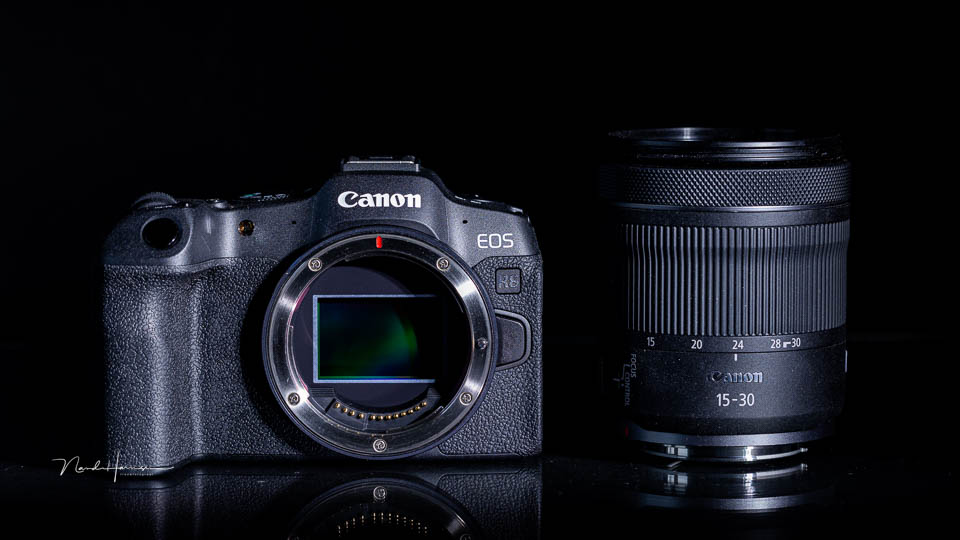
Some specifications
- 24-megapixel CMOS full-frame sensor
- 3-inch fully articulating LCD screen with touchscreen.
- Electronic viewfinder with 2.34 million OLEDs
- Mechanical shutter up to 6 frames per second
- Electronic shutter up to 40 frames per second
- Raw burst mode up to 30 frames per second with 0.5-second pre-shooting
- Body, face and eye AF and tracking for people and animals
- Vehicle AF detection and tracking
- 4K 50p video from 6K footage
- 10-bit C-log3 and HDR-PQ
- False colour overlay for video
- Weighs just 461 grams
Appearance of the Canon EOS R8
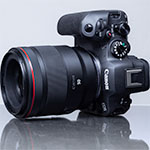
It is striking how small the Canon EOS R8 is. The camera weighs just 461 grams, including the battery. Despite its small size, the camera feels comfortable in your hand, thanks to a well-shaped grip.
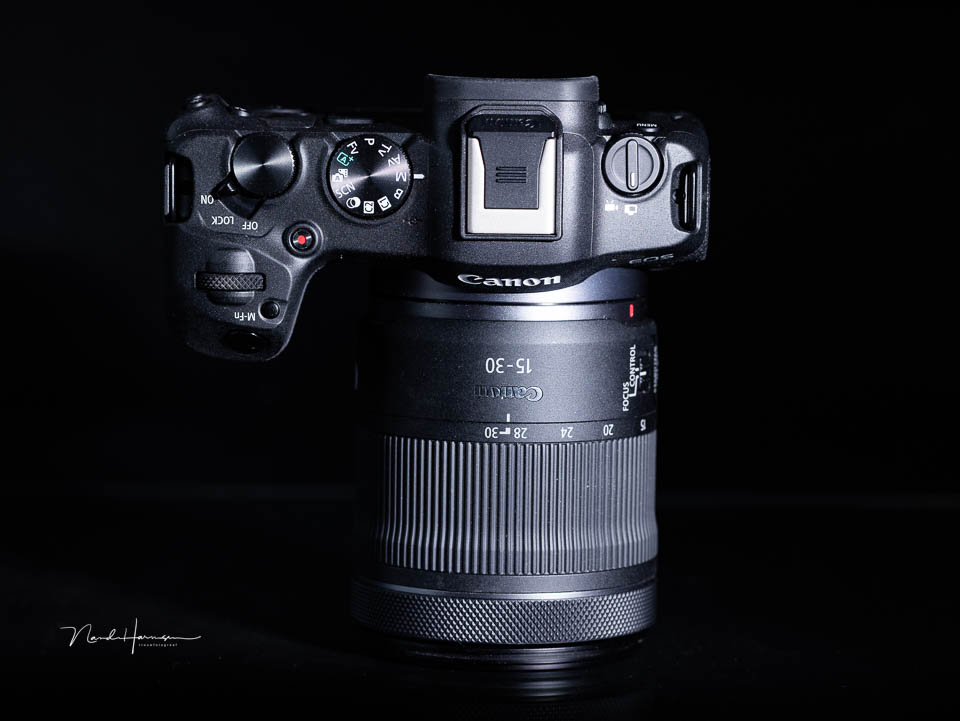
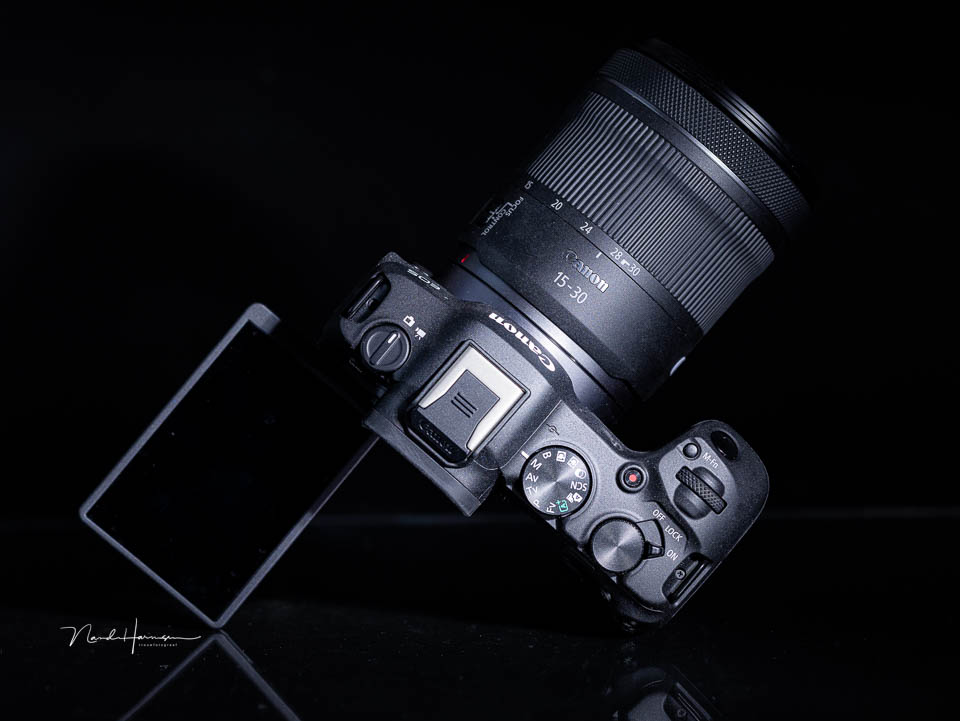
There is a fully tilting three-inch LCD screen, a PSAM mode dial and two control dials. One for your index finger and one for your thumb. There is no third control dial on the back of the camera. A four-way button is located there instead. There is no joystick, but there is an AF-ON button.
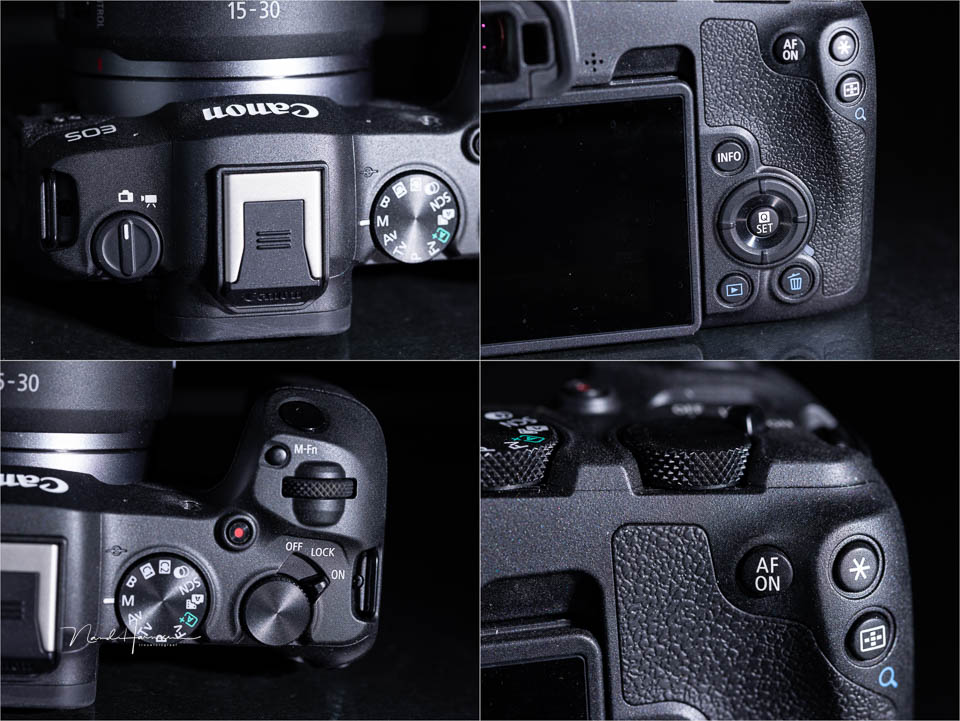
The photo/video switch is located on the left shoulder of the camera. The main power switch itself is positioned around the rear control dial. There are three positions, on, off and lock. There is a Q button for the quick menu on the LCD screen, and the M-Fn button. You can programme various functions under it.
Connections, battery and memory card
Because of its small size, Canon has had to make some concessions. As a result, the EOS R8 has an LP-E17 battery. Depending on how much you use the LCD screen and electronic viewfinder, the battery will last for between 150 and 440 photos. According to the CIP rating, more photos will certainly be possible in practice.
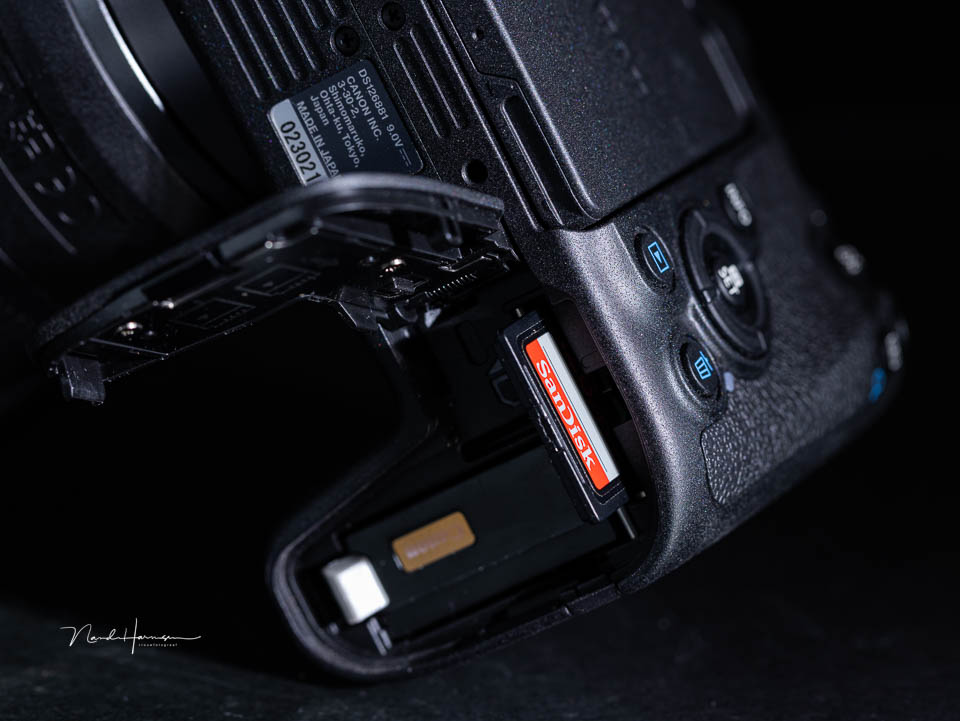
The memory card slot is also located in the battery compartment. The EOS R8 accepts UHS-II SD cards. You need at least a V60 type to use all the video functions.
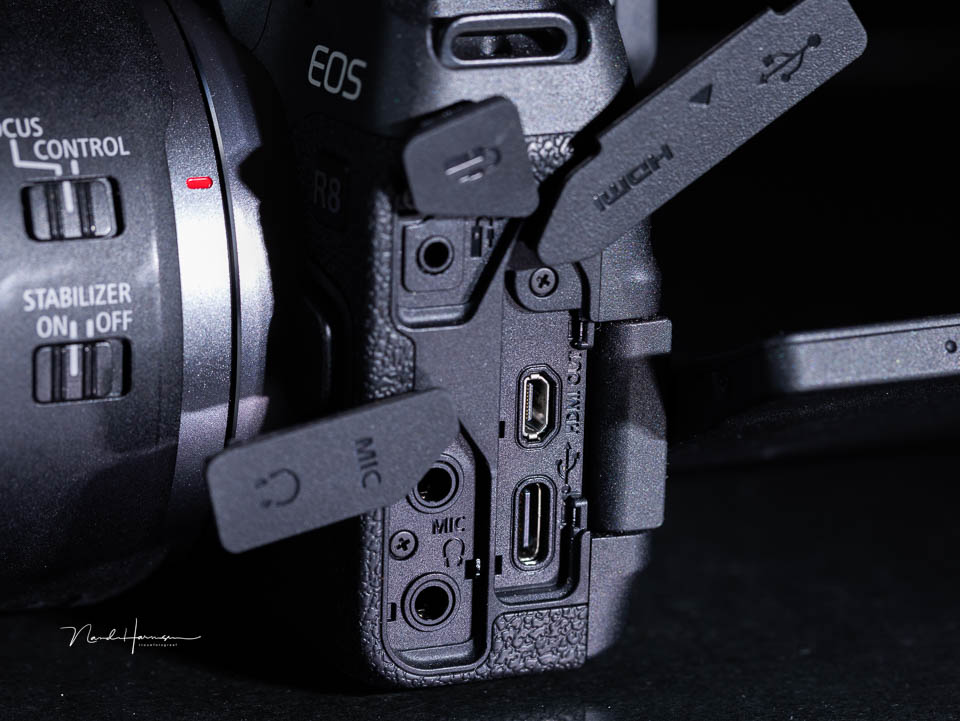
The connections on the camera include a micro HDMI port and a USB-C port with PD support. There is a microphone and headphone connection, and you can connect a remote control. The hot shoe on the camera is multifunctional. For example, you can connect an XLR adapter to it to get four-channel audio input.
Autofocus and speed
The autofocus is fast and accurate. You can choose to detect people, animals and vehicles, or have this selected automatically. If you have eye AF activated, you can select a preference for the left or right eye.
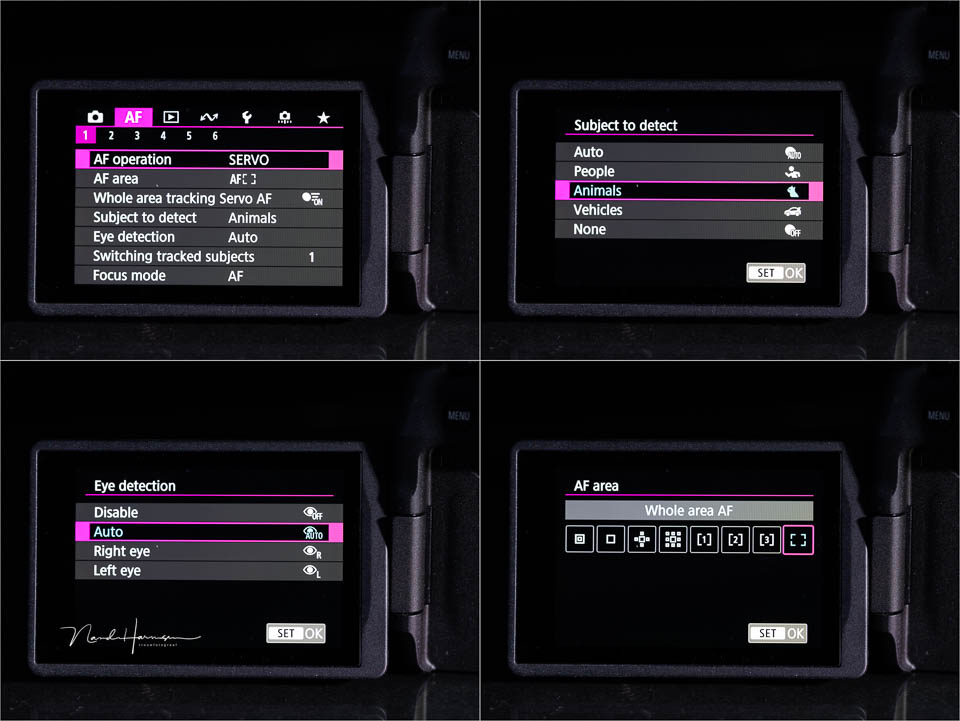
With AF in servo and tracking, the subject is followed across the entire frame. It is also possible to have it followed within a predefined area.
The speed at which the camera can take photos is limited to a maximum of six photos per second with the mechanical shutter. If you switch to the electronic shutter, a maximum of 40 frames per second is available. Do bear in mind that rolling shutter effects can occur. I found the amount of rolling shutter quite acceptable.
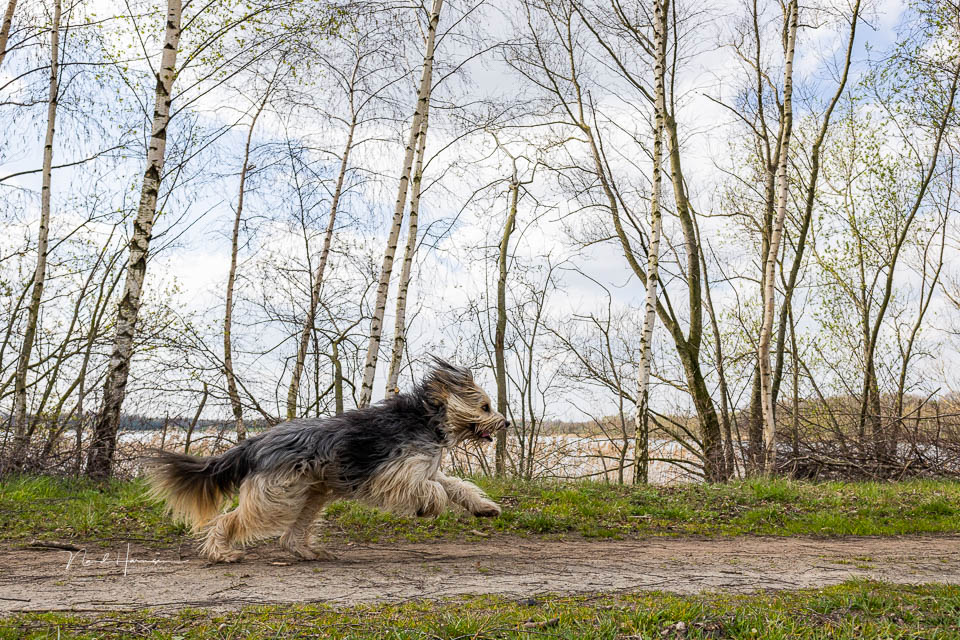
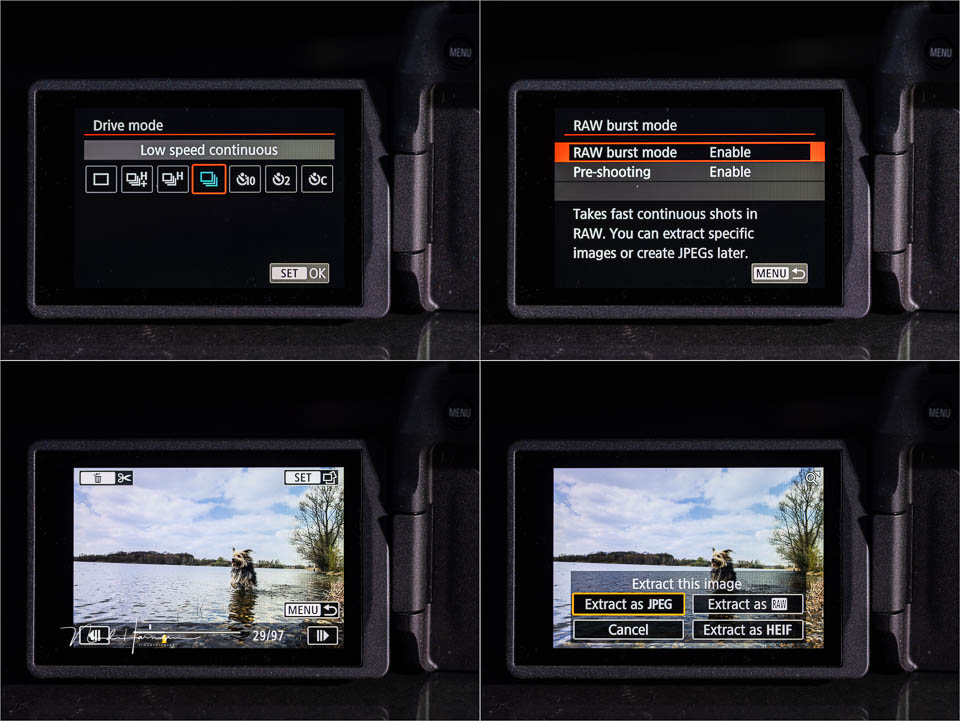
It is also possible to have the camera record a RAW burst. The speed is then a maximum of 30 frames per second, with the option of pre-shooting. The camera continuously records images when the shutter button is half-pressed. When the shutter button is fully pressed, the previous 0.5 seconds of images are also saved.
The RAW burst is a separate file that cannot be read by normal photo software. You can select the desired images in the camera and save them as Raw, jpeg or HEIF.
ISO performance and dynamic range
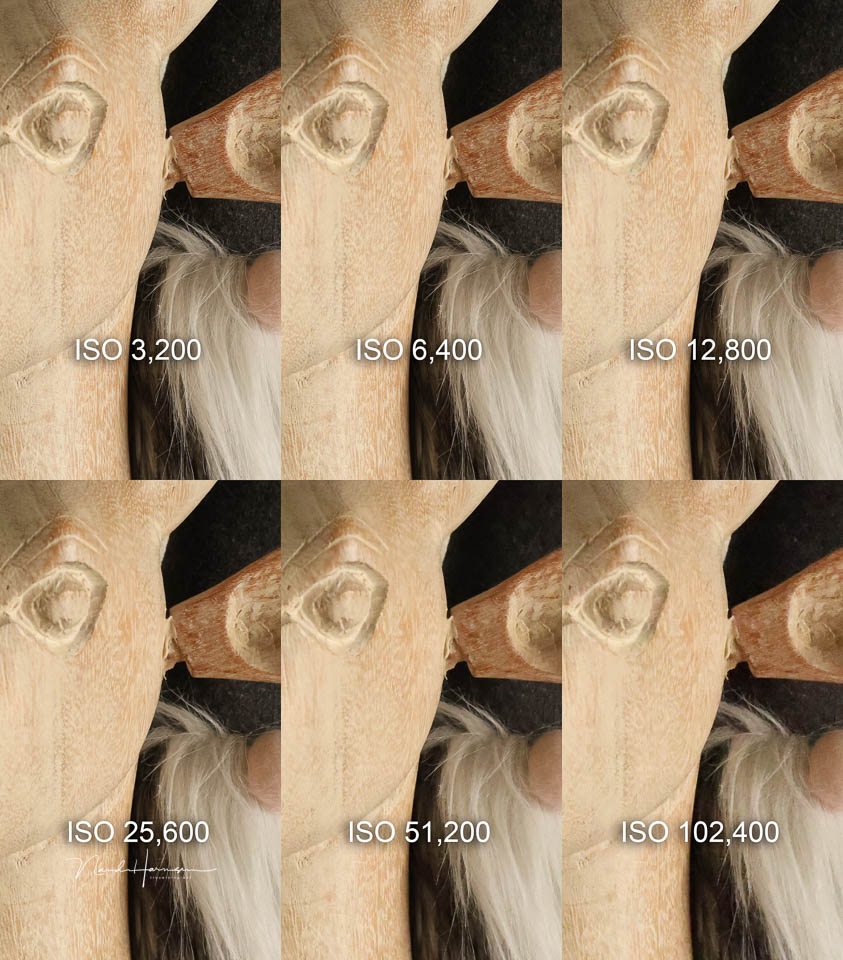
The ISO performance of the Canon EOS R8 can be described as good in one word. You can photograph at up to ISO12,800 without many problems. If you are willing to accept a little noise, you can go one or two stops higher. You do need to have a good exposure, because there is little room for corrections.
I tested the dynamic range by deliberately underexposing a shot at ISO400. This underexposure was then corrected in Lightroom Classic. I then looked at the increase in noise caused by this correction.
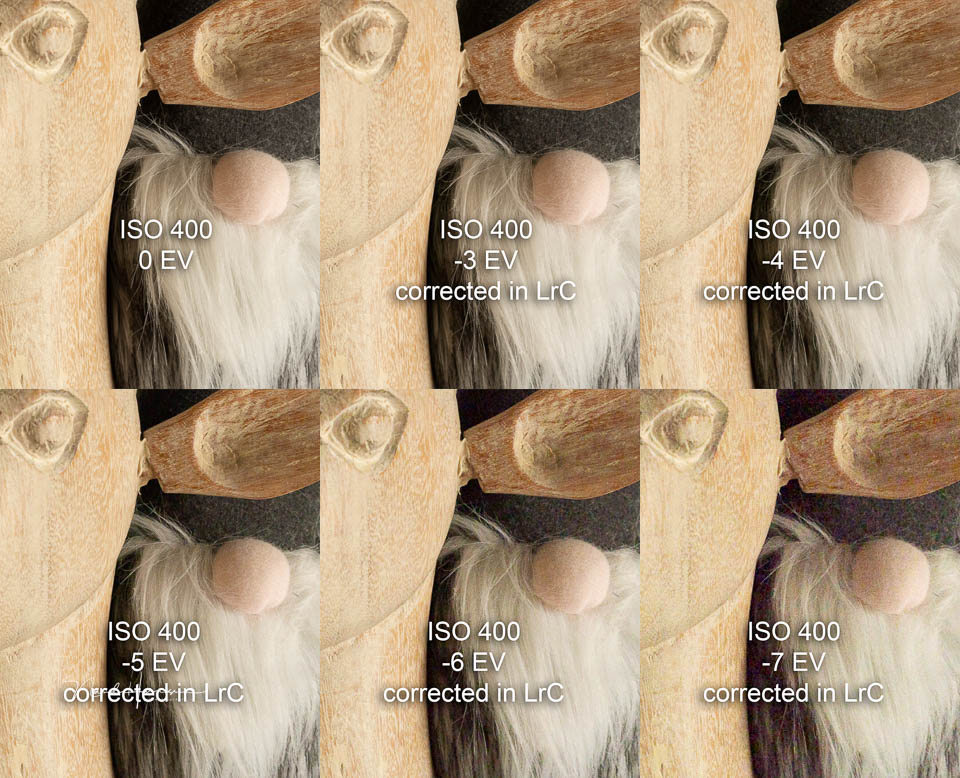
This test shows that as much as 5 stops of correction is acceptable before the increase in noise becomes distracting. You then have no more noise than in a properly exposed photo, but with an ISO value 5 stops higher.
Conclusion
The Canon EOS R8 is a fantastic camera. With this relatively inexpensive mirrorless camera, you make little or no compromise when it comes to performance. The autofocus is fast, accurate and has every feature that the larger siblings have. In some cases, even more.
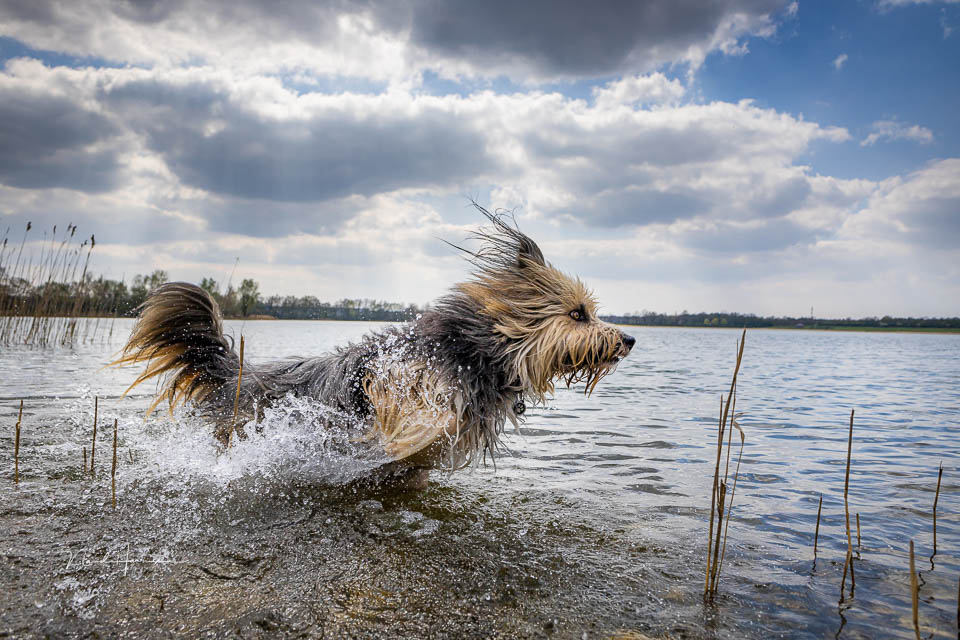
The image quality is also good, with excellent ISO performance and good dynamic range. The sensor's resolution of 24 megapixels is just right. Enough for almost any conceivable use, but not so much that you have to deal with enormous files.
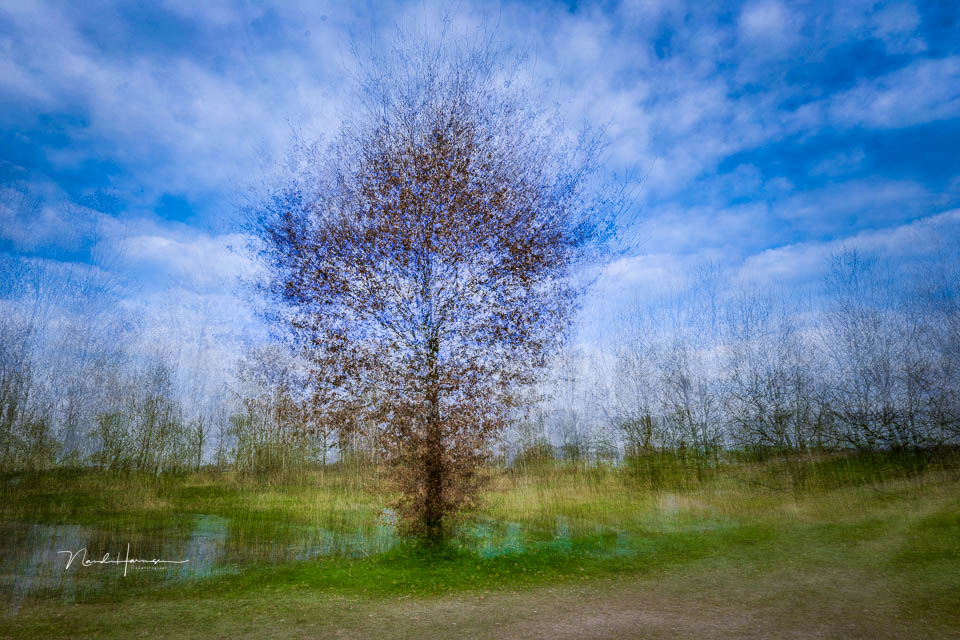
When it comes to frame rate, no action is too fast for you. The RAW burst mode is also a good option that is easy to use. But the EOS R8 offers more than that. Timelapse, interval, multiple exposures and focus stacking are also among its capabilities. There is also a bulb timer.
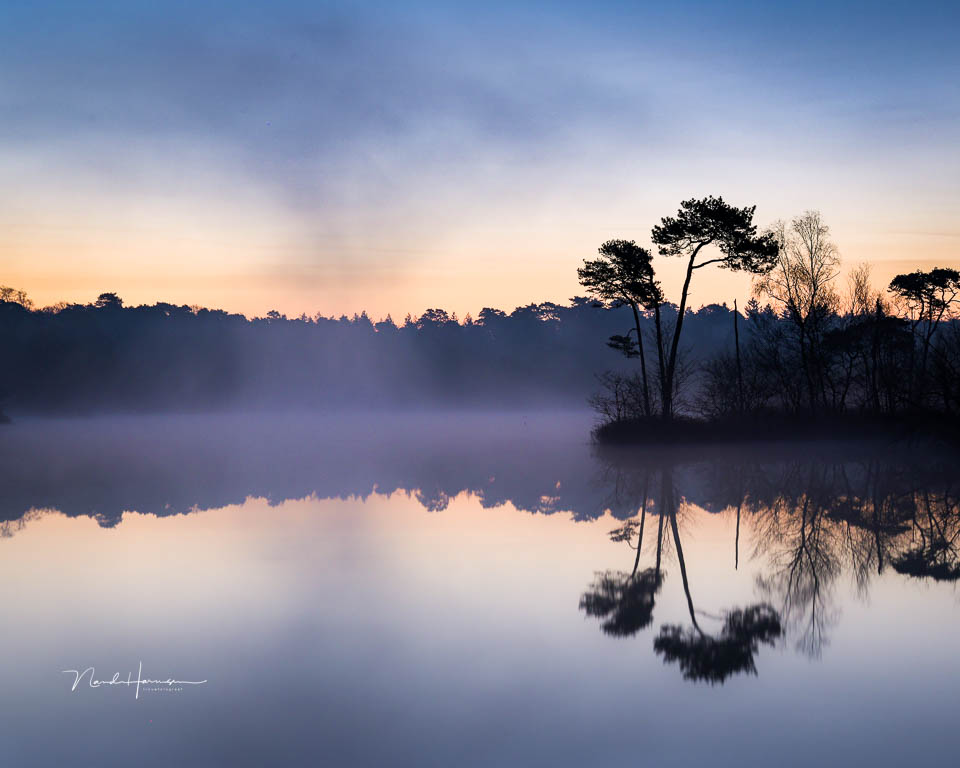
The camera is small, which can be difficult for people with large hands. The grip does make up for a lot, and the low weight gives you little reason to leave the camera at home. The EOS R8 has fewer buttons and dials than the more expensive versions. But this is largely compensated for by the quick menu, touchscreen and Q menu.
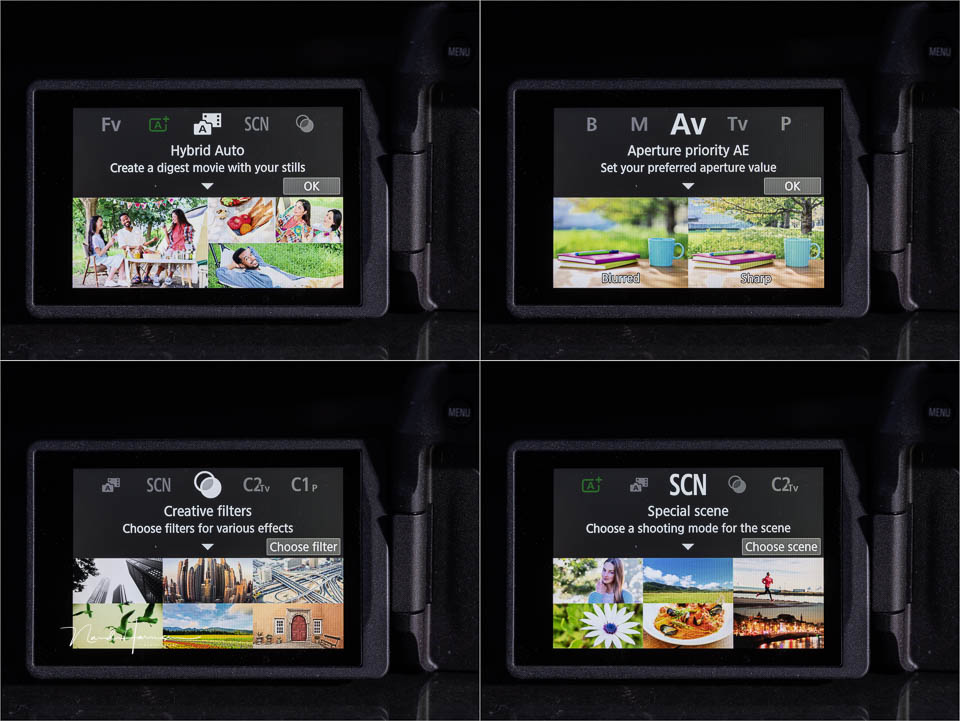
The menu offers the option of guiding you through the camera settings using information pages. This shows that this is also a camera suitable for photographers with slightly less knowledge. Creative setting options are also available when you photograph in jpeg.
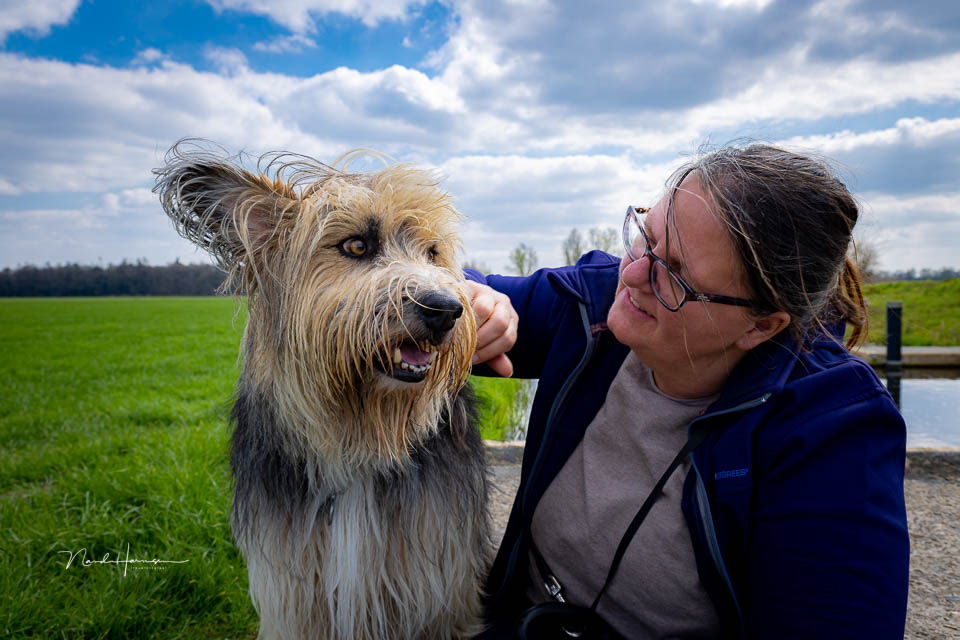
With all these capabilities, the EOS R8 is suitable for both beginners and advanced photographers. Are you looking for a modern, versatile full-frame mirrorless camera? Then the Canon EOS R8 is a very suitable camera. I can recommend it.
What I like
- Good grip, especially for a compact camera
- Weather-sealed construction
- Autofocus is no less capable than that of the more expensive Canon models
- Frame rate up to 40 frames per second
- RAW burst with half a second of pre-shooting
- Extra features such as multiple exposures, focus stacking, bulb timer and more
- Very good ISO performance and dynamic range
- Excellent touchscreen and the familiar Canon menu
- Can be used as a webcam
- 4K 50p video recording from 6K footage and up to 180 fps slow-motion recording in full HD
- Focus breathing compensation for video
What I like less
- Battery capacity
- No joystick
- Memory card location next to the battery
- AF-ON button position is not optimal
- Four-way button instead of a scroll wheel
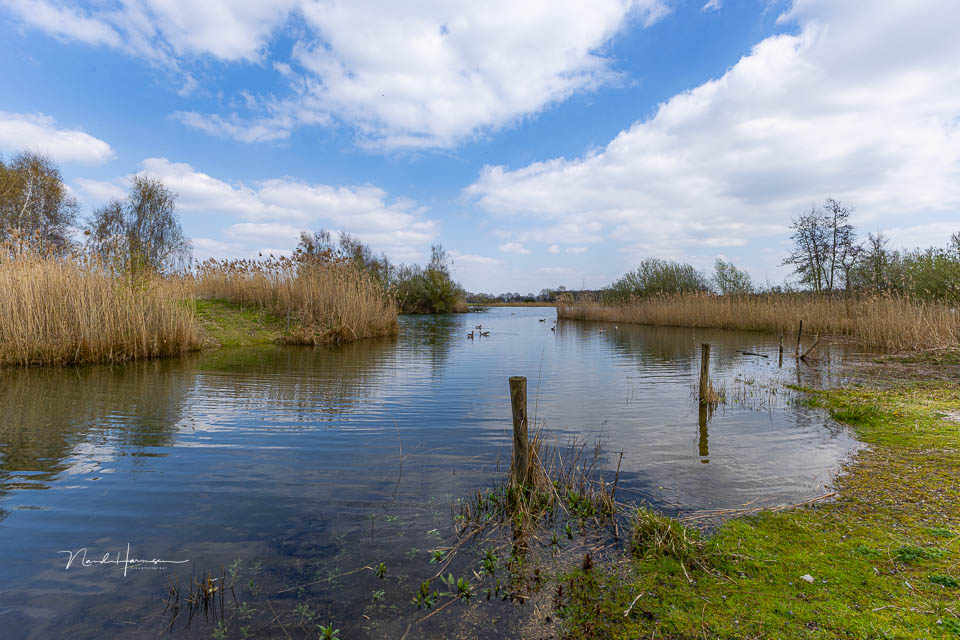
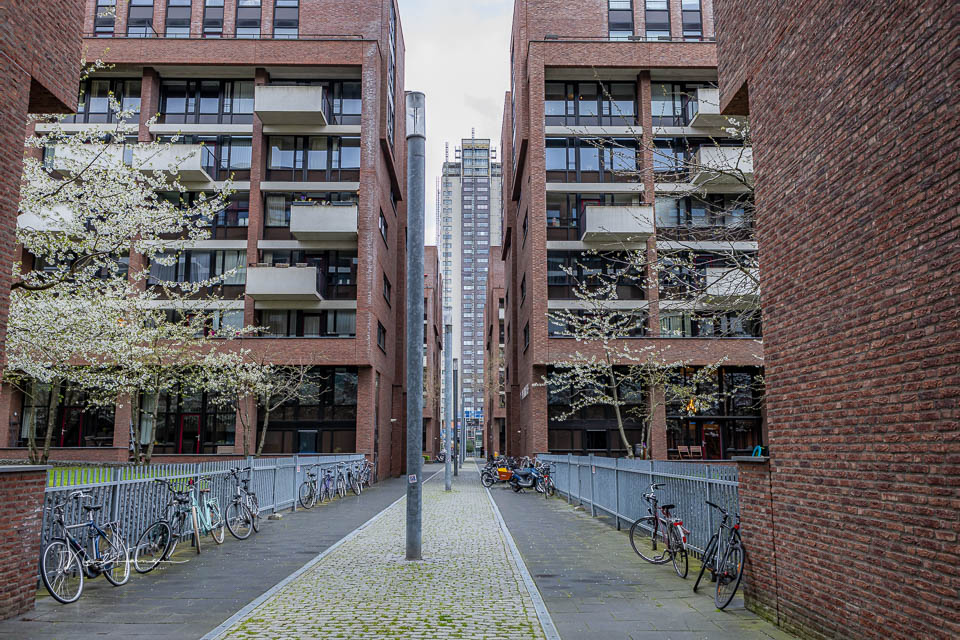
A brief word about video
Unfortunately, I did not have the opportunity to test the EOS R8 for video. Still, I would like to mention a few aspects. The camera records at a maximum resolution of 4K 50p. The entire sensor is used for this (6K recording). You can record in 10-bit C-log3, as well as HDR-PQ.
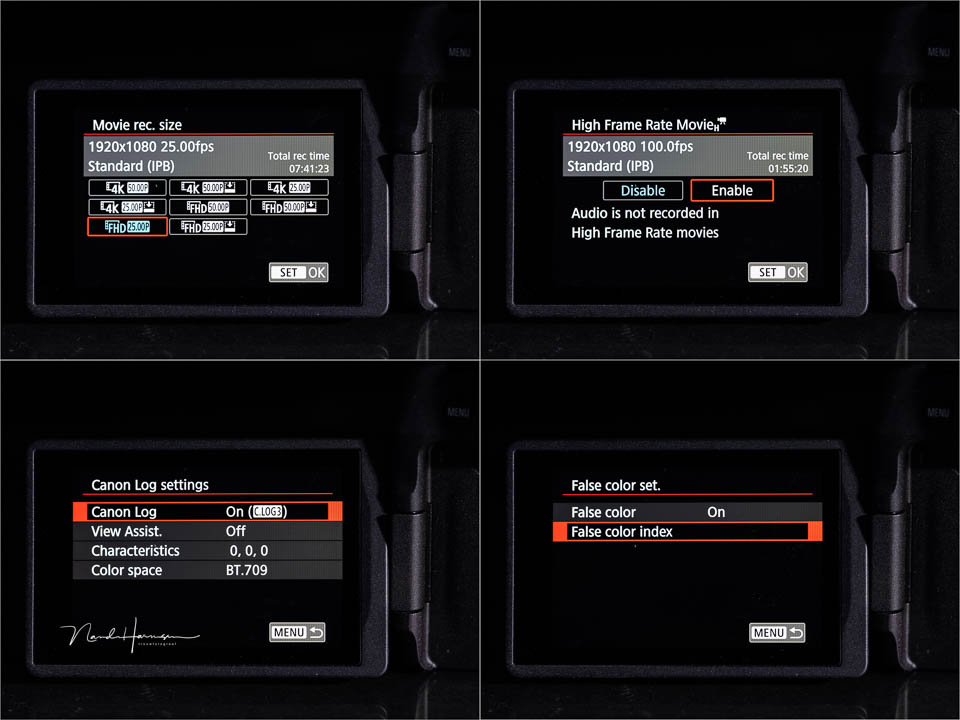
The addition of false colour is striking, as it allows you to control the exposure even better. In addition, the EOS R8 also has focus breathing compensation, and the camera can be used as a webcam.
This suggests that the camera is also very suitable for video. But, as mentioned, I was unable to test this due to a lack of time.
Comparison with the Canon EOS R6 mark II
If the Canon EOS R8 performs so well, is it still worth spending more money on a Canon EOS R6 mark II? Especially since the autofocus capabilities are the same or comparable to those of the more expensive sibling.
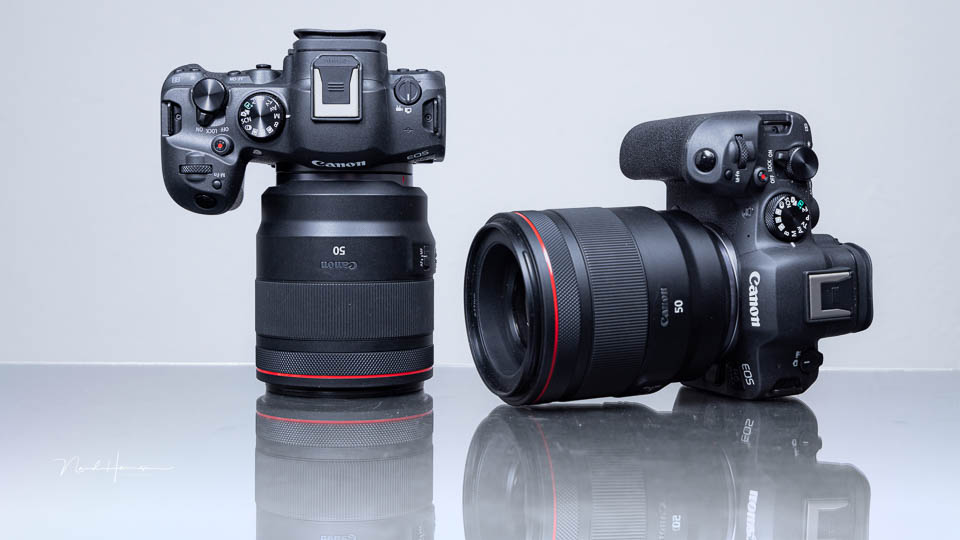
Although many features are the same or comparable, they are two different classes of camera. The EOS R6 mark II is larger and more robustly built, designed to withstand a knock or two. Its size allows for a better and more optimal button layout, including a joystick and a scroll wheel on the rear.
The battery capacity of the EOS R6 mark II is better, and a battery grip can be fitted underneath it. The camera also has space for two UHS-II SD cards. The electronic viewfinder is larger, with a higher resolution. And of course, the EOS R6 mark II has In Body Image Stabilization (IBIS).
Whether these differences are worth the extra cost to you is very personal. Only you can answer that. Often, the best way to decide is to hold both cameras in your hands.
About the author
Nando Harmsen has been photographing for more than 40 years. He specialises in wedding photography and landscape photography. Nando also gives talks, workshops, masterclasses and photo trips, and regularly reviews new and interesting equipment.
You might also like
-
 Review: Canon EOS R5
by Nando Harmsen
-
 Review: Canon EOS R10 mirrorless camera
by Nando Harmsen
-
 Review: Canon EOS R50 mirrorless camera
by Nando Harmsen
-
 Review: Canon EOS R7
by Nando Harmsen
-
 Review: Canon EOS R6
by Nando Harmsen
-
 Review of the fantastic Canon EOS R6 Mark II
by Nando Harmsen
6 comments
-
 Jan de Boer wrote on Tuesday 2 May 2023 at 16:22 | reply
thanks for your explanation, and beautiful Photos
Translated from Dutch.
very special
Jan de boer -
 Martin Smit wrote on Wednesday 3 May 2023 at 08:08 | reply
The article and the comparison with the R6 II are missing IBIS. The R8 is a beautiful camera, but it does not have sensor image stabilization.
Translated from Dutch. -

 Nando
wrote on Wednesday 3 May 2023 at 09:33
| reply
Nando
wrote on Wednesday 3 May 2023 at 09:33
| reply
Indeed, Martin. I forgot to mention that one. Thanks for this addition.
Translated from Dutch.
Also bear in mind that most lenses nowadays also have image stabilization. That makes the presence of IBIS no longer an indispensable option.
I've added it anyway. -
 Donald Willemsen wrote on Wednesday 3 May 2023 at 16:48 | reply
@Nando, in response to your comment to Martin about IBIS, I just want to mention that when both the body and the lens have image stabilization, you have more stops of leeway than with either one alone. So it can be an advantage to use both image stabilizations at the same time (also a disadvantage, by the way).
Translated from Dutch. -
Nando
wrote on Wednesday 3 May 2023 at 17:05
| reply
I don't believe that all lenses and bodies work together with image stabilization. In other words, it doesn't always add up and certainly not always by the same amount. Sometimes it only makes half a stop difference.
Translated from Dutch.
But IBIS and IS are overrated in many cases. What good is it to photograph handheld at 1/4 second when the movement of your subject itself requires at least 1/250 second to appear in the image without motion blur.
It's good for correcting camera shake, but nothing more. -
Donald Willemsen wrote on Wednesday 3 May 2023 at 20:19 | reply
What you say is correct Nando, but when that extra space is there, you can make use of it. Of course depending on the subjects and type of photography. That it doesn't work with all lenses is correct. Usually only with brand-specific lenses. My comment was simply an addition.Everyone does with it what they want.
Translated from Dutch.
Have your say
Please note: Articles older than a week can only be commented on by signed-in visitors.Would you still like to comment? sign in or create a free account.
Become a better photographer every week
A practical photography tip in your inbox every week.
38,982 photography enthusiasts already receive the tips! More about the weekly mail. Or keep up to date via  Facebook.

Elja Trum
Photofacts; everything to do with photography!
Would you like to take better photos and keep up with what is happening in photography? Photofacts publishes articles that teach you something about photography — from a product announcement to a practical shooting tip or a look at a website. Photofacts covers photography every day and is a hobby project of Elja Trum's that got out of hand. The articles are written by a team of volunteer authors. If you would enjoy writing one or more articles for Photofacts, do get in touch.More about PhotofactsPhotofacts is made possible in part by
