

The new Nikon Z6 and Z7 mirrorless cameras
Thursday 23 August 2018, 16:08 by Elja Trum | 10,841 views | 20 commentsThis article was translated from Dutch with the help of AI. Read the original.
Last month, Nikon announced two full-frame mirrorless cameras, the Nikon Z6 and Nikon Z7. With these cameras, Nikon is finally taking a serious step into the rapidly growing mirrorless camera market.
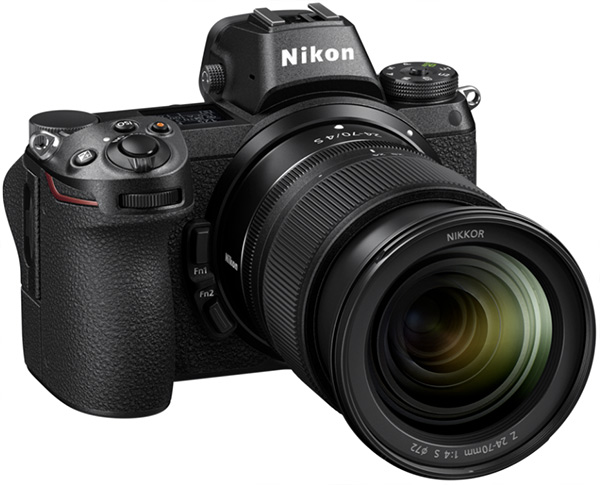
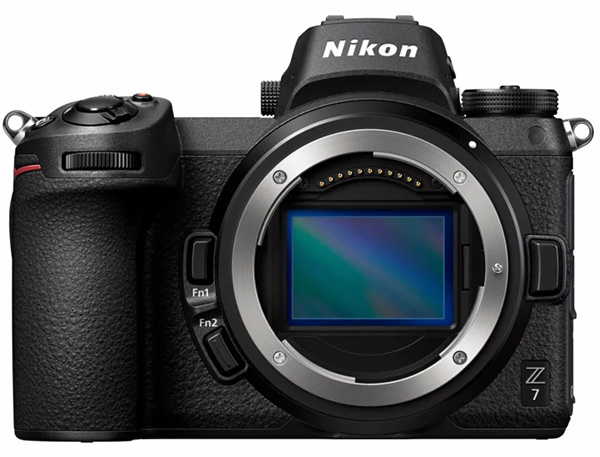
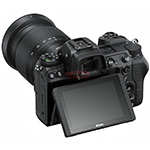
Two models were announced at the same time for Nikon's new Z-mount system. Externally, both cameras are identical, apart from the nameplate.
The difference is in the sensor. The Nikon Z6 has a 24.5-megapixel sensor, while the Z7 has a massive 45.7-megapixel sensor.
Specifications: Nikon Z7
- 45.7-megapixel BSI-CMOS sensor
- Built-in image stabilisation (5 stops)
- 493 autofocus points (90 per cent frame coverage)
- Sensitivity: ISO 64 to 25,600 (expandable to 102,400)
- 9 frames per second
- 3.69-million-dot electronic viewfinder
- 2.1-million-dot tilting display
- OLED top display
- XQD card slot
- UHD 4K video (30p)
- 10-bit 4:2:2 N-Log output via HDMI
- Wi-Fi and Bluetooth connectivity
- Weight: 675 grams
The Nikon Z6 is largely comparable to the Z7, but has a 24.5-megapixel sensor. Its sensitivity ranges from ISO 100 to 51,200. Instead of 493, it has 'only' 273 autofocus points. The Z6 can write its smaller files at 12 frames per second, making it just a little faster than the Z7.
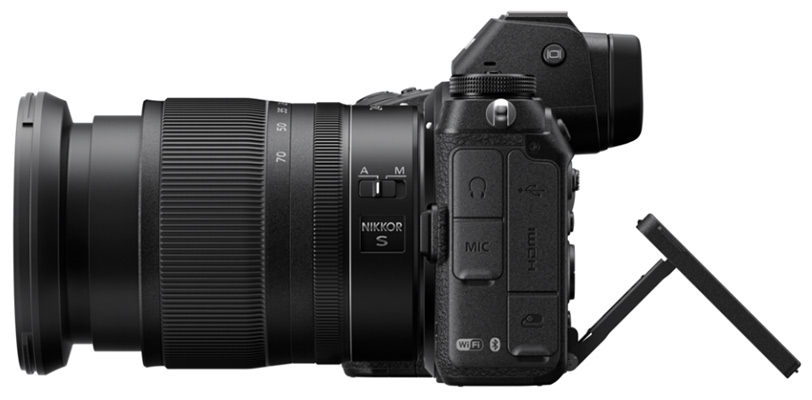
In the hand
The new Nikon mirrorless cameras feel good in the hand. The camera, and the grip, is just slightly larger than the Sony a7 mark III, which people with large hands will particularly appreciate. It also retains a little of the DSLR feel.
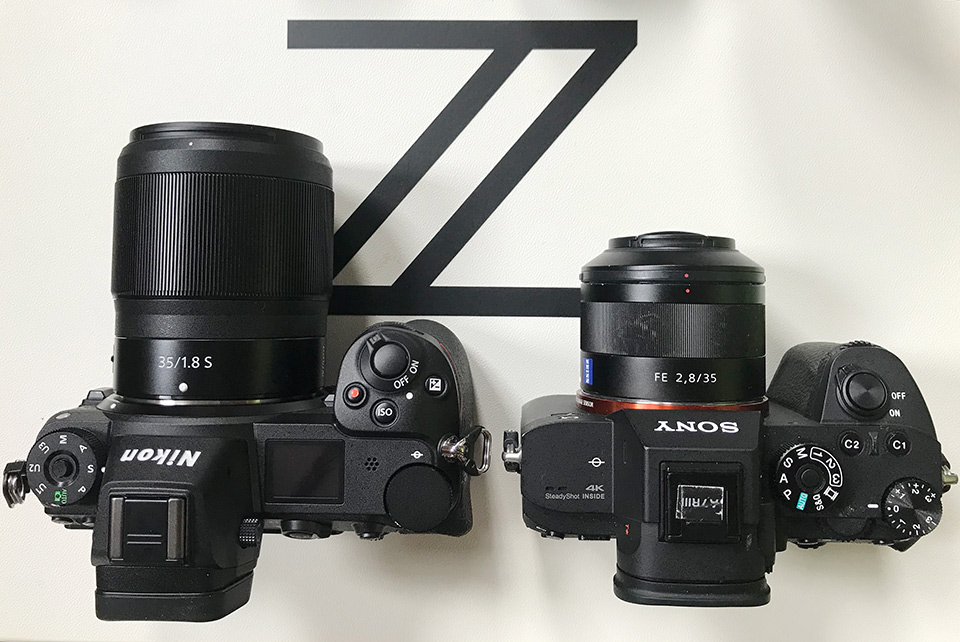
Nikon has done a good job of retaining the Nikon look and feel in this body. Many of the controls are also in familiar places for Nikonians.
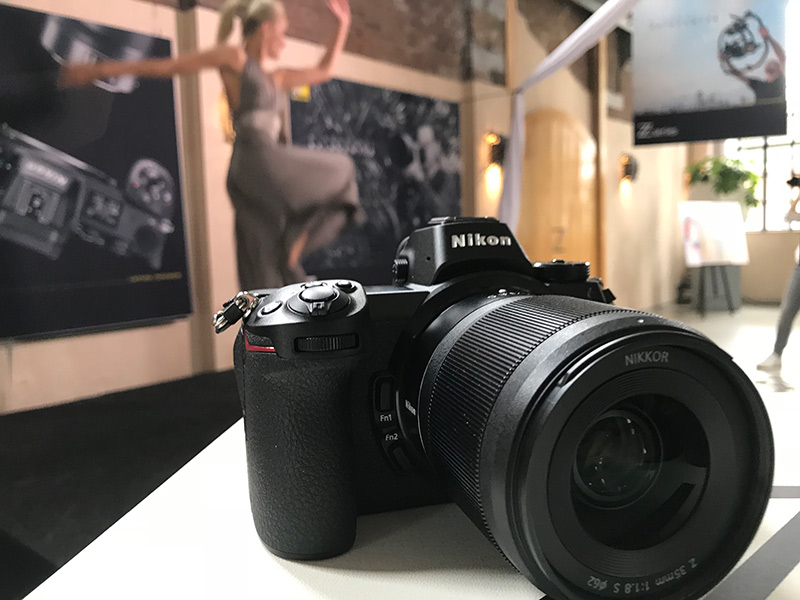
Nikon users will also get a familiar feeling when they dive into the menus. Nikon has kept these the same too. Switching over, or using a DSLR and mirrorless camera alongside each other, should therefore cause virtually no problems.
One thing else that caught my eye was that the display on top of the Nikon Z6 / Z7 unfortunately stays off when the camera is switched off. A small detail, but it would have been useful to quickly check some information while the camera is switched off, such as the battery status and the number of photos you can still take.
Z mount
This new mirrorless camera also comes with a new mount. If the old mount had been used, the lenses would have had to be considerably larger. That would have been a shame for the compactness of the system.
Nikon has made the new mount larger than the old one straight away. This means Nikon can make faster lenses more easily than before, and image quality could also be slightly better.
The electronics have of course also been brought up to date. The design of the F mount dates back to the 1980s, and naturally a lot has changed since then. Communication between lens and camera can therefore now be much faster.
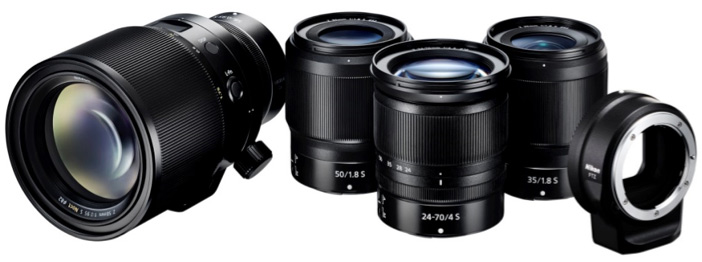
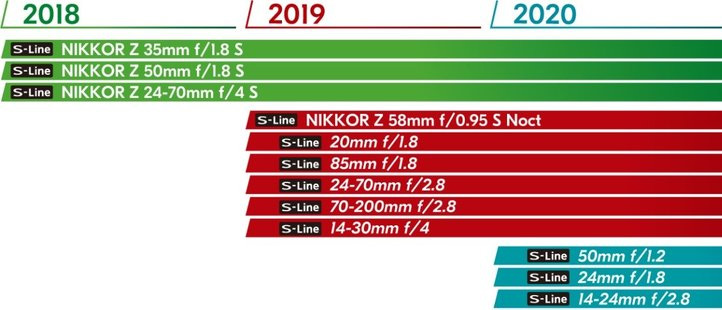
The disadvantage of the new mount is that new lenses are also needed. Initially, three lenses will be released for the system, but the number of available lenses will grow over time.
FTZ Adapter
Fortunately, Nikon has also released an F-mount to Z-mount adapter straight away, called the FTZ adapter (F To Z adapter). With this adapter, you can continue using your existing F-mount lenses on this new mirrorless camera without losing quality or functionality, at least with existing AF-S and AF-I lenses.
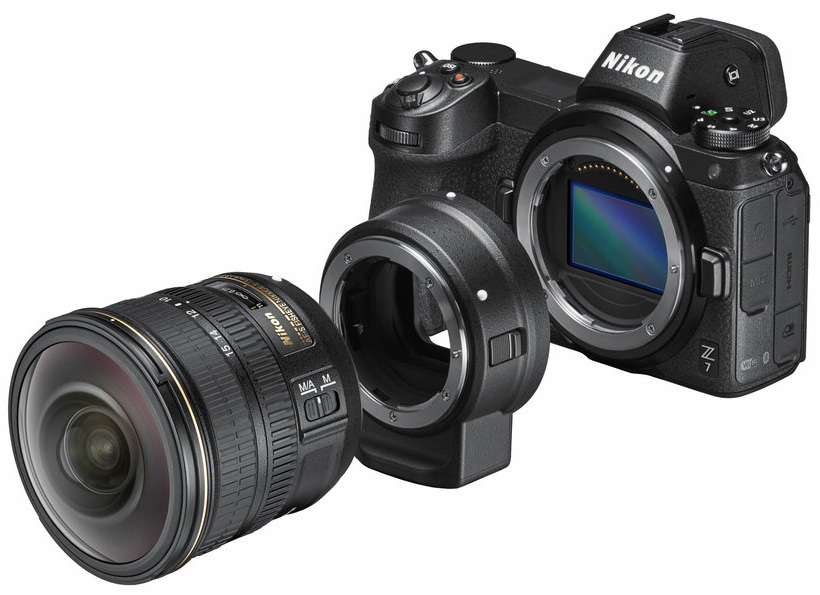
The adapter is nice and light and feels robust. At 299 euros, it is also fairly affordable. For most Nikon photographers, this will be a necessary adapter when switching to Nikon's mirrorless camera.
XQD cards
For this camera, Nikon has chosen XQD instead of the familiar SD(XC). That means you will need a new collection of memory cards and card readers. Initially, Nikon will include a memory card as standard when buying the Nikon mirrorless cameras.
In the future, CFast should also be usable, after a firmware update. Both standards are faster than SD, and the cards themselves are also more robust. In practice, it is of course still a changeover.
It may be noticeable that there is only one memory card slot. Especially in combination with this unusual memory card. Personally, I hardly ever use a second card slot, but many photographers like to write a backup to a second card straight away during important shoots.
Price and availability
The Nikon Z7 is due to be in shops at the end of September and will cost 3,699 euros. The Z6 will also be available from the end of November. It has a recommended retail price of 2,299 euros.
The Nikkor Z 24-70mm f/4 will cost 1,099 euros. A kit consisting of the Z7 and the zoom lens will cost 4,299 euros.
The Nikkor Z 35mm f/1.8 S costs 949 euros and this lens is due to be in shops at the end of September. The Nikkor 50mm f/1.8 S will appear at the end of October and cost 679 euros.
The Mount Adapter FTZ will be available at the end of September 2018 for a recommended retail price of 299 euros including VAT.
Provisional conclusion
With these two new cameras, Nikon is taking a convincing step into the mirrorless camera segment. It was about time, but it is good to see that they have got it right straight away.
There are still a few small details where the competition, namely Sony, seems to do better. Ultimately, real-world tests will have to make the advantages and disadvantages of the different brands clear.
The Nikon Z6 and Z7 leave a good first impression, and I can actually no longer see a reason why you, as a Nikon photographer in the high-end segment, would choose a DSLR over these new mirrorless cameras.
There are of course exceptions, but I think 95 per cent of all photographers looking for, for example, a D750 or D850 would be better off choosing these new mirrorless cameras.
About the author
Elja Trum is the founder of Photofacts and online photography course website Photofacts Academy. He has been writing about photography since 2006. Elja is also the author of (Dutch) books on composition, black-and-white photography, flash photography and portrait photography.
You might also like
-
 Nikon Z 50, Nikon's latest addition to the Nikon Z family
by Michelle Peeters
-
 Nikon announces the Z 6 II and Z 7 II
by Nando Harmsen
-
 Nikon announces new flagship, the Z 9
by Nando Harmsen
-
 Review: Nikon Z 6 full-frame mirrorless camera
by Michelle Peeters
-
 Nikon introduces the Z6 III mirrorless camera
by Nando Harmsen
20 comments
-
 John Boutsen wrote on Thursday 23 August 2018 at 18:34 | reply
Wait for the extensive tests and then consult once more with my financial director (read wife) and then ............
Translated from Dutch. -

-

 ErikvanRosmalen
wrote on Friday 24 August 2018 at 07:51
| reply
The lack of a second card slot is a drawback for many pros, especially in the world of wedding photography, for example, I understandably hear a lot of surprise about it. Have you heard anything about the battery capacity? It would only guarantee 330 photos, which also seems quite limited to me?
Translated from Dutch. -
 Mac wrote on Friday 24 August 2018 at 08:30 | reply
Are the lenses really smaller than for a DSLR? And is the system really much more compact?
Translated from Dutch. -
Rick wrote on Friday 24 August 2018 at 08:32 | reply
In my humble opinion, a camera without a second card slot is an absolute no-go for a professional, and I don't think I'm the only one who thinks that way. A 3,700-euro Nikon Z7 body should certainly have this, this camera doesn't seem to be aimed at the average consumer at all... This alone will cost them, as Erik also says above, many wedding photographers, among others.
Translated from Dutch.
In terms of specs, a beautiful and promising camera otherwise, I'm curious about the real-world reviews.
@elja, the megapixel count of the Z6 is listed in the specifications of the Z7 -
Elja Trum
wrote on Friday 24 August 2018 at 08:41
| reply
@Erik; Yes, a good point. The battery life does indeed seem to be 330 shots. That's on the low side, somewhat comparable to Sony's previous a7 models.
Translated from Dutch.
Not really a problem in itself, as long as you always have two extra charged batteries with you.
These currently seem to be the two main drawbacks of the system: limited battery life and the lack of a second memory card slot.
@Rick; Thanks, I corrected the mistake.
@Mac; The lenses that have been released now do seem somewhat more compact to me. But it's a bit difficult to compare without also looking at quality. Nikon says the quality is better and seems to achieve that with smaller lenses.
The 24-70 f/4 is, for example, much smaller than Sony's 24-70 f/4. But if that smaller size results in poorer performance, photographers won't quickly see it as an advantage.
I do expect that you will get at least the same quality you're used to in a much more compact body/lens combination. There were also some photographers walking around at the event with (professional) Nikons and those things really looked enormous compared to the Nikon Z-series models. -
Mac wrote on Friday 24 August 2018 at 09:54 | reply
Well, in my opinion it's not too bad me that the lezen compact are.
Translated from Dutch. -
Elja Trum
wrote on Friday 24 August 2018 at 10:02
| reply
@Mac; Handy site for a comparison indeed!
Translated from Dutch.
Still, the difference feels bigger in practice than it appears here at the moment. I would especially recommend experiencing it in practice in the store (or perhaps at the Photokina fair beforehand).
But, as you can also see in the photo in the article, a Sony a7 is clearly still a lot more compact, especially if you put a compact lens on it (Sony also has large lenses for the E-mount). -
 Henk Hulshof
wrote on Friday 24 August 2018 at 12:43
| reply
nice piece to read Elja, this is a development I’m keeping an eye on.
Translated from Dutch.
Only 330 photos on one battery is definitely 'a thing' for me (when I photograph weddings).
I do miss info about the AF technology... isn’t that precisely the point where they fall short compared to the Sony A7III ? -
 100
wrote on Friday 24 August 2018 at 14:30
| reply
«If the old mount had been used, the lenses would namely have had to become quite a bit larger. »
Translated from Dutch.
Why?
If the camera had an F-mount, the distance from the flange to the sensor would be much greater (46.5mm instead of 16mm for Z-mount), so the camera would be much thicker. The problem with F-mount is that the opening is too small for modern glass faster than f/1.4. The 55mm of the Z-mount makes it possible to use, for example, f/0.95 (like the announced 58mm f/0.95).
F-mount, incidentally, does not date from the 1980s but from 1959
«In this camera, Nikon chose XQD instead of the familiar SD(XC).»
XQD is not really new for Nikon… D4, D4s, D5, D500 and D850 already use these cards.
XQD, incidentally, is not compatible with CFast but with CFexpress.
«Of course there are exceptions, but I think that 95 percent of all photographers who are in the market for, for example, a D750 or D850 would be better off going for these new system cameras.»
First generation, few “native” lenses available for the time being, only one card slot, battery life is problematic (330 photos or 15minutes of video on a full battery), limited buffer capacity, 9 fps (Z7) sounds fast, but that 9 comes with limitations, without limitations it is only 5.5 fps…
Of course, there are also the necessary advantages, but I don't think that at this point those are important enough for 95% of all photographers to switch immediately. -
 Beno Munneke wrote on Tuesday 28 August 2018 at 12:37 | reply
Elja, a question
Translated from Dutch.
what is the advantage of a mirrorless camera over a DSLR?
(regarding your comment about that 95%...) -
Elja Trum
wrote on Tuesday 28 August 2018 at 13:02
| reply
@Beno; The main advantage in my view is that you can see exactly what the photo will look like directly through the viewfinder. At least, usually. Only in exceptional cases (such as long shutter speeds and flash photography) not.
Translated from Dutch.
This removes a step that can currently take a lot of time. With a DSLR, you take the photo, briefly check on the display whether it turned out well and possibly adjust settings to achieve the desired effect.
With an electronic viewfinder, before taking the photo you can see exactly the image you are going to get: the depth of field you have set and the exposure.
This helps you -in my opinion- enormously to photograph more creatively. You have direct feedback about the camera settings, meaning you also have to spend much less time thinking about them. That gives you time to pay more attention to your composition and, for example, interaction with your subject. -
 Eric de Kuijper wrote on Tuesday 28 August 2018 at 14:22 | reply
I am glad that I made the switch to Sony. I hesitated about waiting, but these two cameras confirm that I made the right decision to switch.
Translated from Dutch. -
 Peter heins wrote on Tuesday 28 August 2018 at 23:43 | reply
As already mentioned above, we shouldn't glorify the mirrorless camera too much . battery life and EVF remain a disadvantage. EVF especially with studio photography , then I go back to my DSLR because on the mirrorless camera the image remains black with the manual settings. And these 2 cameras are more for the pros I think when you see the prices. €299 for an adapter. I think that's quite a lot. Besides, I wonder what you need 47MP for , most bridal couples have an album made , which is at most 40X40cm and maybe print 1 large photo in canvas format. Seems a bit unnecessary to me,we're really going overboard I think. With 24Mp you can manage just fine , I can already see every little decoration on a wedding dress when I look at 100%, so why would you want even more mp's? the bridal couples are happy with the quality delivered now too, aren't they?
Translated from Dutch. -
Elja Trum
wrote on Wednesday 29 August 2018 at 09:18
| reply
@Peter; If it's (still) not for you, then that's of course completely fine too. It's also not the case that something is suddenly wrong with a DSLR now.
Translated from Dutch.
The mirrorless camera has, however, now matured and there are virtually no practical reasons left why you would still choose a DSLR over a mirrorless camera.
I would even say that the tipping point has been reached and that a mirrorless camera now offers more advantages than a DSLR. That doesn't make the DSLR worse, but it does make the mirrorless camera an interesting option.
Every mirrorless camera has an option that allows you to use it perfectly well in a studio. You then no longer see the real-time image you would get with the selected camera settings, but simply a 'general' image. Assign this setting to a function button and you can switch effortlessly to the studio setup.
24 megapixels is fine, until you've worked with 47 megapixels for a few weeks. When you go back, you soon miss details when post-processing. Editing a photo is simply more enjoyable when you have more image information.
@Eric; Nikon has not yet released a direct 'Sony killer', at least. If you have Sony now, then there is no reason at all to switch. If you currently have everything from Nikon, then I think the Z6 and Z7 are more interesting options than switching to Sony now. The specs differ minimally in that respect.
In practice, the Z6's battery also turns out to last for 750 photos, for example. -
 Michel wrote on Wednesday 29 August 2018 at 11:22 | reply
It is very interesting to follow this development as a Nikon user. I just can't find anywhere whether the "third-party" lenses also work fully with the FTZ adapter. Does anyone know if the Sigma line (not the ART line) also works with full AF
Translated from Dutch. -
 Guy Peeters wrote on Wednesday 29 August 2018 at 14:03 | reply
I have now been photographing for 4 years with my Nikon D7100 and in my humble opinion I'm already doing quite well at it , this after 3 years of evening school and the wonderful courses on Photofacts.
Translated from Dutch.
I'm looking forward to something new now and have set my sights on the Z6. I only still have the question , why switch to FF and a rather expensive camera like the Z6. If the photo from my D7100 doesn't really turn out well I run it through Lightroom or PS and …. great, right. Can you convince me why to switch to FF , I am in favor of a mirrorless camera. -
Elja Trum
wrote on Wednesday 29 August 2018 at 15:11
| reply
@Michel; Good question. I haven't seen the answer to that anywhere yet either. But there will surely be people who are going to try that in the short term.
Translated from Dutch.
@Guy; Perhaps this article about the advantages of a full-frame camera will be of some use to you. -
100
wrote on Wednesday 29 August 2018 at 23:29
| reply
@Michel
Translated from Dutch.
Jared Polin tried out the 50 f/1.4 Art and it worked.
Video at around 7:20. -
 info@edleatemia.nl
wrote on Tuesday 4 September 2018 at 11:36
| reply
Hi Elja, I was planning to get a D750, but am now waiting for the Z6. My question is what the possibilities are for transferring the photos to my Macbook, since it has an SD slot.
Translated from Dutch.
Thx, Ed

Have your say
Please note: Articles older than a week can only be commented on by signed-in visitors.Would you still like to comment? sign in or create a free account.
Become a better photographer every week
A practical photography tip in your inbox every week.
38,890 photography enthusiasts already receive the tips! More about the weekly mail. Or keep up to date via  Facebook.

Elja Trum
Photofacts; everything to do with photography!
Would you like to take better photos and keep up with what is happening in photography? Photofacts publishes articles that teach you something about photography — from a product announcement to a practical shooting tip or a look at a website. Photofacts covers photography every day and is a hobby project of Elja Trum's that got out of hand. The articles are written by a team of volunteer authors. If you would enjoy writing one or more articles for Photofacts, do get in touch.More about PhotofactsPhotofacts is made possible in part by
