

Review: PolarPro ND100000 filter, very long shutter speeds
Friday 16 November 2018, 12:06 by Wiebe de Jager | 5,348 views | 3 commentsThis article was translated from Dutch with the help of AI. Read the original.
As a drone photographer and filmmaker, I have gratefully used various PolarPro products for several years, including ND filters for the various drones I work with. For some time now, the company has also offered full-frame filters for mirrorless and DSLR cameras.
That would not be particularly remarkable, were it not for the fact that there are some special filters among them. PolarPro now offers an ND filter with a value of 100,000 (one hundred thousand!) in its range. That lets you achieve highly creative results as a photographer, and it prompted me to get started with this filter.
Neutral Density
Conceptually speaking, an ND filter, also known as a grey filter, is not particularly exciting. ND stands for 'neutral density', which means that the filter blocks light as evenly as possible, preferably without any colour cast.
The extent to which such a filter blocks light depends on the number given by the manufacturer. An ND4 filter lets 1/4 of the incoming light through, while an ND16 filter lets through just 1/16 of the light falling on the lens opening.
Normally, I mainly use ND filters when recording video, to ensure that the amount of light falling on the sensor of my (drone) camera stays reasonably within limits on a bright day.
The advantage is that, with the aperture unchanged, you can work with a longer shutter speed. That in turn produces a more cinematic image. Think of the familiar rule of thumb: the ideal shutter speed is twice the frame rate.
As a photographer, I also occasionally get out my ND filters, but only the stronger varieties. The stronger the filter, the longer the shutter speed, and that lets you play creatively with moving elements in your photo.
Take a photo of a waterfall, for example. Only with a strong ND filter can you achieve that beautiful silky-smooth rendering of the churning water during the day. This is even possible with drone photography, as you can read in this article.
ND100k
Anyone who works a lot with drones, like me, will undoubtedly know the name PolarPro. This relatively young brand was the first company to focus on developing filters specifically for drones.
And successfully so. The brand has benefited greatly from the rapid development of drones and has grown into a major player in the field of ND filters, polarisers and drone accessories.
The knowledge the company has gained from producing high-quality drone filters is now also being applied to making filters for ordinary mirrorless and DSLR cameras. But PolarPro seems to be focusing mainly on a niche market, namely the market for very powerful filters.
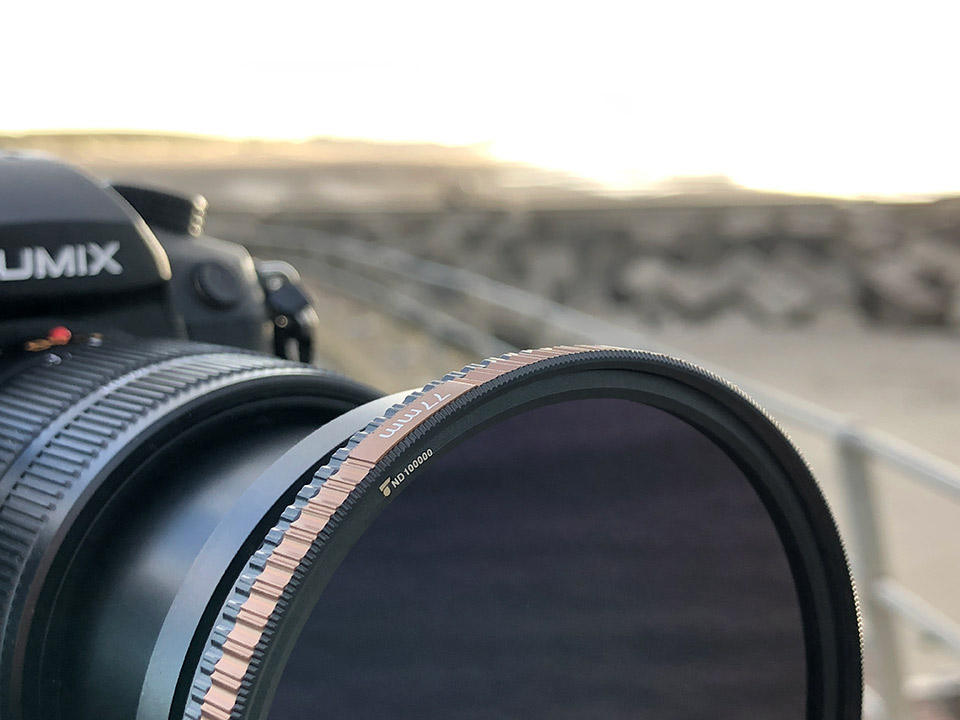
This is clear from the fact that PolarPro recently added an ND100000 filter to its QuartzLine series. This filter lets through just 1/100,000 of the light falling on the lens opening, which is a light reduction of 16.5 f-stops.
Such an exceptionally powerful filter brings interesting possibilities for photography. It lets you make your camera's shutter speed many times longer.
In broad daylight, you can work with normal ISO and aperture settings and shutter speeds of several tens of seconds. This allows you to smooth out all the moving elements in your composition, so to speak.

To the sea
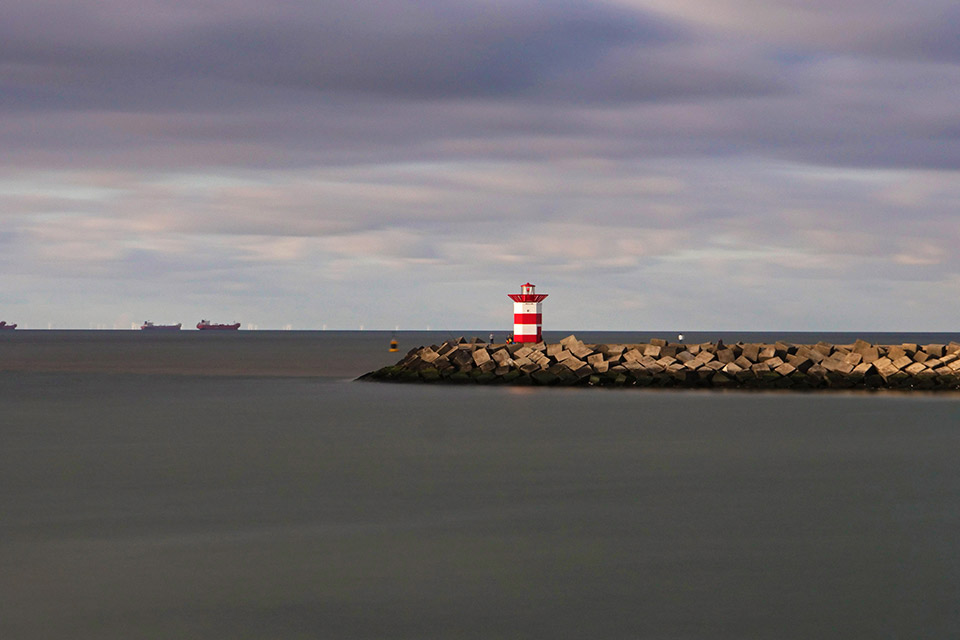
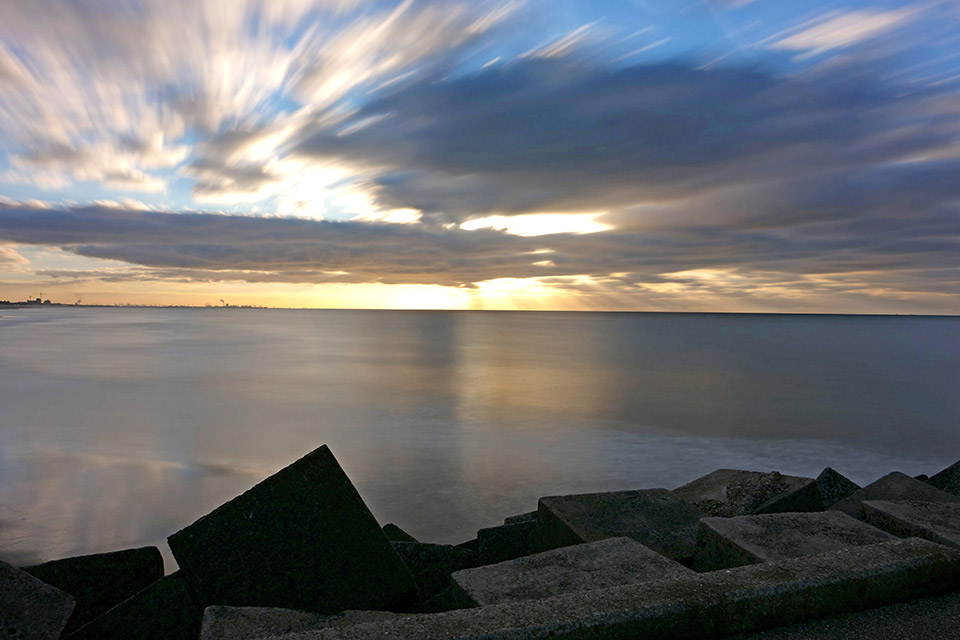
As a resident of The Hague, it was an obvious choice to head to the sea with such a strong filter for this review. I thought it would be fun to show how you can completely filter out the movement of the waves and the reflections on the water.
I chose the southern harbour wall of Scheveningen harbour as my setting, which is always good for photogenic images. Other suitable subjects and settings for long-exposure photography include cloudscapes, waterfalls and urban landscapes, where you can smooth out moving pedestrians and cars, so to speak.
For this session, I photographed with a Panasonic GH5 mirrorless camera and a 12-60mm F/2.8-4.0 Leica lens. It has a 62 mm filter thread, while the filter I wanted to test has a 77 mm filter thread.
Fortunately, PolarPro also supplies a step-up ring, so you can use the ND100000 with its 77mm filter thread on a lens with a smaller diameter. You screw the conversion ring onto the lens, and then screw the filter onto that.
When you take the filter out of the supplied case, its strength is immediately obvious. A filter with a factor of 100,000 lets virtually no light through.
If you look through the filter at the bright sun with the naked eye, you can do so without any problem. The rest of the surroundings are almost completely black. That is promising!
Adjusted workflow
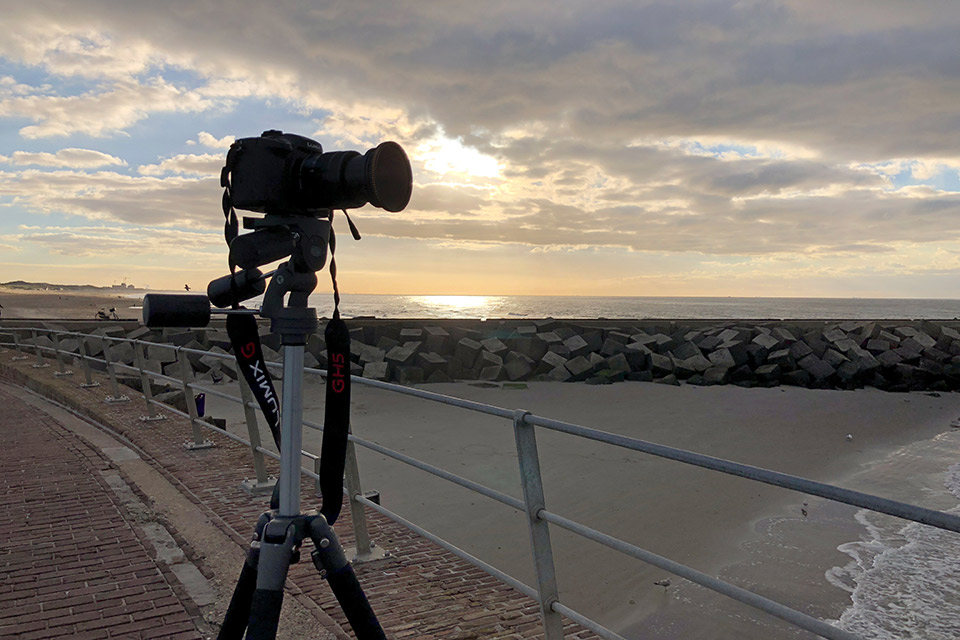
This huge reduction in light does have some consequences for your workflow. First of all, it goes without saying that you can only take photos when using a solid tripod.
With a shutter speed of several tens of seconds, your camera must remain rock steady, fixed on the subject you are photographing, without any movement or vibration. Secondly, it is useful to use a remote or the timer function to prevent pressing the shutter button from causing movement.
The main difference in the workflow, however, is that with the filter on the lens you can no longer see whether the focus is correct or what the composition looks like. The filter blocks so much light that you can barely see anything on the preview screen or through the viewfinder.
This means that you first need to determine your composition and focus without the filter. Then attach the filter, set your desired exposure settings and take the photo.
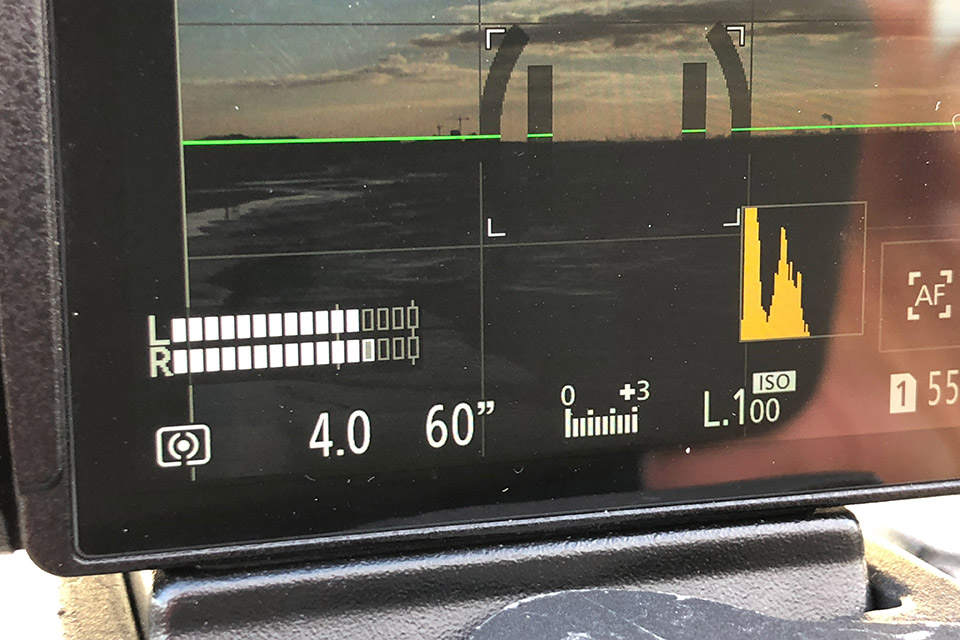
Determining the correct exposure also works somewhat differently from normal. In any case, it is advisable to set your camera to manual exposure, so you can set the ISO, aperture and shutter speed as you wish.
Depending on the accuracy of your camera's exposure metering, you can use the suggested values shown on the screen, but it takes some trial and error to achieve a correct exposure. It is also best to set the white balance manually.
Patience
You need quite a lot of patience when working with very long shutter speeds. Especially if, as with the GH5, you use noise reduction, because every photo with a one-minute shutter speed requires another minute for noise reduction to be applied.
Around sunset, when there is still a reasonable amount of light, you soon get shutter speeds ranging from several tens of seconds to a minute or even longer when using typical ISO values, say up to ISO 400, and apertures up to f/8.
And since your first photo almost never gives you the desired result straight away, you can quickly spend several minutes on every photo.
But the results make it worthwhile. The most fun is to photograph subjects where part of the image remains static, such as buildings or other fixed objects, while another part of the subject is moving.
Think of the moving sea or passing cloudscapes, where the silky-smooth colour gradations contrast nicely with the hard lines of the static subjects.
Conclusion
Admittedly, an ND100000 filter is not exactly cheap. This is due to the complex production process. The 16 light-blocking coatings in total have to be applied very evenly, which requires carefully controlled production.
PolarPro seems to have mastered this well. At least, I could not detect any visual deviations or fluctuations in the exposure in my photos.
It is good that PolarPro supplies a practical, foam-lined storage case, a lint-free lens cloth and a pouch with the filter. The ND100000 is available in various filter sizes, 37, 46, 67, 77 and 82 mm, but thanks to separately available step-up rings you can also use the filters on lenses with other diameters.
If you want to get started with extremely long shutter speeds in daylight, the PolarPro QuartzLine ND100k is a good choice. Make sure you have a sturdy tripod and, if necessary, a cable release or remote for your camera.
It takes some searching to find subjects that work well for long-exposure photography, but once you have found them, you can achieve highly creative results with this filter.
Thanks to Degreef & Partner for making this review possible. View the full PolarPro range.
About the author
Wiebe de Jager is dronefotograaf en videomaker. Op Dronewatch.nl schrijft hij dagelijks over de ontwikkelingen op het gebied van drones. Wiebe is tevens auteur van de boeken Dronefotografie, Dronevideo's maken en 360º-graden fotografie en -video. Via YouTube zie je zijn recente foto's en video's.
You might also like
-
 Review: Haida M10 Insert Variable ND filter
by Nando Harmsen
-
 Review: Sony A7 IV
by Nando Harmsen
-
 Review: Canon EOS R6
by Nando Harmsen
-
 Review: Canon EOS R8 full-frame mirrorless camera
by Nando Harmsen
-
 Review: Sony ZV-E10 vlog camera
by Nando Harmsen
-
 Review: Canon EOS R50 mirrorless camera
by Nando Harmsen
3 comments
-
 Oscar Kramer wrote on Tuesday 20 November 2018 at 15:21 | reply
Thanks for the clear explanation. I’m going to get to work to make something beautiful of it too. Kind regards, Oscar
Translated from Dutch. -
 guest wrote on Tuesday 20 November 2018 at 20:18 | reply
Wiebe, thanks for the information. After reading it, I wonder whether the results of the filter discussed are (more or less) identical to using a 10 f-stop and a 6 f-stop HD filter on top of each other.
Translated from Dutch.
Henk -

 wdejager
wrote on Wednesday 21 November 2018 at 10:38
| reply
Hello Henk, you can indeed 'stack' filters, but that doesn't improve image quality. First, you have a greater chance of unwanted reflections/ghosting, and secondly, you may experience vignetting (depending on the size of the filters). And also bear in mind that in photography the following applies: the fewer obstacles the photons encounter on their way to the sensor, the better.
Translated from Dutch.
Have your say
Please note: Articles older than a week can only be commented on by signed-in visitors.Would you still like to comment? sign in or create a free account.
Become a better photographer every week
A practical photography tip in your inbox every week.
38,937 photography enthusiasts already receive the tips! More about the weekly mail. Or keep up to date via  Facebook.

Elja Trum
Photofacts; everything to do with photography!
Would you like to take better photos and keep up with what is happening in photography? Photofacts publishes articles that teach you something about photography — from a product announcement to a practical shooting tip or a look at a website. Photofacts covers photography every day and is a hobby project of Elja Trum's that got out of hand. The articles are written by a team of volunteer authors. If you would enjoy writing one or more articles for Photofacts, do get in touch.More about PhotofactsPhotofacts is made possible in part by
