

Review: Haida M10 Insert Variable ND filter
Friday 6 November 2020, 20:02 by Nando Harmsen | 7,379 views | 7 commentsThis article was translated from Dutch with the help of AI. Read the original.
Do you ever use neutral density filters? The dark pieces of glass you place in front of your lens block light, forcing you to use longer shutter speeds.
This allows you to take special photos in which the movement of clouds or water is beautifully visible.
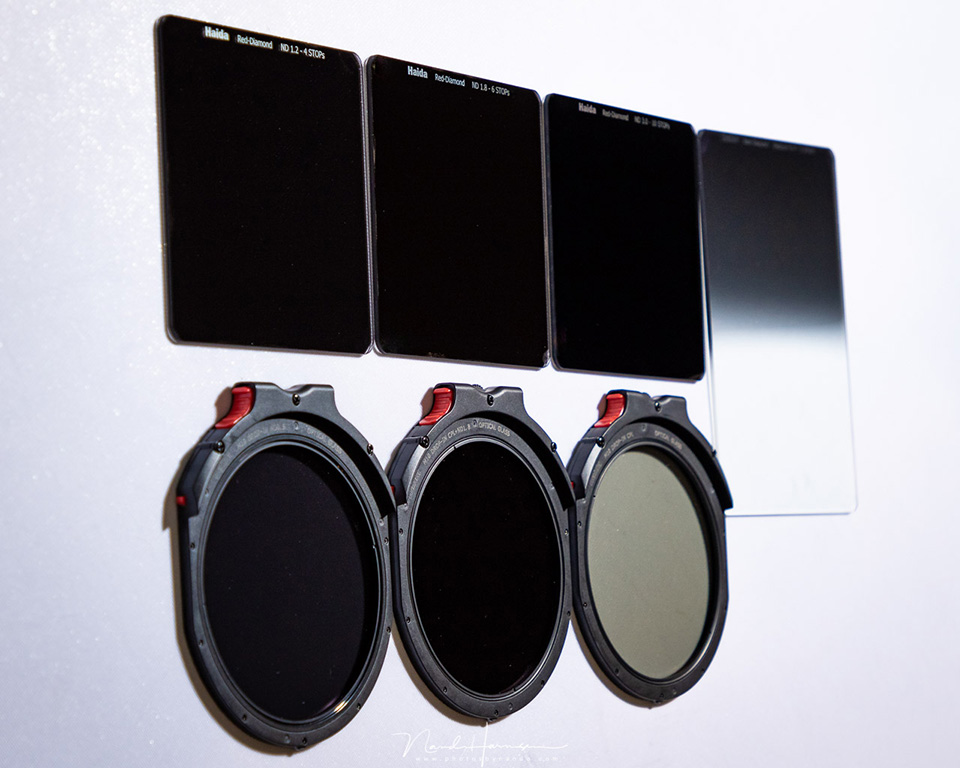
There are neutral density filters available in many different strengths, ranging from two stops to as many as 20 stops, the filter I recently wrote a review of.
Usually, a three, six and ten-stop filter makes a good combination with which you can practise almost all types of long-exposure photography.
Would you like to know more about long-exposure photography? I have an extensive Long Exposures video course on Photofacts Academy, covering everything about this type of photography.
There may be situations where a neutral density filter produces a shutter speed that is too long, while a less powerful neutral density filter produces a shutter speed that is too short.
You really want a shutter speed somewhere in between, but you do not have a neutral density filter for it. You then have to change the ISO, which may not be the ideal solution. Wouldn't it be nice to have a variable neutral density filter?
Haida sent me a pre-production variable neutral density filter to review. It is a new filter intended for use with a filter holder. Its name is the Haida M10 Insert Variable ND filter.
The Haida M10 Insert Variable ND filter
Normal variable neutral density filters are screwed onto your lens, and you turn a ring that rotates two polarising filters in relation to each other. A polarising filter lets light through in one direction and blocks all other directions.
With two polarising filters, it is possible to block two directions, drastically reducing the amount of light that gets through.
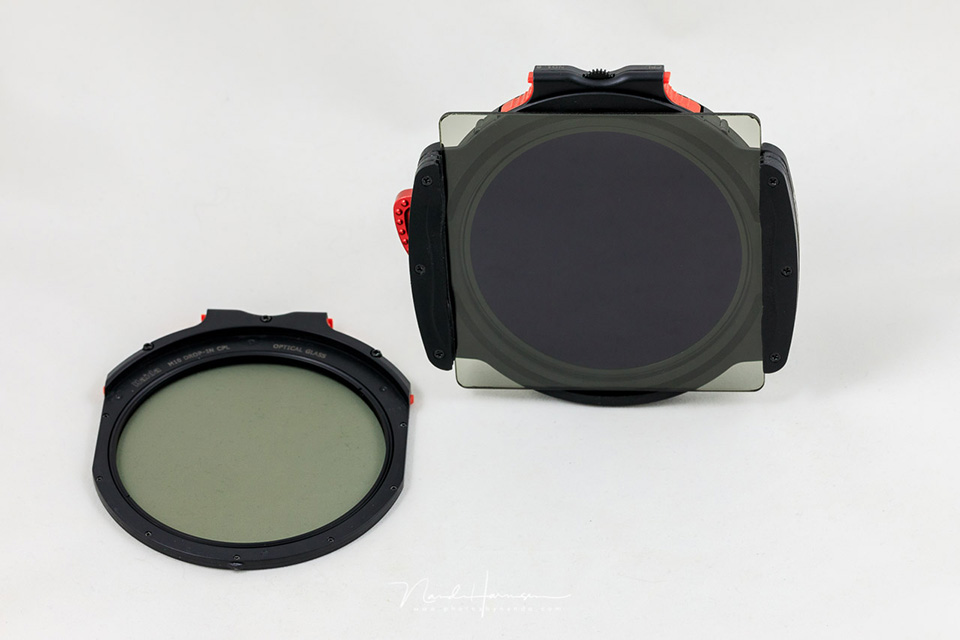
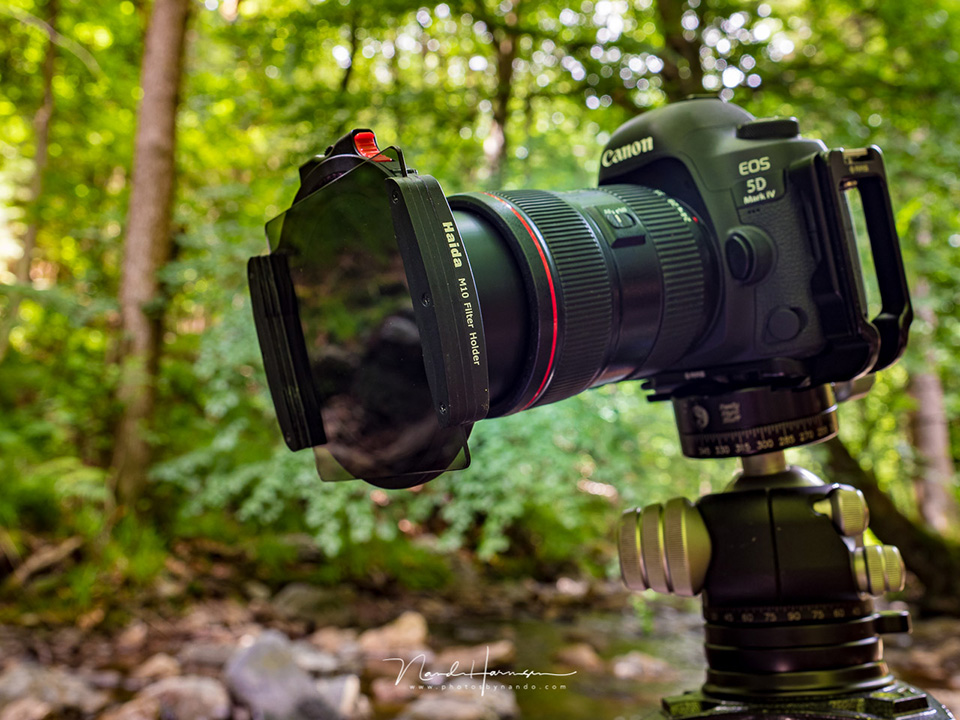
The Haida M10 Insert Variable ND filter is essentially a 100 x 100 mm square polarising filter that can be placed in a filter holder.
It is intended to be used with the polarising filter from the M10 system, meaning you effectively have two separate polarising filters in your filter holder.
By rotating your standard polarising filter with the wheel on top of the filter, you can control how much light gets through.
The filter is made from the same material as all Haida Red Diamond filters. It is K9 Optical Glass, which does not cause a colour cast, is scratch-resistant and repels water. The glass has nicely rounded corners. To the eye, it is transparent with a slightly darker tint.
How much light can the filter block?
You have to use the M10 Insert Variable ND filter with one of the available polarising filters from the Haida M10 filter system.
Alongside the standard polarising filter, there is also a polarising filter combined with a 3-stop neutral density filter (ND0.9), or a 6-stop neutral density filter (ND1.8). If you use this with the variable filter, you can block up to 9 stops of light.
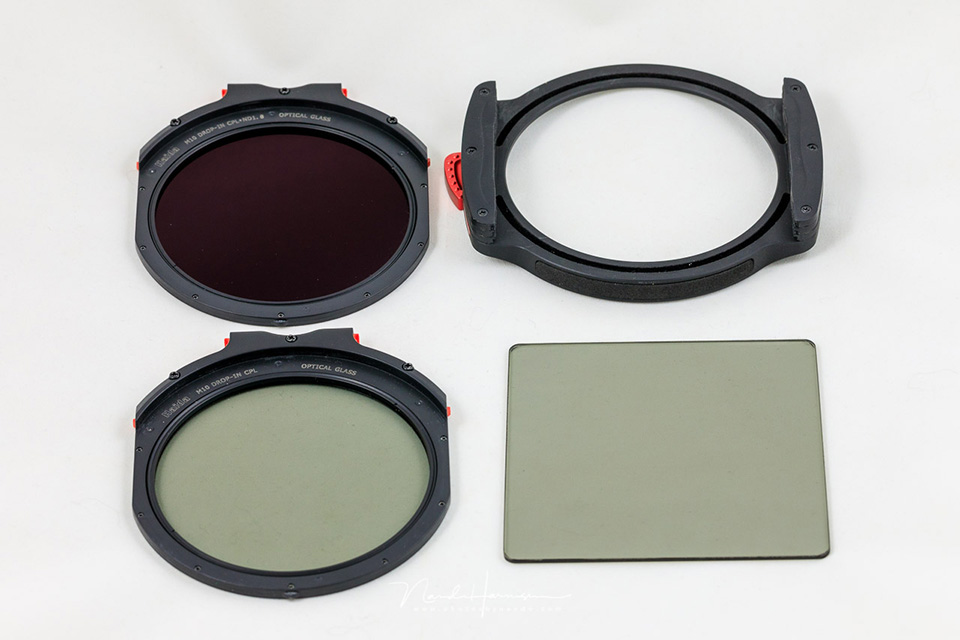
- Combine the M10 drop-in polarising filter with the variable ND filter to block 2-4 stops (ND2-ND16)
- Combine the M10 drop-in polarising filter + ND0.9 with the variable ND filter to block 3-5 stops (ND8-ND32)
- Combine the M10 drop-in polarising filter + ND1.8 with the variable ND filter to block 6-9 stops (ND64-ND500)
When you only want to block 1 stop of light, using a polarising filter is sufficient.
The disadvantage of a variable ND filter
A variable ND filter sounds very appealing. You have several neutral density filters available in one filter.
Still, there is a disadvantage to a variable neutral density filter that is important to know about. I have already explained how a variable neutral density filter works.
By rotating the polarising filters in relation to each other, there comes a point where the light being blocked is at right angles to itself. In the most extreme position, a dark cross will then appear in the photo.
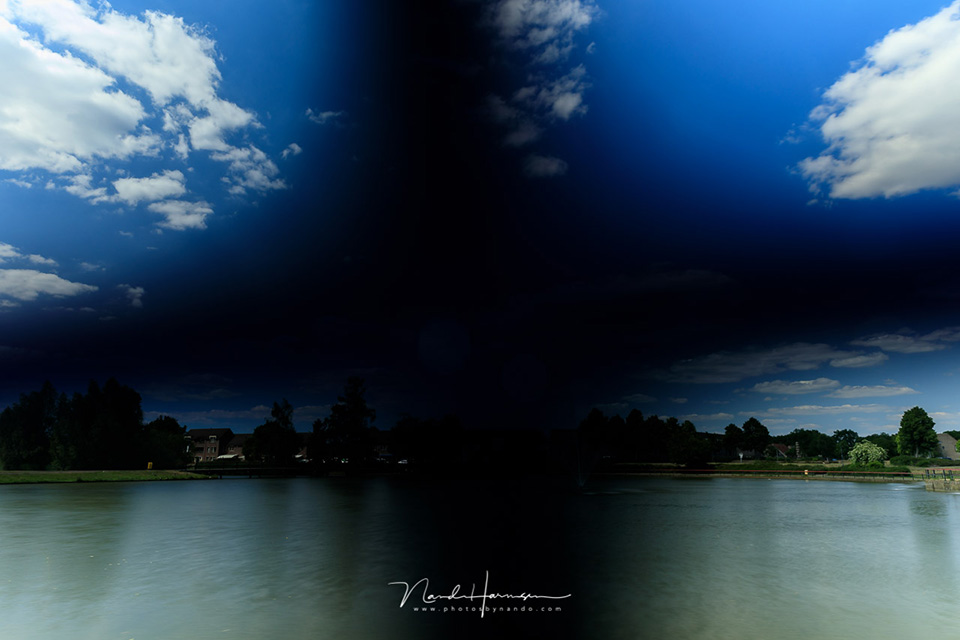
This happens gradually, of course, rather than suddenly. You obviously want to avoid this, but it can be difficult to see in certain situations.
It is frustrating to discover at home that two of the corners in your photo have become noticeably darker.
This effect becomes stronger the more wide-angle you use. Even with a 24mm focal length on full-frame, this effect is already noticeable.
With an even wider angle of view, the effect will occur much sooner. But using a polarising filter with an extreme wide-angle lens is never sensible anyway.
In practice
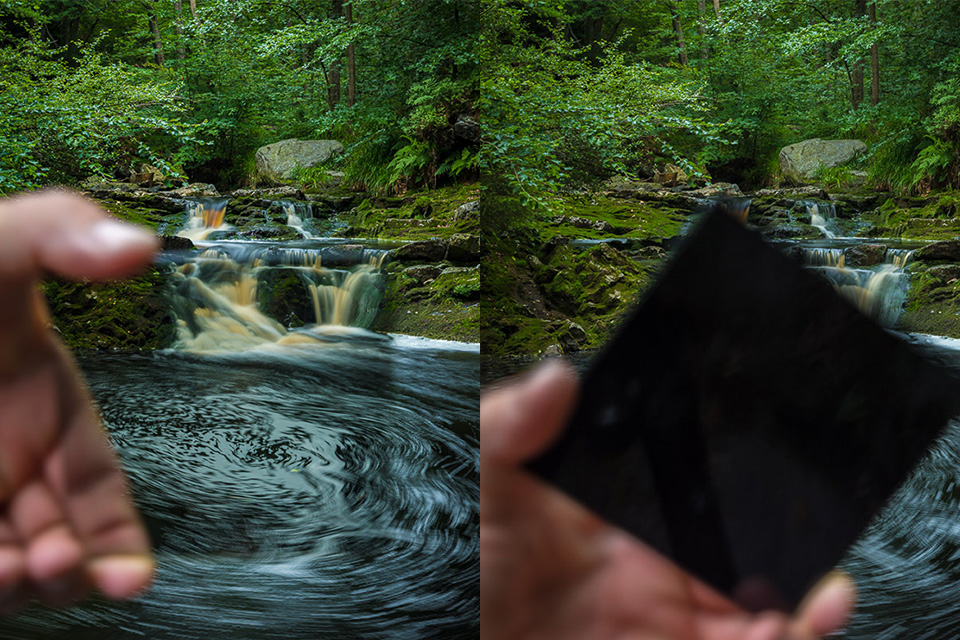
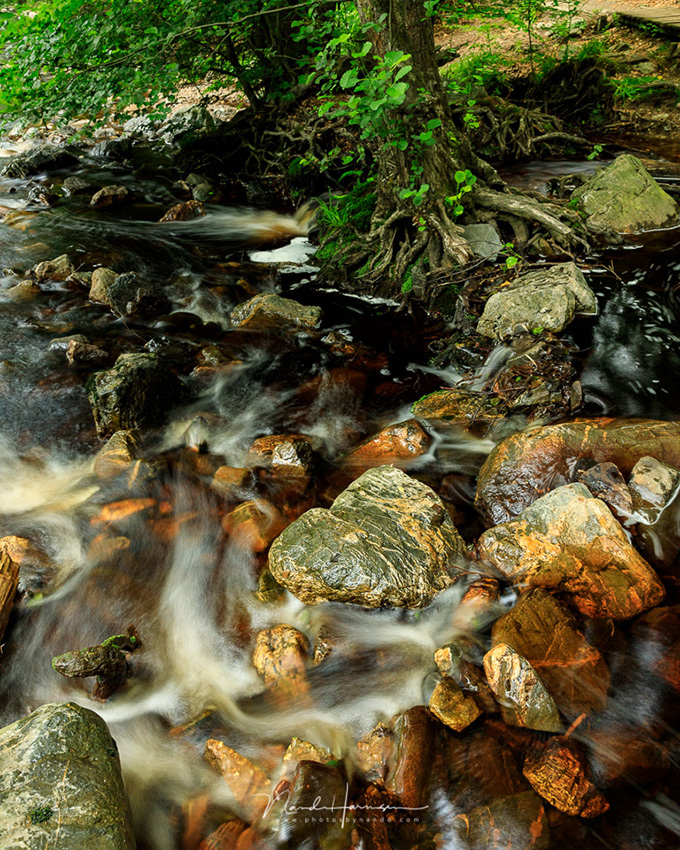
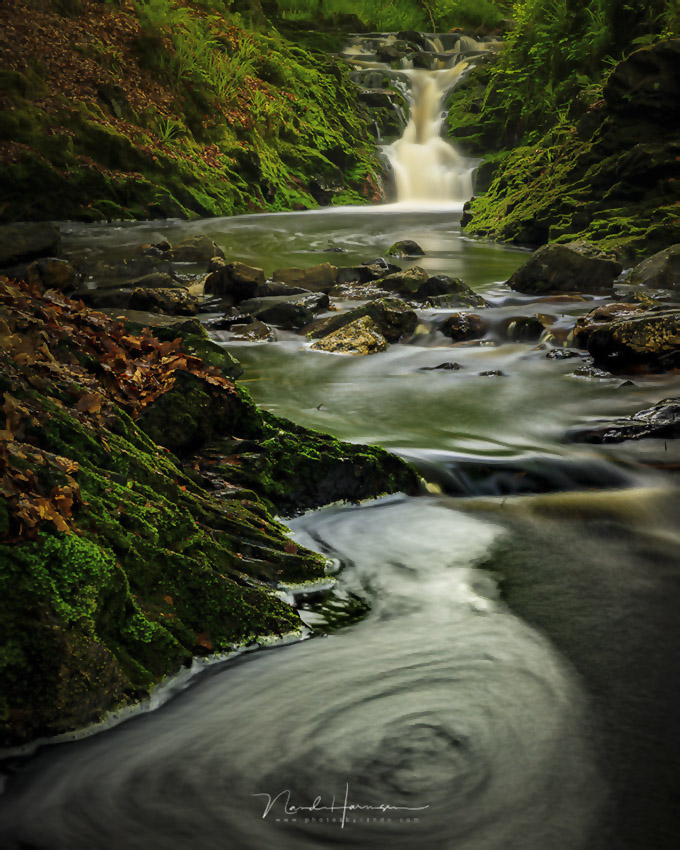
The best place to use a variable neutral density filter is in situations where the shutter speed is very important. Think of waves at the seaside, or fast-flowing streams, where you want to capture the movement of the water perfectly.
I took the filter to the Hoëgne stream in the Belgian Ardennes to give it a proper test.
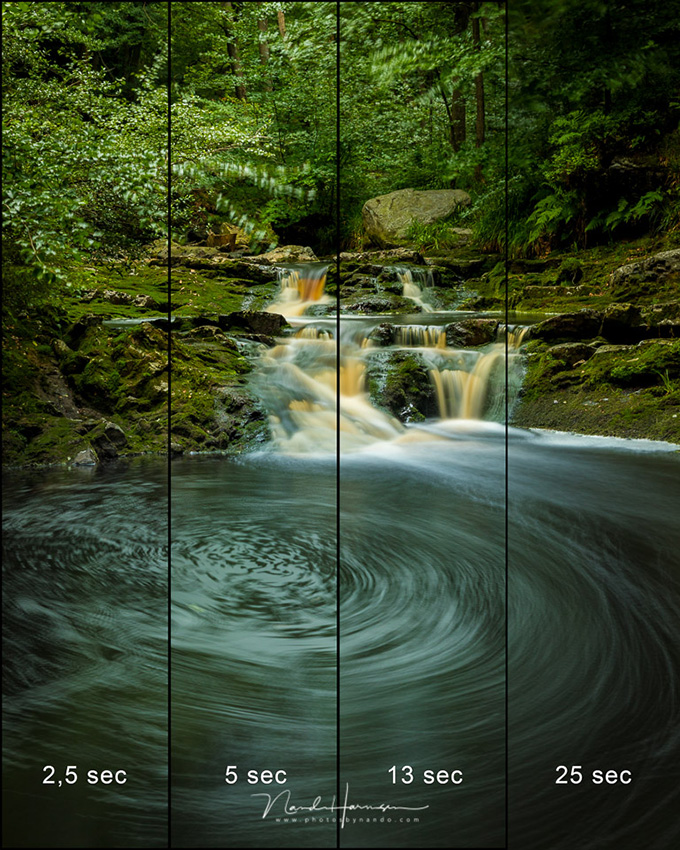
Using the Haida Insert Variable ND filter gave me the opportunity to set the shutter speed very precisely by rotating the polarising filter as required. But I did notice that this also changed the reflections in the water and on the wet stones.
Of course, it is then possible to rotate the entire holder. This only works when you are not also using graduated neutral density filters.
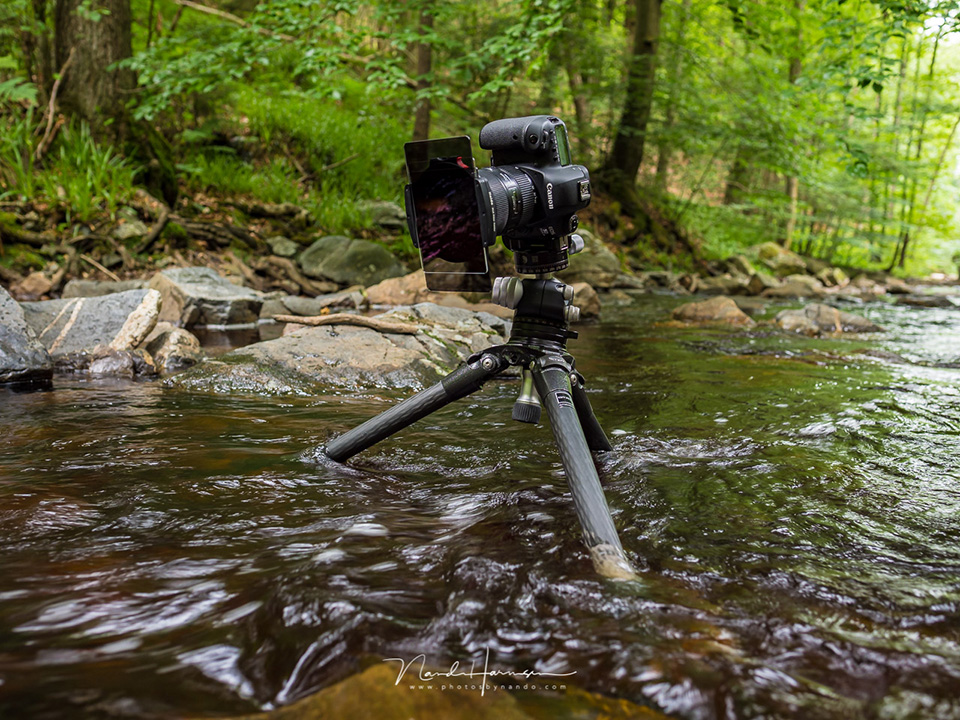
I had to make sure that I did not get a dark cross in the frame, which is difficult to see in the busy surroundings of the forest. You need to pay close attention, especially when using an ultra-wide-angle lens.
That is precisely why I used 24mm as my wide-angle focal length, and no wider than that.
What I like about the filter
- No visible colour cast
- Variable ND functionality with the advantage of a filter holder
- Scratch-resistant and water-repellent coating, not tested
- The various polarising filters with built-in ND filters provide a wide range of stops
- The variable ND filter can also be used as a separate polarising filter
- Usable in other filter systems with a built-in polarising filter
- Unlike the screw-in version, the entire holder can be rotated to control the polarisation of the landscape
- One variable ND filter can be used on multiple lenses with different diameters
What I like less about the filter
- Not a compact system because a complete filter holder has to be used
- Not practical as a variable ND filter for filming because of its size
- You need three polarising filters for the full range of 2 to 9 stops
More advantages and disadvantages
There are a few more advantages and disadvantages to mention that are not specific to this Haida filter. These apply to all variable filters, regardless of the design or brand.
The advantages of a variable ND filter include the ability to set the filter strength continuously, so you no longer need to have several neutral density filters. This is of course the major advantage when the exact shutter speed is critical.
But the biggest problem is still the dark cross that appears when you rotate the filters too far in relation to each other.
In the field, this is often difficult to see, especially because it slowly appears in the corners and can go unnoticed until you view the images at home on your computer.
I would like to thank Haida for providing this M10 Variable ND filter. It is available from omnifoto.nl.
About the author
Nando Harmsen has been photographing for more than 40 years. He specialises in wedding photography and landscape photography. Nando also gives talks, workshops, masterclasses and photo trips, and regularly reviews new and interesting equipment.
You might also like
-
 Review: Haida variable ND filter with built-in polarisation
by Nando Harmsen
-
 Variable ND filter, or not?
by Nando Harmsen
-
 Review: Haida X in 1 Ultra-Low Reflection Magnetic Filter
by Nando Harmsen
-
 Haida magnetic filters, a perfect alternative to a filter system
by Nando Harmsen
-
 Which ND filters should you choose as a beginner?
by Nando Harmsen
7 comments
-

 Donald Willemsen
wrote on Tuesday 10 November 2020 at 10:33
| reply
Donald Willemsen
wrote on Tuesday 10 November 2020 at 10:33
| reply
Thank you Nando for this clear explanation. I would love to switch to the Haida filter system, but my wallet can't handle it. That is also the problem with other good filter systems, they are quite expensive. Personally, I have already experienced that, for example, Cokin's amateur filters don't really have decent quality. They are cheap though 😉.
Translated from Dutch.
Your article is definitely an incentive to start saving for a good filter system. -
 Chiel van Langevelde wrote on Tuesday 10 November 2020 at 11:31 | reply
In its extreme setting, 20 stops, is the variable ND filter also suitable for photographing the sun?
Translated from Dutch. -
 Nando
wrote on Tuesday 10 November 2020 at 12:08
| reply
Nando
wrote on Tuesday 10 November 2020 at 12:08
| reply
@Chiel,
Translated from Dutch.
The variable ND filter reaches a maximum of 9 stops, not 20 stops.
I strongly advise you not to point your camera at the sun with a telephoto lens while using the variable ND filter. For that, you need at least 16 stops, and you will never achieve that with a variable ND filter.
I have also written an article about Haida's 20-stop filter. That one is suitable for solar photography. -
 Hans den Boer
wrote on Wednesday 11 November 2020 at 21:20
| reply
Hans den Boer
wrote on Wednesday 11 November 2020 at 21:20
| reply
The fading of reflections mentioned here - often unwanted - is actually THE reason for me that I have never seriously looked into it further (if I want that, I just use a polarizing filter). Another disadvantage is that - as far as I know - no compendium can be attached to the system. And if you want an exposure time of several minutes in full sun anyway, that can sometimes come in handy.
Translated from Dutch.
With the REALLY long exposure times (of several minutes), an exact shutter speed usually isn't that relevant (4 minutes or 6 minutes generally doesn't make the difference). And if it is, you can also perfectly well play around with your ISO value(as long as you don't overdo it, of course). With 3 ND filters in my backpack (the Little-, Big- and Super Stopper from Lee), I can manage perfectly well in virtually all common situations.
Which of course doesn't alter the fact that it's always good to be able to choose from multiple systems, and what isn't optimal for me may be just right for someone else.
-
Nando
wrote on Thursday 12 November 2020 at 11:50
| reply
@Hans den Boer:
Translated from Dutch.
The variable ND filter is actually not a filter for removing reflections, but for achieving longer shutter speeds. However, because it uses polarization, you have to take that into account.
For removing reflections only, a separate polarizing filter is needed.
By compendium you probably mean a lens hood? There are also systems that offer the option of a lens hood. If you need that, you can of course choose that instead.
You are of course right regarding shutter speeds of 4 minutes and 6 minutes. However, the difference between 1 and 2 seconds is many times greater. That is when a variable ND can offer the most benefit. -
Hans den Boer
wrote on Thursday 12 November 2020 at 14:31
| reply
I do indeed mean an (adjustable) lens hood. And what you say: it is in fact not a polarizing filter (but it does work more or less like one), and that makes it less predictable (and I see that as an undesirable side effect)
Translated from Dutch.
Of course the difference between 1 or 2 seconds is much greater, but then I would either correct that in my RAW file, or simply adjust my ISO value or - if possible - adjust my aperture value (or a combination of all three). I certainly do see the added value of this system, but I definitely find it less universally applicable than my current system. -
Nando
wrote on Thursday 12 November 2020 at 14:43
| reply
@Hans:
Translated from Dutch.
It’s about the fact that not everyone has, or can afford, a set of 3 ND filters. In that case, a variable one is handy.
Of course, you don’t want to have to adjust your aperture, because then you get a different depth of field, and a different photo than you would like.
Increasing your ISO to get the desired shutter speed can lead to too much noise.
If you have a 3, 6 and 10 stop ND filter, such a filter is pointless. But if you don’t have those, this could certainly add value, provided you take the limitations into account.
Have your say
Please note: Articles older than a week can only be commented on by signed-in visitors.Would you still like to comment? sign in or create a free account.
Become a better photographer every week
A practical photography tip in your inbox every week.
39,079 photography enthusiasts already receive the tips! More about the weekly mail. Or keep up to date via  Facebook.

Elja Trum
Photofacts; everything to do with photography!
Would you like to take better photos and keep up with what is happening in photography? Photofacts publishes articles that teach you something about photography — from a product announcement to a practical shooting tip or a look at a website. Photofacts covers photography every day and is a hobby project of Elja Trum's that got out of hand. The articles are written by a team of volunteer authors. If you would enjoy writing one or more articles for Photofacts, do get in touch.More about PhotofactsPhotofacts is made possible in part by
