

Review: the Haida M10 filter system and Red Diamond filters
Friday 12 June 2020, 16:32 by Nando Harmsen | 6,655 views | 3 commentsThis article was translated from Dutch with the help of AI. Read the original.
At the end of 2015, I was given the opportunity to use Haida filters. They replaced my ten-year-old Lee filters. These resin filters needed replacing, and Haida seemed like a suitable system.
Unfortunately, the system was not ideal for me, and I continued using Lee filters. In 2019, however, Haida launched a completely new system, with a completely new filter range, the Haida M10 system and Red Diamond filters.
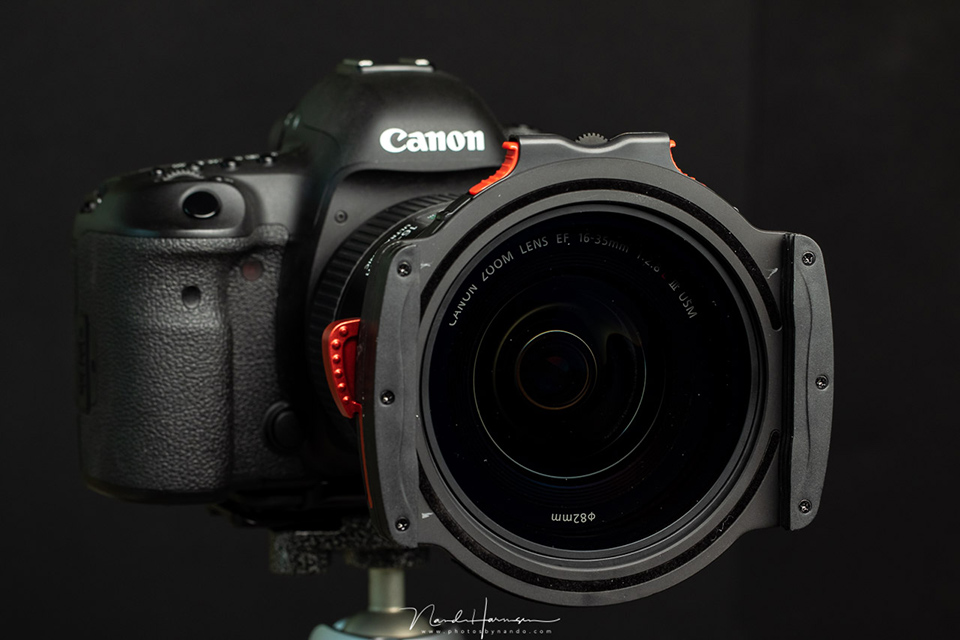
After using it extensively during my Winter in Lofoten photo trip, I was impressed by the Haida M10 filter system. So much so that I can recommend it to everyone. In this article, I want to discuss this system in detail.
The Haida M10 filter holder
The basis of the system is the same as any other filter system. It consists of an adapter ring that is screwed onto the lens, after which the filter holder is clicked into place. You buy an adapter ring for each lens, and you can move the holder from one lens to another.
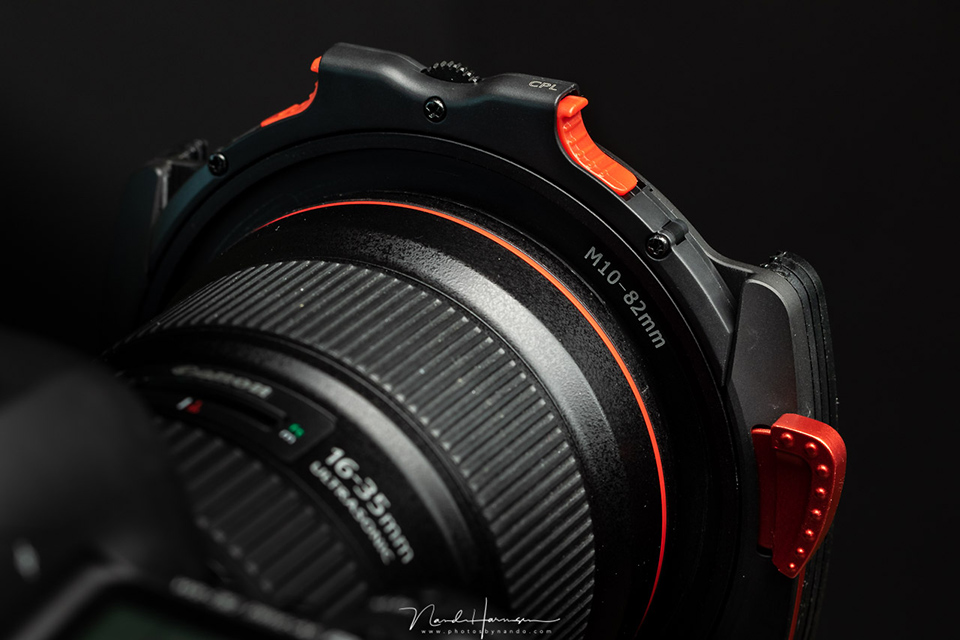
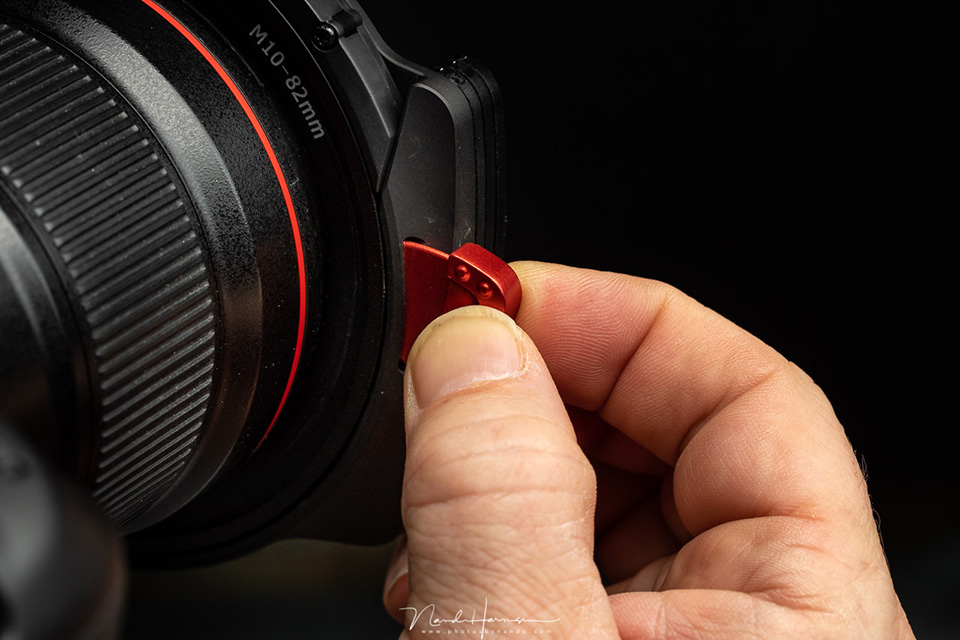
You hook the Haida M10 filter holder behind the adapter ring on one side, while a spring-loaded clamp provides a secure attachment on the other side. The system is designed so that you can clamp it onto the adapter ring with just one hand.
The holder is not fixed in place, so it can rotate freely. This means you can easily change the angle of your filter. There is no risk of the holder coming loose, which is very important.
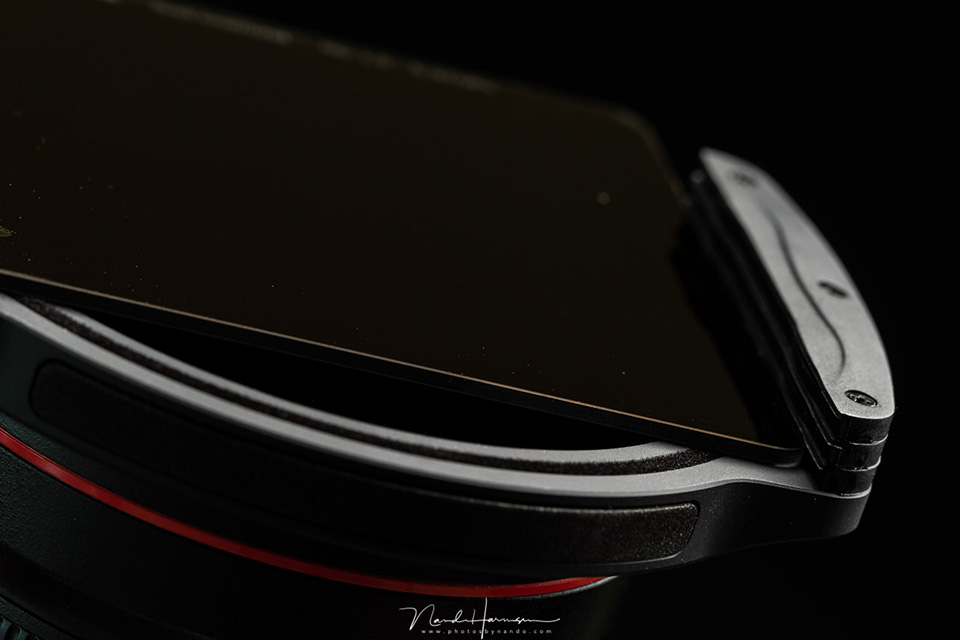
The special feature of this M10 filter system is the option to use drop-in filters. It is not only suitable for square and rectangular filters. The holder comes with a drop-in polarising filter, which simply drops into the holder. Two small plastic tabs hold this filter perfectly in place.
For strong ND filters, it is important to prevent light leaks. The Haida M10 holder has a foam layer on the inside for this purpose. This seals a square ND filter perfectly. However, if you already have an ND filter with its own foam layer, you will first have to remove that layer before you can place the filter in the M10 holder.
The Red Diamond ND filters do not have a foam layer, so you can use them directly in the holder. However, if you already have a holder in which you want to use the Red Diamond filters, you can still stick the supplied foam ring onto the filter.
The M10 holder comes in a nice pouch that also has room for the polarising drop-in filter. You can attach this pouch to your backpack, belt or anywhere else with a carabiner. You will need a separate filter pouch for the filters themselves. Alternatively, you can carry the filters in the supplied metal cases. That works too.
The Red Diamond system filters
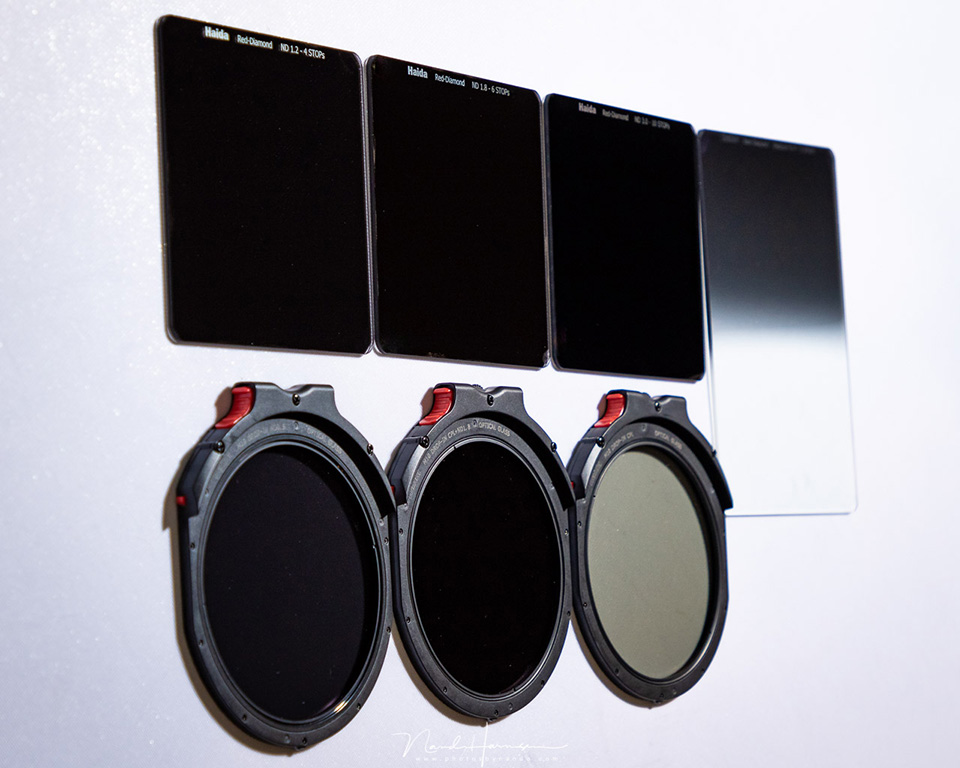
The M10 filter holder is suitable for the standard system filters of 100 x 100 mm and 100 x 150 mm. These slide into the slots, as they do with any other filter holder. There are two slots as standard, but Haida supplies the parts for a third slot.
The glass filters are perfectly finished. The corners are neatly rounded, and there are no sharp edges. This is kinder to your fingers, and also makes it easier to slide the filters into the holder. It also makes the filters less prone to breaking.
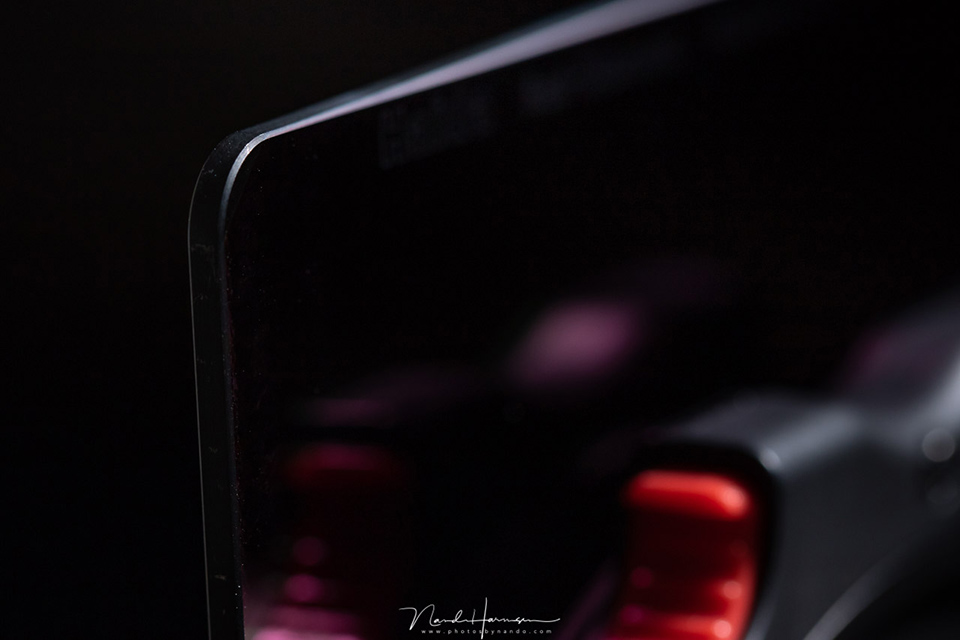
A defining feature of the new Red Diamond filters is the toughened glass, which is extremely resistant to scratches. Although I will never try it, and I am careful not to drop a filter, these filters should also survive a possible fall.
It may be more important to know that the Red Diamond filters are completely colour-neutral. Regardless of which filter you use, whether it is a graduated ND filter or an ND filter of 3, 6 or even 10 stops, there is no colour shift at all. This currently makes these filters some of the best on the market.

All filters come in a sturdy metal case. The drop-in filters come in a plastic case. This makes carrying them in your camera bag worry-free. However, it is certainly advisable to use a dedicated filter pouch, as it takes up less space and is easier to use.
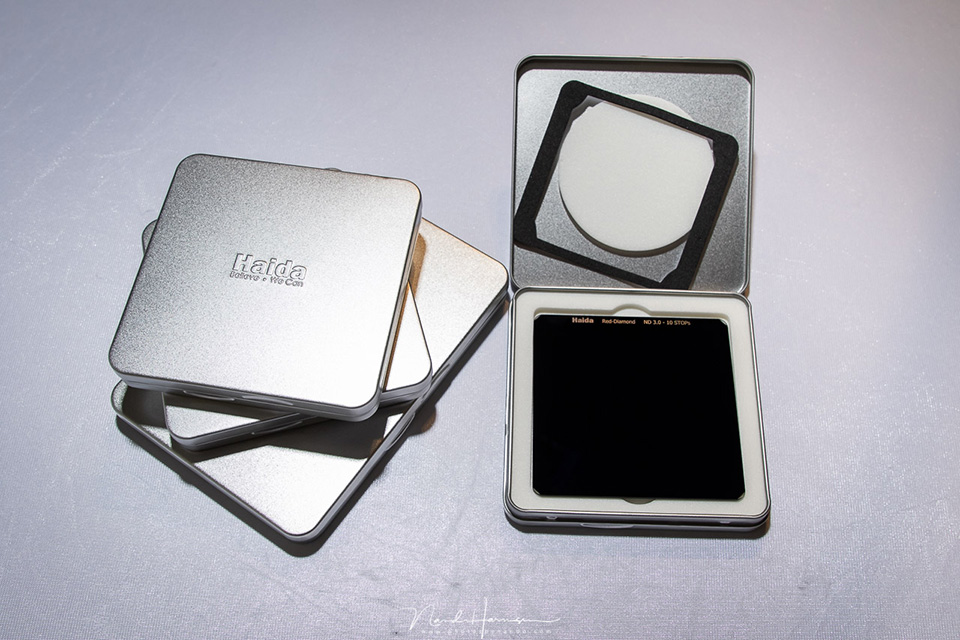
There is also room for drop-in filters
The special feature of this M10 holder is the option to use drop-in filters. A circular polarising filter is supplied as standard with the holder, but other drop-in filters are also available. You can choose from ND filters, or ND filters with an integrated polarising filter. A dedicated night filter is also available, and a variable ND filter is planned.
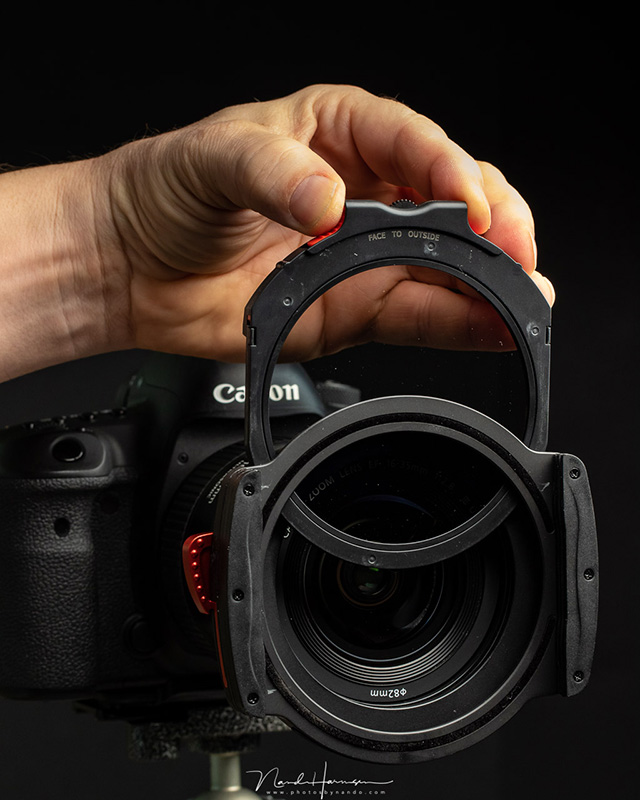
The drop-in filters are housed in a plastic frame that fits seamlessly into the holder. If the filter is also a polarising filter, you will find a small wheel on top of the drop-in filter that lets you rotate the polarising filter. This allows you to set the degree of polarisation independently of the filter's position.
If you do not want to have a filter in this slot, Haida has a light-blocking drop-in filter. This is essentially just the frame, without a filter. It prevents stray light from entering the filter holder when you are not using a drop-in filter.
Using it in practice

The filters were used extensively during the wintry conditions in Lofoten, Norway. Wrapped up well against the low temperatures and harsh, stormy wind, I used the M10 filter holder and Red Diamond filters with great pleasure.
The construction of the M10 filter holder makes it possible to attach it to the adapter ring even while wearing thick gloves. The same applies to inserting the filters, both the large glass Red Diamond filters and the drop-in filters. Only taking the filter out of the filter pouch is difficult with gloves.
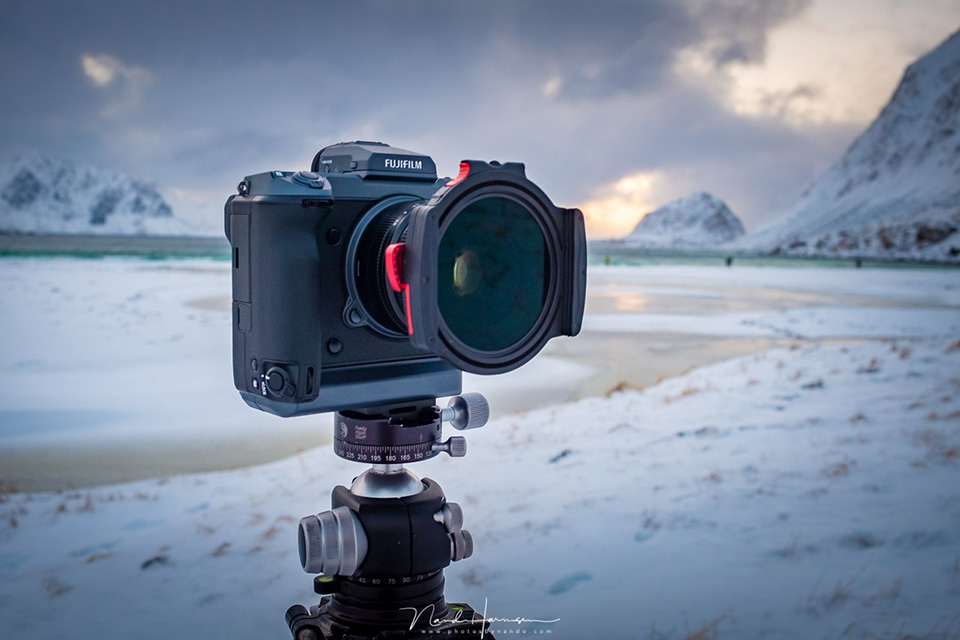
At first, I had my doubts about the filter holder being able to rotate freely, but its construction means there is no risk of the holder coming loose.
I found that it was actually useful for the holder to rotate freely, as it made it easier to position the filters correctly. There is no small release screw getting in the way.
Conclusion and advice
After the Winter in Lofoten trip, I continued using the filters in all kinds of situations that were less harsh and grim. The Haida M10 holder is pleasant and easy to use. Each lens now has an adapter ring permanently attached, so I can fit the holder in an instant, even with one hand.
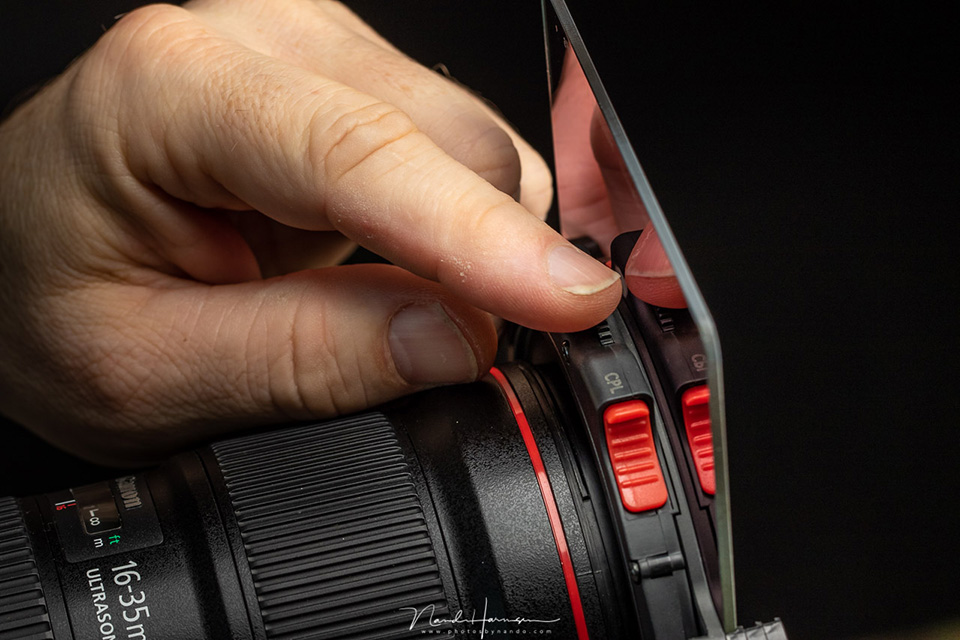
The only disadvantage I experienced concerns the rotation wheel for the polarising filter(s). It is small and sits very close to a graduated ND filter when this is placed in the first filter slot.
There is then a risk of touching the graduated ND filter when rotating the wheel. When the filter is in the second slot, the risk is already much lower, and with square ND filters it is not a problem at all.
Apart from that, I can certainly recommend the Haida M10 system filter holder and the Red Diamond filters. I am convinced that they are among the top class in the world of system filters.
The Haida M10 system is also available in the larger M15 size, or in the smaller M7 or M8 size, suitable for smaller camera systems such as the M43 format.
Pros
- The M10 holder is very quick and easy to attach
- The M10 holder stays perfectly and securely in place, while remaining rotatable
- Excellent finish
- Drop-in filters provide perfect protection against light leaks
- Filter glass is of high quality and has an excellent finish
- Filters are scratch-resistant and can survive a reasonable fall
- Drop-in filters can be inserted without removing other filters
- Drop-in filters are also available as ND filters combined with polarisation
- The polarising filter is easy to rotate without removing the filter
- No colour cast at all with the ND1000, ND64 or stacked ND filters
Cons
- Polarising filter cannot be used without the M10 filter holder
- The notation indicating the type of drop-in filter could be easier to read
- The tabs on the drop-in filter are made of plastic, durability?
- The rotation wheel for the polarising filter is small and sits close to a graduated ND filter
- There is no way to lock the rotation of the M10 filter holder
Where can you buy them?
The Haida M10 system filter holder and Red Diamond filters are available from omnifoto.nl, which also supplied these filters for this review. Mention my name, Nando Harmsen, when placing your order for a nice little extra.
About the author
Nando Harmsen has been photographing for more than 40 years. He specialises in wedding photography and landscape photography. Nando also gives talks, workshops, masterclasses and photo trips, and regularly reviews new and interesting equipment.
You might also like
-
 Review: Haida M10 Insert Variable ND filter
by Nando Harmsen
-
 Review of the handy Haida Magic Stick-It Wrapper Cloth
by Nando Harmsen
-
 Review: Haida variable ND filter with built-in polarisation
by Nando Harmsen
-
 Review: Haida MagSafe Magnetic Filter Holder for Smartphones
by Nando Harmsen
-
 Haida magnetic filters, a perfect alternative to a filter system
by Nando Harmsen
-
 Review: Haida X in 1 Ultra-Low Reflection Magnetic Filter
by Nando Harmsen
3 comments
-

 Paulussie wrote on Tuesday 16 June 2020 at 16:41
| reply
Paulussie wrote on Tuesday 16 June 2020 at 16:41
| reply
Hello!
Translated from Dutch.
I bought a similar system years ago, with graduated filters etc., but very quickly stopped using it altogether. I don't know what these graduated filters are like, but the ones that were on sale back then were much too sharply defined, in other words the transition was too abrupt, you could see it immediately in the photo. Moreover, they were made of plastic, and were already scratched after three or four times. So I was quickly cured.
The only filters I still have now are polarizing filters and a variable ND filter. The latter isn't really a great success either, if I had to buy them again I would simply get 2 or more individual ND filters.
I do all other filter effects in post-processing, I can determine much more precisely what should or shouldn't be adjusted, and I don't have to lug around such a weird trumpet on my cameras.
Your results are good though. -
 Nando
wrote on Thursday 18 June 2020 at 09:27
| reply
Nando
wrote on Thursday 18 June 2020 at 09:27
| reply
@Paulussie:
Translated from Dutch.
Plastic filters are indeed susceptible to scratches. You should therefore handle them carefully. There is also a lot of difference in quality. With the glass Haida filters, you don't have to worry about that kind of scratching. As for the limitation, that depends entirely on the type of graduated neutral density filter. You have a hard gradation, medium, and soft gradation, and each type has its own application. It seems you had the wrong neutral density filter for your photography.
You can indeed simulate graduated neutral density in your photo editing, but personally I find it more fun to be out in the field taking photographs than working in my photo editing program.
The new course on photographing with neutral density filters will soon be available online at Photofacts Academy. In it, I explain everything about using this kind of filter -
 Donald Willemsen
wrote on Saturday 28 August 2021 at 18:01
| reply
Donald Willemsen
wrote on Saturday 28 August 2021 at 18:01
| reply
Partly because of this review, ordered a starter kit. Arriving Tuesday
Translated from Dutch.
Have your say
Please note: Articles older than a week can only be commented on by signed-in visitors.Would you still like to comment? sign in or create a free account.
Become a better photographer every week
A practical photography tip in your inbox every week.
39,024 photography enthusiasts already receive the tips! More about the weekly mail. Or keep up to date via  Facebook.

Elja Trum
Photofacts; everything to do with photography!
Would you like to take better photos and keep up with what is happening in photography? Photofacts publishes articles that teach you something about photography — from a product announcement to a practical shooting tip or a look at a website. Photofacts covers photography every day and is a hobby project of Elja Trum's that got out of hand. The articles are written by a team of volunteer authors. If you would enjoy writing one or more articles for Photofacts, do get in touch.More about PhotofactsPhotofacts is made possible in part by
