

A bridge camera for wildlife photography?
Monday 24 February 2020, 16:32 by Rob Dijkstra | 21,010 views | 24 commentsThis article was translated from Dutch with the help of AI. Read the original.
Most wildlife photographers work with a DSLR or a mirrorless camera. As the organiser of photo excursions, I know better than anyone what some people invest in their hobby.
And let's be honest: if you want to take photography seriously, a good camera, several lenses, a sturdy tripod and one or two flashes are essential, aren't they?
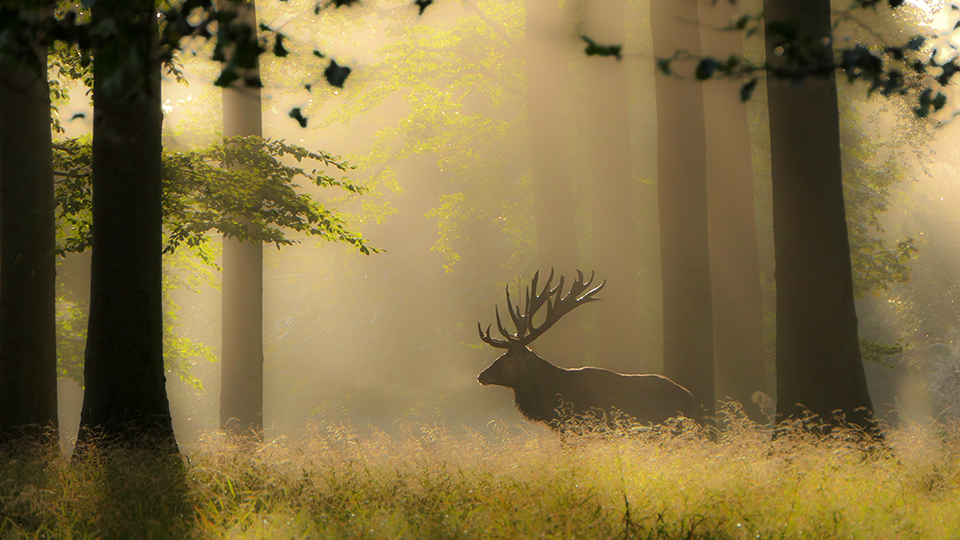
Thinking the other way round
Over the years, my way of working has changed. Instead of using more and better, and therefore more expensive, equipment, I have gradually started to minimise more and more.
From a large backpack full of equipment, two camera bodies, a 100-400mm telephoto zoom, a 70-200mm short telephoto zoom, a 21mm wide-angle lens, a 28mm wide-angle lens, a 35mm wide-angle lens, a 50mm standard lens and a 100mm macro lens, I eventually switched to a mirrorless camera.
The reason was that all that equipment restricted my freedom of movement, because after a few hours of carrying it around, you had had enough.
The mirrorless camera brought much lower weight and volume. I chose a couple of zoom lenses and suddenly I could fit my entire kit in a shoulder bag. When I went into the field, it felt like a real relief.
I still found myself changing lenses, but well... that is simply part of photography. I had got into the habit of putting a sizeable telephoto zoom on my camera body, so I was ready quickly if a deer appeared from the edge of the woods.
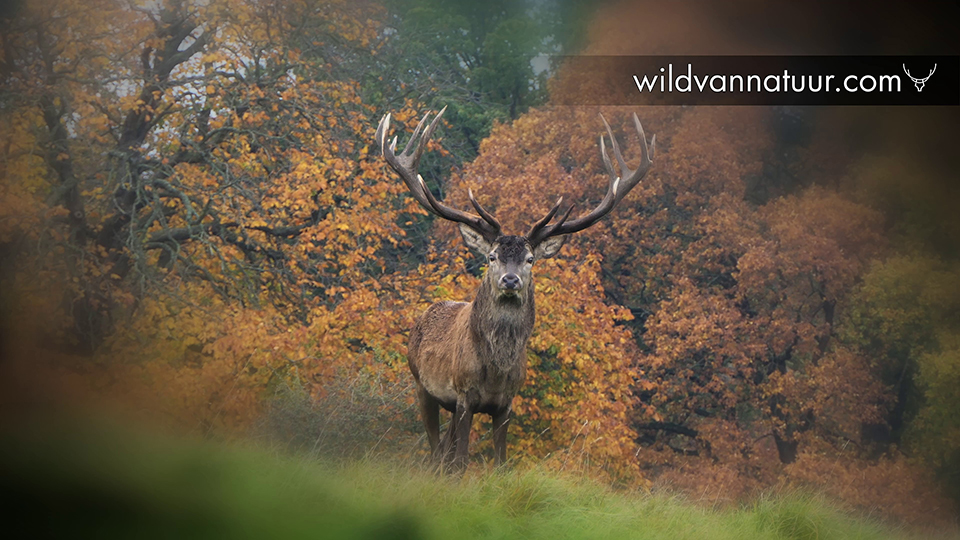
The turning point
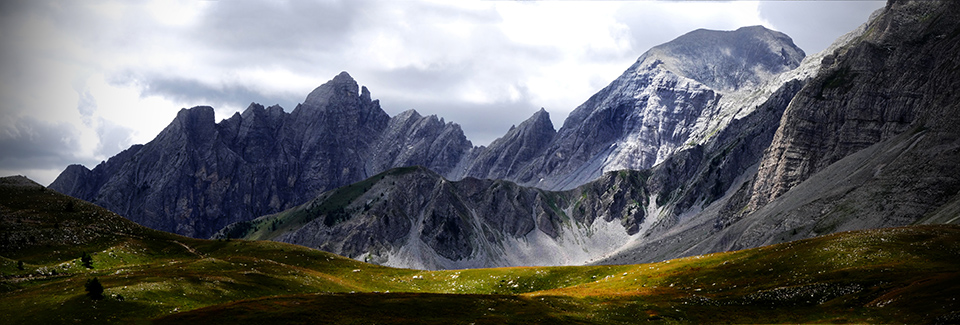
During one of my holidays in the Alps, I decided to leave my equipment at home and take only a bridge camera with me. I had bought a Sony RX10, the first version, with a 24-200mm zoom range, and I really enjoyed photography during that holiday.
What a relief it was to photograph with such a light camera alone.
And what astonishing quality came out of such a camera.
Of course, I fully realised that a 1-inch sensor does not match the quality offered by a full-frame sensor, and that the zoom lens could not be compared with a prime lens.
But this camera was so light that I did not feel restricted by the weight at all.
What if?
When I came back from my holiday, I considered this: what if I sold my equipment and switched entirely to using a bridge camera? Would that be possible, what would I give up, and what would I gain?
The time was not quite right yet, and for a while I continued using my mirrorless camera alongside the bridge camera. Until the next generation of cameras arrived.
Panasonic brought out the DMC-FZ1000, comparable to the Sony RX10 but with a zoom lens up to 400mm and the ability to record in 4K, ultra HD, quality. From that point on, I was converted.
No regrets
There is no ideal camera. Every camera and every system involves compromises. My choice certainly does not have to be the right choice for you. But going back to fewer options has been liberating for me.
I enjoy photography more than ever. I never again have the feeling that I should have brought my telephoto lens, and I miss far fewer shots because I no longer have to change lenses.
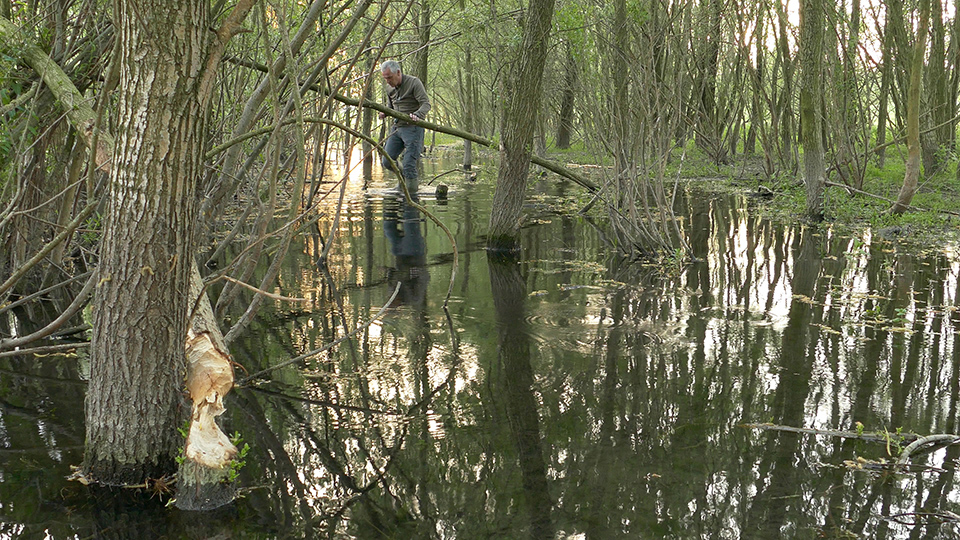
Filming with a camera
I am a fan of nature documentaries: the BBC Earth series, Holland - Natuur in de Delta. I think they are fantastic.
I also started filming with my bridge camera. I discovered, and this is more or less specific to some Panasonic cameras, that when I filmed in the highest quality, UHD or 4K, the camera used a 1.5 crop factor.
Instead of starting at 24mm wide angle, it suddenly starts at 36mm. In this filming mode, you therefore have less wide-angle range. That is difficult for landscapes.
At the other end of the zoom range, you do not have 400mm but suddenly 600mm. And that is fantastic for wildlife photography. The video below says it all.
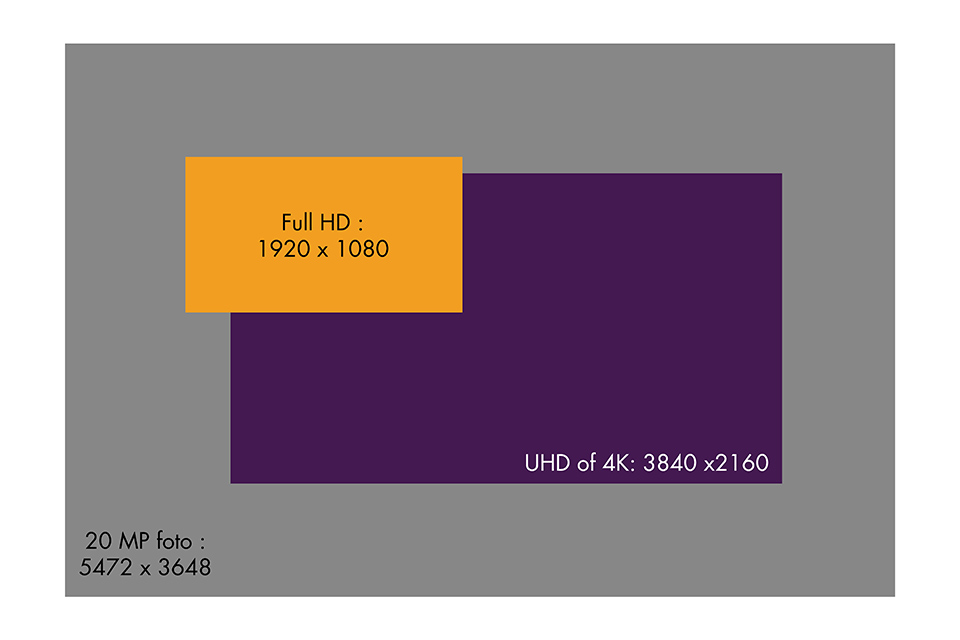
Now it gets a little more complicated: when you film, there are two common, good-quality options: full HD, 1920x1080, and 4K or Ultra HD, 3840x2160. Not all cameras offer both of these qualities. Full HD is more or less standard on all cameras, while 4K quality is less common.
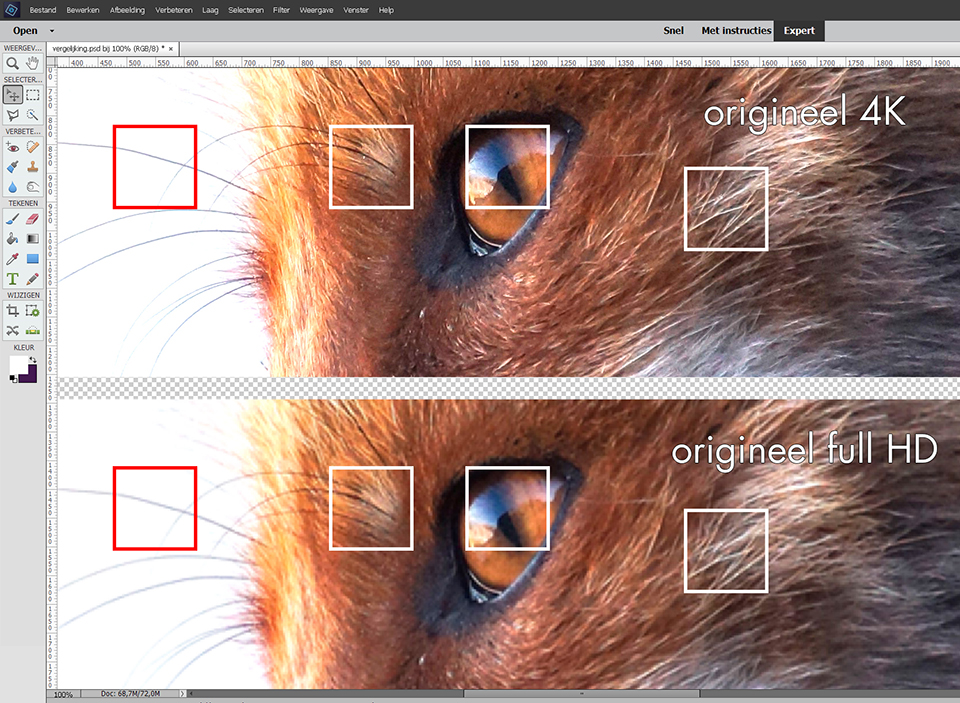
And then there is a whole collection of other formats that makes things even more complicated. But we will leave those out here. If you film in Full HD and take a photo from that footage, you will not have the quality you are used to.
My camera has a 20-megapixel sensor, which produces images of 5472 by 3648 pixels. That is more than enough to hang a good-sized enlargement on the wall. If I take an image from a Full HD video, the resolution is suddenly 1920 x 1080. Roughly 2 megapixels.
Good for a 9x13 centimetre print, but no more. In 4K quality, however, it is already 3840x2160. About 8 megapixels, which is printable at A4. And 4K quality is also the quality shown by many new screens.
So if I take a photo from 4K video footage, I still have the maximum resolution my screen can display. A small footnote: you cannot extract a RAW file from video footage, only JPEG photos.
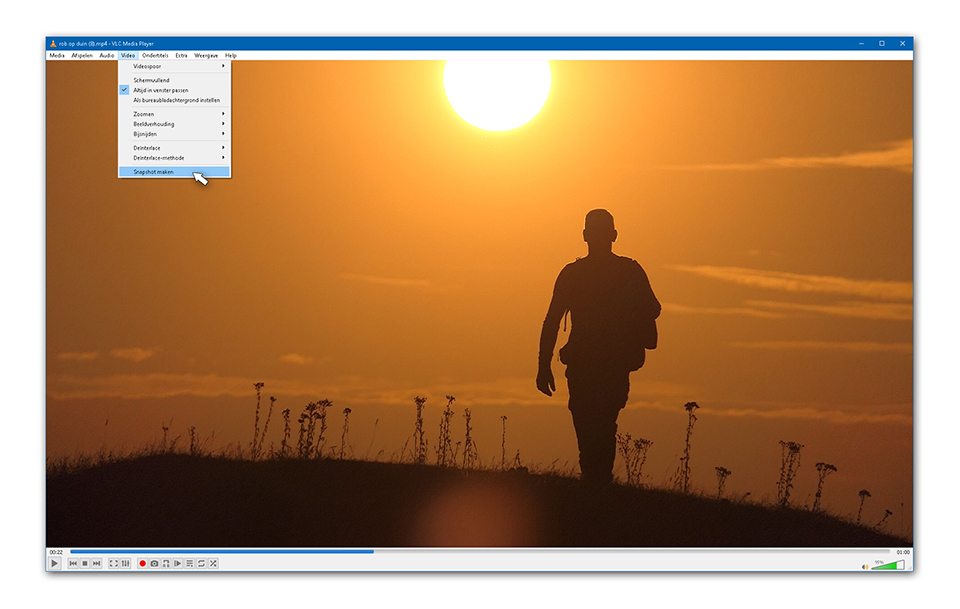
You can easily create a photo from video footage with VLC player.
Digital zoom
Many cameras, especially bridge and compact cameras, can zoom digitally to astonishing magnifications, but this always costs a considerable amount of quality. I therefore strongly advise against it. You are better off cropping from a good RAW file than using digital zoom.
Do not be misled by the image on your camera's monitor. It is too small to show the disadvantages clearly. If you care about quality even slightly, do not use digital zoom
SmartZoom or Intelligent Zoom
My Panasonic camera also offers i-Zoom, or intelligent zoom. Because in video mode you cannot use the entire 20-megapixel sensor, but use no more than 8 megapixels in 4K, the camera can use these pixels effectively to crop further without visible loss.
A factor of 2 becomes possible at that point. In sufficient light there is no loss of quality, while in low light noise appears more quickly.
That extra crop factor of 2 makes it an almost ideal wildlife camera. My current Panasonic DMC-FZ2000 has a 24-480mm optical zoom range.
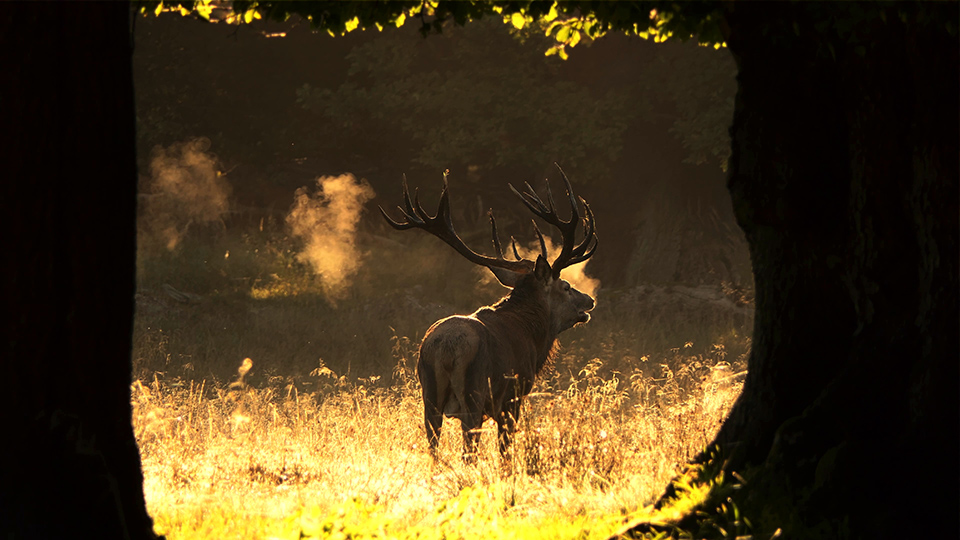
In 4K video quality, that becomes 36-720mm, and combined with i-Zoom it goes all the way to 36-1440mm. You can bring animals incredibly close with a camera that is still very compact.
And the photos I extract from the video footage are still 8 megapixels. If you cannot get enough zoom range, the Nikon P1000, with a 24-3000mm zoom range, is worth considering.
The sensor is very small, however, so noise and artefacts appear quickly, especially in poorer light, which naturally occurs fairly often in wildlife photography. My experience is that this camera does not offer the quality I get from my Panasonic.
What about bokeh?
To be honest, I am sometimes jealous of the beautiful bokeh produced by a 400mm or 500mm prime lens. My Panasonic does this less beautifully, with its 1-inch sensor. But if I zoom in far enough, it clearly gets better.
Well, I said it already: no camera is ideal. And this is one of the compromises I make when I work with a camera like this.
Macro or zoom?
A bridge camera can usually focus very close, down to a few centimetres, in wide-angle mode. That extremely close distance is not always as useful as it sounds: butterflies do not like it when you get that close. In situations like this, I generally prefer to use the video mode.
Zoomed in to 1440mm, I can still focus from about a metre away. I can then easily capture a small butterfly filling the frame. For even more extreme magnification, I use a good close-up lens.
Filming is the new photography
Imagine this: you have found a beautiful spot where a kingfisher regularly comes to hunt. The bird dives into the water from the same branch every time. These kinds of fast actions are particularly difficult to time.
If you film it in 4K, you can simply pick the right frame from the dive afterwards. You can still display it at full size on a 4K TV or monitor.
What do you mean, fewer options?
I cannot explain every aspect of photographing with a bridge camera in this article. You can assume that the possibilities are as extensive as those of an advanced DSLR.
My Panasonic offers more, though: focusing afterwards, Post-Focus, built-in focus stacking, timelapse and slow motion at a great many speeds. It is truly astonishing what a camera like this can do.
Your current camera can film, but you do not?
Funny... almost all photographers see filming as a kind of toy version of photography. Filming has a completely different dimension and offers you a new way to tell your story: with sound, music and movement...
Filming is much more difficult than photography because, unlike photography, a single beautiful shot is not really any use. You need several shots to tell a story. And a plan.
If that sounds like a nice challenge, have a look at the Filming with your camera course at Photofacts Academy. You can see me at work there in Burgers' Bush.
And just as with photography, there is also some post-processing involved. There is a course at Photofacts Academy for that too.
What now?
Should you now trade in your expensive equipment for a bridge camera? No, not straight away. But if you regularly struggle with the weight or the hassle, it is worth considering.
And if, like me, you enjoy roaming around in nature for longer periods and do not want to be hindered by a heavy backpack full of equipment, you now know that I experienced it as a liberation. Give it some thought.
And if you are completely into filming, I do not know a better camera for it than the Panasonic DMC-FZ2000. The model has been around for several years, and I expect its successor this year. I can hardly wait.
About the author
Rob is fotograaf, filmer en natuurgids. Onder de naam WILDvanNATUUR organiseert hij een groot aantal excursies en workshops voor hobbyfotografen en natuurliefhebbers in het gebied tussen Zuid-Duitsland, Denemarken en de Franse noordkust, op maximaal een dag autorijden.
You might also like
-
 Wildlife photography and switching to mirrorless
by Evert Doorn
-
 7 tips: Wildlife photography for beginners
by Rob Dijkstra
-
 Sony RX10 V bridge camera announced
by Elja Trum
-
 The battle between DSLRs and mirrorless cameras
by Michelle Peeters
-
 6 Reasons to Stick with a DSLR and One Reason Not To
by Nando Harmsen
-
 Get Low for Wildlife Photos
by Elja Trum
24 comments
-
 Ernst van Erkelens wrote on Tuesday 25 February 2020 at 08:10 | reply
Funny that in the photo under the article, you're still holding a hefty telephoto lens.
Translated from Dutch. -
 marij wrote on Tuesday 25 February 2020 at 12:28 | reply
Which processing program do you use with this camera, I don't think the Panasonic program is that great.
Translated from Dutch. -
 Jean-Pierre van der Zanden wrote on Tuesday 25 February 2020 at 12:29 | reply
Besides my Canon 5DMIII, I also have a Sony a7RIII mirrorless camera, both full-frame, and I use my Canon lenses on the Sony... Full frame AND fast telephoto lenses give me the sharpness, but especially the beautiful blur that I'm addicted to. Unfortunately, that's not possible with a bridge camera, I myself have a good Fujifilm bridge camera, which I actually never use anymore... Still take that heavy backpack along, even in the heat of Borneo or Malaysia...
Translated from Dutch.
-
marij wrote on Tuesday 25 February 2020 at 12:34 | reply
Which editing program do you use? I don't think Panasonic's program is great.
Translated from Dutch. -
 Wim wrote on Tuesday 25 February 2020 at 12:35 | reply
You put perfectly into words what has also been haunting my mind for a while. All that drudgery and those lens changes, I'm tired of it. On vacation I lose all my carry-on luggage to photo gear.
Translated from Dutch. -

 bartuyt
wrote on Tuesday 25 February 2020 at 13:25
| reply
Rob,
Translated from Dutch.
Your article really spoke to me! I too have always lugged around a lot of high-quality equipment and hesitated for a long time about switching to a "bridge"... I am now 71 years old and, partly because of your considerations, I am going to do that after all. I am keeping my Fuji X-T3 with 50mm for "street", because the Pana FZ2000 is a real eye-catcher on the street and I like to shoot unnoticed. Having now bought a one-year-old Pana FZ 2000 with lots of extras for € 450, I am going to focus on that now. Thanks for this informative contribution!
Bart Uijterlinde; www.bartuiijterlinde.net -
 Joep wrote on Tuesday 25 February 2020 at 13:28 | reply
Interesting,
Translated from Dutch.
I also switched a few months ago from a Canon DSLR (600D) to the Panasonic 1000 II. Less weight, always the right lens, fast and, for whatever reason, sharper photos. In addition, a great many possibilities, I sometimes wonder whether I have a computer with me that can take photos, or the other way around. -
Joep wrote on Tuesday 25 February 2020 at 14:21 | reply
@Marij, photo editing:
Translated from Dutch.
I use an old ACDSee program for the quick work, if you take 1000 sports photos, some of which need to go online quickly, you don't want to spend more than 30 seconds per selected photo. For the serious work Photoshop, but that keeps disappointing me, really quite complex, not intuitive for me, slow learning curve. I might switch to Lightroom sometime, if I want to take the time for that. -
 Ynze Braaksma wrote on Tuesday 25 February 2020 at 22:05 | reply
Interesting to read and there are certainly good arguments for taking photos with a bridge camera (with a 1-inch sensor). The Panasonic FZ1000 that I had bought a few years ago for the same reasons was unfortunately not such a success for me. After 250 mm the sharpness deteriorated considerably and only at 400 mm could I sometimes still get a tack-sharp image. Apart from that it was an excellent camera with indeed plenty of possibilities. I decided to sell the camera, with quite a bit of pain in my heart. In the meantime I had become so used to the convenience of the bridge camera, especially during my travels, that I looked for an alternative brand. Well, that leaves only 1 brand with a larger sensor, the Sony RX series. The RX10IV was the latest model but my goodness, that thing was expensive! I thought about it for a long time and read many reviews before buying it. In the end I still had a few beautiful X-T Fujifilm cameras and the Sony was "for alongside them". Eventually I bought it anyway and after that it was hardly ever out of my hands... What an absolute HELL of a camera this is in every respect! Super sharp throughout the entire zoom range and from the widest aperture. Very fast autofocus with an almost one hundred percent hit rate, I never look back anymore to check the sharpness. Anyway, I could go on like this for a while. I am incredibly happy with it and will never again take my interchangeable-lens camera with me when traveling. 24-600 mm top quality, wonderful! I do little filming but the quality of that is also excellent, with the possibility of extracting 8-megapixel photos from it. I am not yet at the point of selling my Fujifilm cameras with beautiful glass, they are also top-notch. But when I take photos nearby where I could also easily use the interchangeable-lens camera, the decision often still comes out in favor of the Sony RX10IV. As far as I am concerned, the bridge camera with a 1-inch sensor is therefore an excellent alternative without sacrificing any noticeable difference in quality. You are somewhat dependent on good light because noise occurs more quickly compared to a larger sensor (but Sony has also come up with an amazingly beautiful solution for this, by the way).
Translated from Dutch. -
 Demeyere Philippe wrote on Wednesday 26 February 2020 at 08:27 | reply
Since my trip to St Raphaël (with the T.g.v.) 4 years ago, I promised myself that I would no longer take my DSLR with me on a family outing. Too many stops during the walk to change lenses, lack of freedom of movement, etc.
Translated from Dutch.
It's not very pleasant, for the family too.
I searched YouTube for some reviews of bridge cameras and stopped at Graham Houghton's tutorials.
If you are looking for an in-depth analysis of a Lumix / Panasonic bridge camera, you've come to the right place.
After that I bought an FZ200 to try and I am quite satisfied with it, although this Bridge is rather at the bottom of the range.
I think I am going to upgrad a little for next spring and the FZ2000 seems like a good choice, but I am still open to other options. -
 Rob Dijkstra wrote on Wednesday 26 February 2020 at 10:12 | reply
As the author of this article, I would also like to respond.
Translated from Dutch.
Several times, people ask about and discuss editing programs. In fact, this is of course completely separate from the camera. But just to share my experiences: I use Photoshop Elements myself. And for the same reason as why I use the Panasonic FZ2000: no unnecessary baggage. Powerful tools, in Dutch, no mandatory annual fee but a one-time purchase...
I think it's a fantastic combination!
Rob Dijkstra | www.wildvannatuur.com -
 Frank wrote on Wednesday 26 February 2020 at 10:32 | reply
Dear Rob,
Translated from Dutch.
I am very happy with your article. Veery happy. Then I know that it wasn't a wrong decision to buy the Lumix FZ-1000.
I also bought the Panasonic FZ-1000 because of the weight of the lenses and bodies of my Nikon camera. Because of the very positive reactions on the internet. So on e.g.
youtube and such. I searched extensively. Of course I would have preferred the Sony RX10 IV. But I can't afford that. However, I can't manage with the FZ-1000 what I do with my Nikon DSLRs. Unfortunately. So after this I bought another Full Frame Nikon. But yes then we can go up to 300 mm. And max 420 . (x1.4) Should be possible I hear everywhere.
But the FZ-1000.................well.
I find it quite complicated compared to my Nikon.
The possibilities are bizarrely many.
The body too small. Too bad there is no batt pack for it.
I am probably doing something wrong with the settings.
Macro - Landscape - animals in good weather..
But flying birds...........no
Even birds sitting still. I can't get them sharp.
Not even at 20 meters.
They seem sharp on the screen.
But when I look at them at home on my 24 inch, I usually don't get very happy..
Before this I had a Nikon Bridge B700.
That was easier to use.
But a small sensor.
So traded in for the Lumix FZ-1000
Unfortunately, you don't write anywhere in this article about the settings for taking good photos with the Lumix.
If I want those from you, I have to take a course with you.
Too bad. But I do understand.
It is no use to me, because everything you would tell me I would lose in no time.
Regards,
Frank -
 osten wrote on Wednesday 26 February 2020 at 10:56 | reply
It was educational.
Translated from Dutch.
Regards,Osten -
 Leen Koper wrote on Wednesday 26 February 2020 at 13:08
| reply
I shared your concerns about the weight of your equipment, as I already wrote myself in a previous article. For me, it was a reason to switch to m4/3 equipment. The Panasonic GX80 with a 14-140 lens (another 200 euros cheaper too) and sometimes the Olympus 9-18 in my jacket pocket meet virtually all the requirements I have in my case. I only take faster lenses with me when it is strictly necessary and I do not have to walk too far. Moreover, if I take a tripod with me, I can make do with a much lighter one than before. And indeed, the supplier's software is hardly usable, just -like you- PS Elements is more than sufficient and pays for itself within a year compared to a subscription.
Translated from Dutch. -
Marij wrote on Wednesday 26 February 2020 at 14:32 | reply
I have had the Panasonic FZ1000 for a year now, before that I had a Nikon Coolpix. Well, it does mean learning to work with a different camera again, but I am still satisfied with the price/quality ratio. To photograph birds, it is a requirement that the sunlight falls well on the bird, then you can also zoom in optimally, do use a tripod. For a blurry background I use the combination "macro zoom", then you can see on the screen exactly what becomes sharp/blurry as you move the camera forwards or backwards. For landscapes I set the autofocus mode to the selection of a horizontal row of squares, approximately where I choose the horizon, that produces better images than the autofocus on "49 mode", i.e. a better depth of field. In low light, the right setting is also quite a challenge, you could write a book about that, but you can always still choose iA.
Translated from Dutch. -
Frank wrote on Thursday 27 February 2020 at 12:50 | reply
Dear Rob, one more addition to my comment from yesterday.
Translated from Dutch.
I also find it very educational.
And because of you, I now have a test version of Adobe Elements on my PC, and I see its many advantages.
(while I have always said, Adobe PS is not coming onto my computer)
Nikon has e.g. , NEF and NRW and Panasonic has RW2.
PS Elements can handle all of that.
And it is just a one-time payment.
Not super high.
So that will probably happen.
I will keep experimenting with my FZ-1000.
And with your tips and the tips of all the other people who write nice comments here I am getting quite far.
Regards,
Frank -
Rob Dijkstra wrote on Saturday 29 February 2020 at 19:46 | reply
@Frank,
Translated from Dutch.
well, you call the possibilities 'insanely many' - I say "a whole lot of bang for your buck...
But not everyone is into 'experimenting extensively on their own' - which is probably why my specific workshop for this camera is quite popular
Flying birds are a challenge for every camera and yes... there are cameras with faster AF systems. But in my experience it is still perfectly possible. A matter of using S mode with a sufficiently high shutter speed (usually 1/1000 or faster) and using AF-C mode.
Rob Dijkstra | WILDvanNATUUR -
 Lisette1984 wrote on Tuesday 16 June 2020 at 10:49
| reply
Nice article that describes exactly my dilemma about trading in my DSLR with lenses for a bridge camera. Because I have a Sony now, I am thinking about whether I would want to purchase a Sony RX10 III or IV. But I am curious whether anyone knows if you can also film with it and zoom in further as described above and get this out of it? And does this camera perhaps also have some kind of superzoom function? I would love to hear from you
Translated from Dutch. Greetings, Lisette -
 Hans van Helden wrote on Monday 22 June 2020 at 14:40
| reply
Hello Lisette,
Translated from Dutch.
yes, both the Sony RX10 mark3 and the mark4 version have that. In Sony's case it is called 'clear image zoom' and can be used for both filming and photography (when filming in both HD and 4K - when photographing only in JPG format)
The crop factor I described with the Panasonic when switching to 4K format is not present with the Sony, On the other hand, both of these Sonys have a zoom range of up to 600 mm (full-frame equivalent), and with that 'clear image zoom' function it therefore becomes 1200 mm.
I currently also use both of these models and there are some differences: the mark4 is clearly faster at focusing than the mark3. The mark4 also has a touchscreen.
Tip: this month there is a cashback promotion on various models at Sony....
kind regards,
Rob Dijkstra, excursion leader | filmmaker | photographer -
 Dieuwertje wrote on Tuesday 25 February 2025 at 16:16
| reply
Good day,
Translated from Dutch.
I am orienting myself towards nature photography and indeed don't want to lug around lenses, so I end up with a bridge camera.
Now I read the article with great interest.
However, the Panasonic FZ2000 weighs 966 g, if I'm not mistaken...
Would a Panasonic Lumix DC-FZ82D also be a good choice? This also saves weight, 640 g.
Thank you in advance for your time and advice. -
 Ivdp73 wrote on Saturday 1 March 2025 at 12:19
| reply
Hello Dieuwertje,
Translated from Dutch.
Nice that you already asked the question about this camera! Recently I bought a Panasonic Lumix DC-FZ82, without the D, partly because of its range of 20-1200. I bought it second-hand and I think a major difference is that the new one (with the D) no longer has Wifi. Why they removed that is a mystery to me. I do find it very convenient to use. Other than that, I don't think there are any major noteworthy differences.
I came across this article because I can't get my photos sharp enough. According to others from a photography club I'm part of (who all haul around kilos of equipment), that isn't possible with my little camera either. But I really think it should be possible and I just don't know how yet. Hence my search on the internet as well.
I am eagerly waiting to see what the experts have to say about this camera...
Regards, Ivon -
Dieuwertje wrote on Sunday 2 March 2025 at 09:13
| reply
I hope someone with knowledge will respond to this (already old) article.
Translated from Dutch.
I curious whether this camera is indeed suitable.
After browsing further on the internet, I came across these cameras (if these can be found second-hand).
I am curious whether there are otherwise good options among these:
- Nikon coolpix b700
- Canon PowerShot sx70hs
- Canon PowerShot g3x
- Canon PowerShot sx740hs lite edition
We'll wait and see.. -
 Nando
wrote on Monday 3 March 2025 at 09:29
| reply
Dear Diewertje,
Translated from Dutch.
The time between this article and your response has changed nothing. A bridge camera is was and still is a good option.
The only thing that changes is the camera models. New models have seen the light of day. Determine what. your budget is and see what you can get for it. New or second-hand. The quality per camera won't make that much difference nowadays, provided they are in the same price range. -
Dieuwertje wrote on Monday 3 March 2025 at 12:52
| reply
okay, thanks for your response.
Translated from Dutch.
For me, the choice is between a Canon PowerShot sx70hs or a Panasonic lumix dc-fz82D
Have your say
Please note: Articles older than a week can only be commented on by signed-in visitors.Would you still like to comment? sign in or create a free account.
Become a better photographer every week
A practical photography tip in your inbox every week.
39,024 photography enthusiasts already receive the tips! More about the weekly mail. Or keep up to date via  Facebook.

Elja Trum
Photofacts; everything to do with photography!
Would you like to take better photos and keep up with what is happening in photography? Photofacts publishes articles that teach you something about photography — from a product announcement to a practical shooting tip or a look at a website. Photofacts covers photography every day and is a hobby project of Elja Trum's that got out of hand. The articles are written by a team of volunteer authors. If you would enjoy writing one or more articles for Photofacts, do get in touch.More about PhotofactsPhotofacts is made possible in part by
