

How to recognise a kitsch photo in 3 steps
Monday 11 March 2019, 14:41 by Elvira Smit | 18,896 views | 41 commentsThis article was translated from Dutch with the help of AI. Read the original.
Recently, I posted a photo on Instagram, with the caption: my guilty pleasure: making a kitsch photo. I received questions about it. About what I actually considered kitsch. And whether I could write a blog post about it. So, here it is.
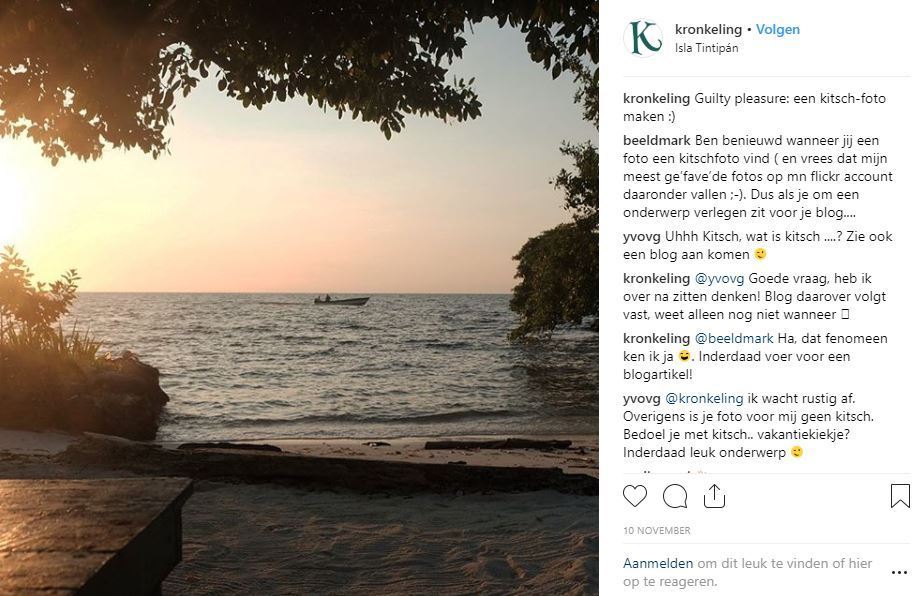
It’s funny, really. I added that caption without thinking. It was only when I received questions about it that I started thinking about what kitsch actually is.
What is kitsch?
I mainly use the word kitsch as a substitute for cheap sentimentality. And that was also my opinion of the photo I posted. But what does Wikipedia say about it?
"Kitsch is the often derogatory term for artistic works characterised by sentimentality, sensationalism or slickness. Kitsch is often equated with tastelessness, ugliness or poor quality."
Hmm, I don’t find Wikipedia’s definition very concrete. Almost all the words used are subject to taste. Because when, for example, is something sentimental? I’m missing concrete guidelines. So I came up with some myself. Below, you’ll read 3 characteristics that, for me, determine whether a photo is kitschy or not.
1. You’ve seen the photo many times before
A kitsch photo shows something you’ve seen many times before, in a similar composition. It’s the standard way of capturing something.
The Instagram account Insta_repeat gently pokes fun at photos that are posted and shared millions of times. Such as a person posing on the centre line of a road:
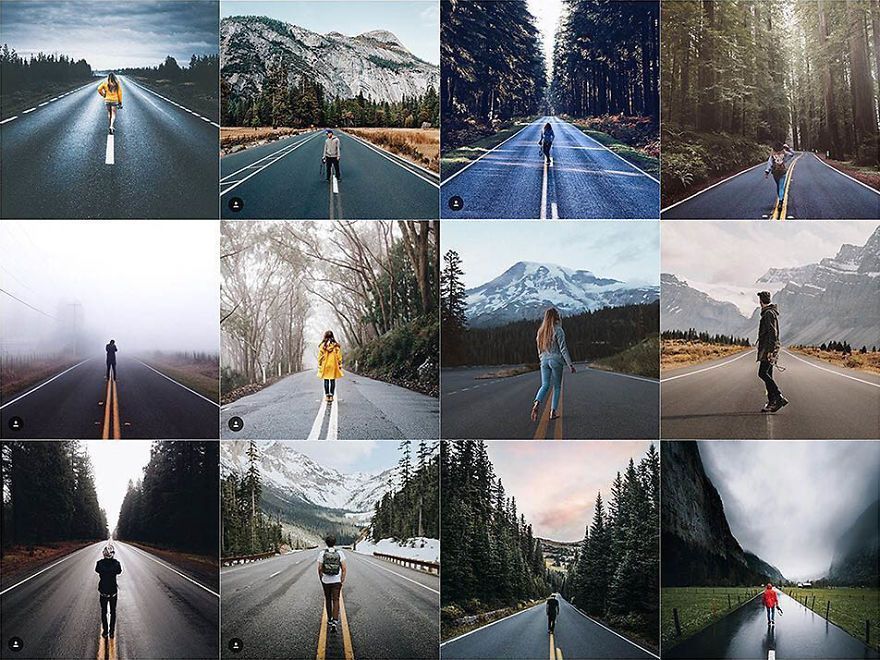
You see countless visual repetitions (you can read more about that here).
2. The photo has only one layer
In a kitsch photo, everything is revealed at first glance. Like this photo of a tourist striking a predictable pose by the Leaning Tower of Pisa:
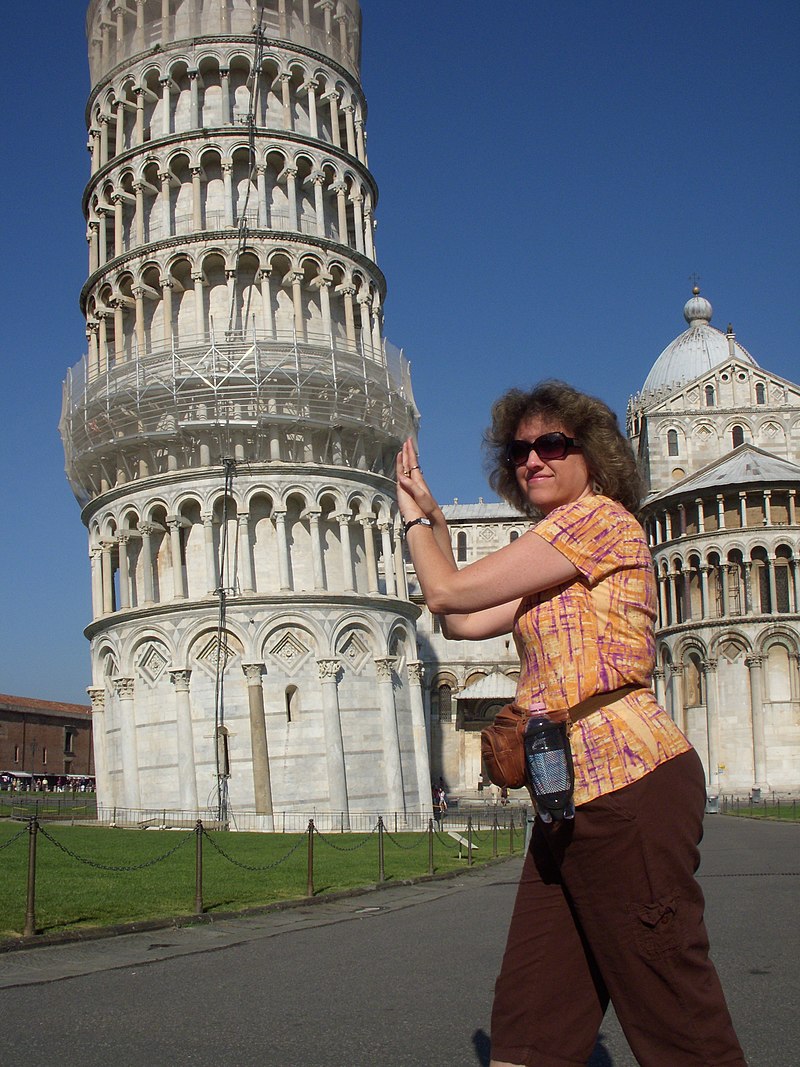
We’ve seen the photo above countless times before. And it’s a photo with only one layer: the what. We see the posed tourist, the tower and a bit of the surroundings. It doesn’t go any deeper. The photographer’s intention is completely clear. That’s different with Martin Parr’s photo, also of the same tower:
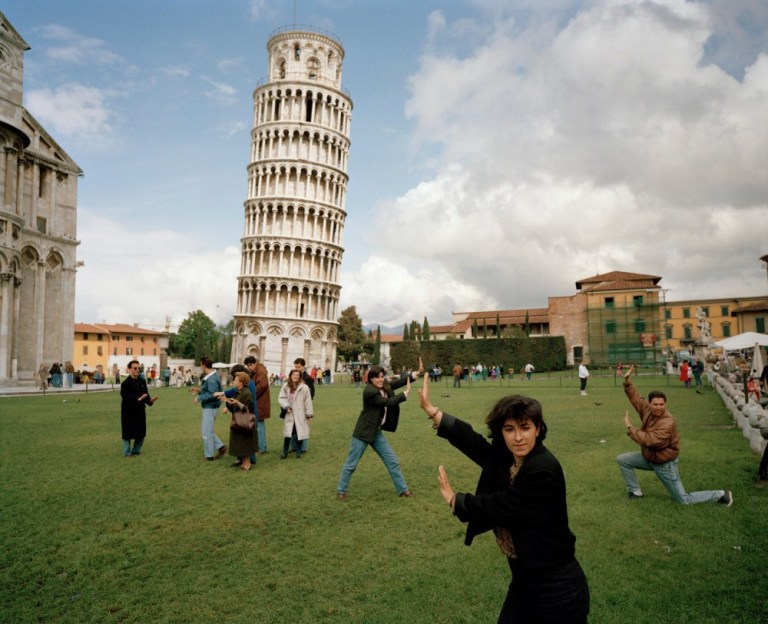
Here we suddenly see the absurdity of 3 tourists holding up the tower in different places. Martin Parr wants to say something with this photo. Perhaps something about our tourism industry gone too far. Or about how we behave at tourist locations. In short, the photo contains several layers. You can read things into it and reflect on the photographer’s intention.
That’s why I consider the first photo of the tower to be a kitsch photo, and the second one not.
3. The photo doesn’t grate
Right, so you’ve seen the photo many times before, the image has only one layer and:
that one layer doesn’t grate
Nothing in the photo evokes negative or ‘difficult’ emotions. It’s a sugary-sweet image of a wonderful world. The Swedish furniture giant specialises in this kind of imagery. Their art photography department doesn’t grate. Because that doesn’t sell. At least, not to the masses.
So, is the photo I made kitsch or not?
Right, let me immediately apply my self-made definition of kitsch to the photo that started the discussion, the image above this article:

1. Yes, I’ve seen this photo many times before. It’s a standard composition of a sunset, with sea, beach and some foliage around the edges.
2. The image also has only one layer. You see the sunset, and that’s it.
3. Finally, there’s nothing grating about this image at all. Just before that, a cat walked right through this scene. The animal enthusiastically made a little hole in the sand, and then proceeded to do its business in it at length. If I had photographed that, it would no longer have been a kitsch photo. But I was just too late, unfortunately.
Disclaimer: this article is in no way an argument against the kitsch photo. There’s nothing wrong with photographing scenes beautifully in a standard way, in my opinion. But it can sometimes help to be aware of the possibilities. And that things can also be done differently, if you want to.
About the author
Ik heb een eigen fotografieblog, Kronkeling. Daar schrijf ik om de week twee artikelen. Over hoe je je blik kunt scherpen, je creativiteit kunt aanwakkeren, en over fotografen die mij inspireren. Geen technische zaken, wél over hoe je leert kijken. En dat blijkt nog een hele klus. Een mooi startpunt zijn de Kronkeltips, die vind je hier.
You might also like
-
 How do you recognise a subject in a photo?
by Nando Harmsen
-
 The basics of flash photography explained
by Huub Keulers
-
 The tilt of a tilt-shift lens explained
by Nando Harmsen
-
The shift of a tilt-shift lens explained
by Nando Harmsen
-
 Choose white balance to suit your taste and create the right mood
by Nando Harmsen
-
 Video: Why I Love Photography
by Elja Trum
41 comments
-

 mrawie wrote on Tuesday 12 March 2019 at 10:35
| reply
You can of course philosophize endlessly about what is and isn't Kitsch. Yet I miss one element in Elvira Smit's description of Kitsch: that is "pretension". Kitsch pretends, for example, to be "art", or "literature". And I don't see that in her photo; I find it sweet, a nice little view, a pleasant reminder of a holiday; but it isn't pretentious. And there is nothing wrong with lovely souvenir photos, only they are often not that interesting to strangers.
Translated from Dutch. -
 Elvira Smit
wrote on Tuesday 12 March 2019 at 12:04
| reply
Dear Mrawie, thank you for your wonderful addition! As you say: you can philosophize endlessly about kitsch, and with your addition I will certainly do so again
Translated from Dutch. Kitsch can indeed also pretend to be something (like 'real' art), and sometimes it is therefore an over-the-top exaggeration of what it pretends to be. I agree with you that the example photo above does not quite meet that standard. Food for thought!
-
 Martin Hermes wrote on Tuesday 12 March 2019 at 12:24 | reply
I really find photos of streams of water and waterfalls where the water looks like floating mist kitsch I call them yoghurt photos. You are not depicting reality but a fashion trend and almost everyone thinks it looks beautiful. If you then take a standard holiday photo of reality that looks like something that has already been shown more often people talk about kitsch? Everyone photographs in their own way whether someone else finds that kitsch is totally unimportant.
Translated from Dutch. -
 Nelleke Bouman wrote on Tuesday 12 March 2019 at 12:34 | reply
You can think something is kitsch, but that doesn't make it so. Same as with art, who decides when something is art or not? Endless discussion, then.
Translated from Dutch. -
Elvira Smit
wrote on Tuesday 12 March 2019 at 12:45
| reply
Hi Martin Hermes & Nelleke Bouwman, thanks for your additions!
Translated from Dutch.
And just as with kitsch itself, you can of course also find the discussion about it unimportant or endless. In this article, I tried to record my own line of thought:
How do I use the word kitsch in relation to a photo?
My answer to that tells me something about how I experience photography, and what I consider important and unimportant in a photo - which in turn teaches me something about myself and my search in photography.
For some readers, this is (hopefully) an invitation to reflect on this as well, and for others a reason to happily click on to another article. Either way; wishing you lots of photography fun!
P.S. @Martin Hermes: great term, yoghurt photos -
 Mabel Amber
wrote on Tuesday 12 March 2019 at 13:09
| reply
I would rather talk about the "photographic cliché", by that I mean a well-worn theme.
Translated from Dutch.
But even then, you can distinguish different degrees of quality, both technically and in terms of content.
In short, be careful with a judgment and study the subject matter first before dismissing a so-called "kitsch" photo (or cliché, whatever you want to call it) as junk. -
Elvira Smit
wrote on Tuesday 12 March 2019 at 13:17
| reply
Hi Mabel Amber, exactly; be aware of your own (pre-)judices and try to dissect them. Nice addition too that there are different degrees of (subjective) quality.
Translated from Dutch. -
 Ineke van Iersel wrote on Tuesday 12 March 2019 at 13:27 | reply
kitsch .... not artistic ... beautiful, not beautiful .... straight out of camera or endlessly edited ... raw or jpg ... does it mean something to you or do you want to show off with it ??
Translated from Dutch.
I think no photo is kitsch, at most meaningless to others.
If you want to create masterpieces then you have to put a lot of effort into it Or be very lucky
Ineke -
 guest wrote on Tuesday 12 March 2019 at 13:45 | reply
May I ask you a question Elvira?
Translated from Dutch.
Was it your intention, when you went to carry out your "guilty pleasure", to give a really *good* example of a "kitsch" photo" ? Or just a snapshot taken off the cuff, without any further concern for quality ? -
 willyduvel
wrote on Tuesday 12 March 2019 at 13:49
| reply
What is art …………..and for whom ??
Translated from Dutch. -

-
Elvira Smit
wrote on Tuesday 12 March 2019 at 13:59
| reply
@Ineke: Nice perspective and a good question whether you photograph for yourself or to show off with it...
Translated from Dutch.
@gast: Answer to your question: it was a snapshot taken off the cuff. My musings on kitsch only began when I got the question on Instagram about what I actually consider kitsch.
@Willyduvel: Phew, that's material for another article. Or for countless articles. Because there too, there is no hard-and-fast truth...
@Kezeman: Well, handvaten or handvatten... I also wondered about the correctness of handvaten and had therefore looked it up. According to Genootschap Onze Taal, both are allowed! -
 P.M. Buth wrote on Tuesday 12 March 2019 at 14:23 | reply
Poses, lighting techniques and the rule of thirds. Straight-up invitations to make kitsch photos!!!
Translated from Dutch.
Also the photo trips to faraway places, photogenic locations and safaris produce a copy of what has been captured before and are therefore kitsch.... Is that what is being suggested??
I have a different view of kitsch and that comes down to "too much of a good thing".
That is how I keep the pleasure of making attractive-looking photos alive and dare to experiment with examples that appeal to me....
How is it with you guys??? -
 FrankVdeV wrote on Tuesday 12 March 2019 at 14:23 | reply
Calling such a photo kitch I find arrogant towards millions of amateur photographers. Just wrong word usage. You didn't check the meaning of kitch before your post. No prob. Check first, next time
Translated from Dutch. -
 Stef
wrote on Tuesday 12 March 2019 at 14:32
| reply
I definitely recognize this, because I fall into it often enough myself. I also find it difficult to make a somewhat original photo. Many subjects and techniques such as coloring and buttermilk streams have already been captured so often that it is difficult to make an interesting shot. Everyone looks at a photo in a different way, the amateur photographer critically and the layperson by what is in fashion at the moment. What also plays a role, I think, is the comment "not according to the rules", which can limit you in your creativity. As an example, two years ago I visited a photo exhibition with a number of beautiful landscape photos ,after the second round it struck me that although the locations differed, the shots all did not have the horizon in the middle, a path or stream that leads somewhere, 1/3, 2/3 etc. These rules are of course applicable but also make the photo predictable, not to say clichéd. What I find important is, do you make the photo to enjoy it yourself, or do you make them for other viewers? I think this could also become an endless discussion. Why do you choose hobby photography, of course also because you want to distance yourself from the everyday rules and really let yourself go in your hobby. So many people, so many opinions.
Translated from Dutch. -
 Fon wrote on Tuesday 12 March 2019 at 14:39 | reply
A brilliant discussion! Probably without a real answer to the question asked. But you don't have a discussion to be right, but to become better from it. This applies to all parties! Personally, I still miss the use of color. In my view, a photo can become 'kitsch' through, for example, unnatural use of color.
Translated from Dutch. -
L. Reints wrote on Tuesday 12 March 2019 at 15:04 | reply
I quickly looked it up in Van Dale: anything that is not genuinely sentimental or not truly artistic, but tries to be. (pseudo-art). The pretension of being something it is not, that is the essence of it in my opinion. Then taste or preference no longer has such an influence either.
Translated from Dutch. -
 Johan wrote on Tuesday 12 March 2019 at 15:06 | reply
According to the wiki standard, the vast majority of digital photo mush is kitsch, around 80%. That is a rule for all art: pop/rock, painting, literature, film: Predominantly more than middle-of-the-road work. Just go and have a look at an art market. Nothing wrong with that, it’s just that you can earn a few bucks with it.
Translated from Dutch.
But if you enjoy giving your photography individual content, you have little choice but to explore boundaries. It doesn’t make you popular at the photo club or on the course, but you are freed from the eternal macro of the butterfly or flower, the soft contour photo of your almost naked aunt and and a whole lot of other sadness. Hopefully handles (and not -vats) for taking well-considered photographs -
 Helen Brandenburg wrote on Tuesday 12 March 2019 at 15:25 | reply
Even a photo of something that has already been photographed 1000x can still be found beautiful because of special details.
Translated from Dutch.
The photo where it all started has much more to it than you see at first glance. The reflection on the terrace is beautiful, the shadows on the beach, the hammocks and the tent in the background surprising. If all that had been cropped out, there would indeed be a boring, worthless sunset left, but is that really kitsch? And then there is also 'camp', kitsch on purpose, those may well be some Pisa photos that still have meaning for the maker because the girlfriend he is now no longer with is holding up the tower. Indeed, endless discussions, but interesting! -
 Anton Buurman wrote on Tuesday 12 March 2019 at 15:27 | reply
Always center texts and forever; always maintain the same eye level from which you photograph.
Translated from Dutch.
The Simplistic Alliance once sang: "Search for yourself, brother, find yourself, be and remain only yourself".
And that is what really matters, I think: if you make that photo with your possibilities: is it good.
And yet here I want to make a plea (the Our Language Society will surely disapprove of this) for looking for that other viewpoint; photograph from a child's eye level; look upwards (and hold your camera like that and click) go and stand close to a facade to strongly emphasize the repetition; deliberately keep the horizon extremely low.
Very simple thoughts, to make that 'other photo'.
And what I find so nice: the Instagram collection of the people on the center line of the road forms a little work of art in itself.
And so the circle is round again, I think.
Crucial in all of this? Seeing. Seeing and seeing again!
Just leave that looking for what it is for a moment....... -
 Bernard wrote on Tuesday 12 March 2019 at 15:49
| reply
Kitsch... nice that you bring it up. Without a concrete definition, and therefore no measure to use for comparison, I would say. But even if there were one, could you still determine what is kitsch and what is not? By now I think there is no place left in the world that has not already been photographed or snapped. Snapped may actually be a better word than photographed, because taking a snapshot is no longer a problem these days. Almost everyone has a smartphone. That immediately brings me to another criterion for kitsch, if everyone has already snapped everything, can you even still speak of kitsch at all. Owning a smartphone creates a completely different problem these days: during an event, thousands of photos of the same thing are taken. What happens to them? Why do people prefer to take snaps rather than experience/feel the event? At home they all look at what they could have seen live. Only if you can add something personal, artistic or unique to a photo would you say that it is not kitsch, but where do you draw the distinction then? Just look at painting. There are countless portrait paintings by old masters. All one layer: the portrait of someone. Yet all those paintings fall under the heading of art, usually with a capital A, and we do not discard the Frans Hals portraits because we already have enough Rembrandts. We also consider a self-portrait by Picasso (non-figurative) to be art. That may well be the tipping point. When is it kitsch and when is it art?
Translated from Dutch. -
Bernard wrote on Tuesday 12 March 2019 at 16:20
| reply
@Anton Buurman. This of course stems from the question: who decides whether it is art or kitsch? Can you say of your own work that it is art or kitsch? At most, that it is intended to pass for it. In my opinion, it is "the others" who determine which category it belongs to. Your comments about making your photos "different" do indeed make sense, but... if you want it to be different, don't you then again belong to a larger group that wants it to be different? In other words, a photo of a photographer photographing and then a photo of that
Translated from Dutch. -
Mabel Amber
wrote on Tuesday 12 March 2019 at 16:20
| reply
@Elvira
Translated from Dutch.
I was the guy who asked the question about "shooting from the hip", but the Photofacts system is behaving strangely, because I WAS logged in. Now on to the "snapshot".
To be honest, I do think you should post a "Good" photo to illustrate your theme and not just a snapshot without any further qualities, sorry, but I am being honest about this.
Here you have a series of so-called "Kitsch" photos, but within the genre they are high-quality photos, both in terms of quality and content:
https://pixabay.com/images/search/beach%20sea/ -
Elvira Smit
wrote on Tuesday 12 March 2019 at 17:02
| reply
@everyone: what interesting opinions, new insights and original perspectives you share in the comments! Quite a few of your reactions are worthwhile articles in their own right
Translated from Dutch.
As far as I'm concerned, these varied reactions confirm the fact that there is no 'truth' to be found in this discussion. Insight, though: into your own preferences, your way of working and the photographic wishes you have. I continue to read your reactions with enthusiasm! -
Anton Buurman wrote on Tuesday 12 March 2019 at 17:03 | reply
@ Bernard: I get excited about this; yes! that's how it is!
Translated from Dutch.
It is comparable to the Russian matryoshka doll.
But still; what Elvira is liking now on pixabay; beautiful, isn't it, that is therefore not kitsch (I think) that is SEEING with capital letters.
The image is fascinating.
I sometimes show it to my sweetheart, when there is a photo on my phone: then I show that 'other' crop; that too makes a world of difference! For me it is about the composition of the plane.
Example: in the foreground the youngest child with just a little bit of jam still on the lips (because that was on the pancake). In the background: her little brother, who is walking with an empty plate. You can just SEE that the boy is walking to the kitchen. He knows that that's where the supplies are! Quickly snapped on a phone. With the result: world photo. No kitsch. How often will such a photo have been taken?
(Take a very small grain of salt with this; I am trying to look objectively at this photo, but these children do belong to our family ....... )edit such a photo? Hmm
Don't.
Exceptionally beautiful 'much-discussion' this. Chapeau! -
Bernard wrote on Tuesday 12 March 2019 at 17:40
| reply
@Anton. Yep, that's how you make photos that you consider worthwhile. Perhaps this is also the only real criterion. At least, I don't think like: today I'll make a photo that Piet likes. But is it then about art or kitsch and how do you recognize it? That was the original question. What happens when you elevate kitsch to art? That happens too. A number of years ago, the phenomenon of "lomography" suddenly became fashionable. The worse the photo, the better. It's the same discussion as: what do you find beautiful or what do you like to eat? But anyway, on a dreary day like today I am thoroughly entertaining myself with this "discussion".
Translated from Dutch. -

-
Anton Buurman wrote on Tuesday 12 March 2019 at 20:49 | reply
I’m going to give it a try after all.
Translated from Dutch.
In my view, kitsch is: (in random order)
1. the painting of the little gypsy girl with the slipped-down shoulder strap.
2. ceramic tiles with a wood pattern
3. adhesive plastic from the ’60s and ’70s
4. plastic flowers that look just like the real thing (my mother used to say: "Those flowers at Mien’s are so beautiful; just like plastic" .
5. Linoleum with a tile pattern
6. Marmoleum with a parquet pattern (indistinguishable from the real thing; pffff).
When it comes to photography, I can’t figure it out: that one photo (which someone else considers kitsch) has my grandmother in it! This is the last one we took of her before she passed away....... So yes, we’re talking about emotional value, where YOU as the maker see that photo again and don’t see the mountains in it, but the ENTIRE holiday; the smell, the music on the square, the wine, the singing and so on.
And then there’s another phenomenon (I think); that what you now consider kitsch, from say 30 years ago, or worse still: 50 years ago: we didn’t have anything else. That was it. Just after WWII in the middle of the reconstruction.
You do have to keep that in mind.
Anecdote: my parents had a camera with a roll in it; it could take 12 -no, I mean TWELVE- photos (negative of 6x6 cm.) on it. On the next holiday, the last 2 photos were quickly taken, so a fresh roll could be put in the camera.
Taking the roll in-waiting-developing-waiting-printing-waiting-picking it up - - - --> 4 photos failed.
Anecdote 2: at the weekend, we sometimes go for a walk with a camera too; sometimes without one (doesn’t happen often) I get home and I’ve taken 120 or 150 photos. On the projector in the evening. -
Bernard wrote on Tuesday 12 March 2019 at 21:48
| reply
@Anton. It keeps getting better. If I understand correctly, kitsch is about art. Or at least something that is supposed to pass for art. In that respect, your list is missing: Dorus Rijkers with a sou'wester, the black-and-white drawing of a little deer (always to be found on a draped cloth on the mantelpiece) and wrought-iron fish on a piece of natural stone. Yes, apparently I am from the same generation (1946).
Translated from Dutch.
As far as photography and kitsch are concerned, I think you hit the nail on the head. Namely: WHO determines WHAT is kitsch. Your examples are clear and speak for themselves. At home we had a bellows camera with 120 film with 6x9cm negatives. Even with that camera it could take years before the film was full. Later, at the beginning of the 1970s, I went on holiday with 2 or sometimes even 3 Agfa CT18 35mm slide films. Mind you, that was good for 72 or 108 exposures, of which 30% did not meet my quality standards and ended up in the bin. These days I take it easy and shoot an average of 2500 photos a year at 30MPix (Canon EOS 5DmkIV). But I also shoot with my iPhone and reason: if you don't shoot, you might miss a precious moment.
To return to the original question once more: "How do you recognize a kitsch photo in three steps?", it is simple for me to answer. I only need 1 step. I need that one step to form MY opinion and immediately point out that my opinion is not, or need not be, someone else's opinion. One particular thing really has to be said, and was already mentioned earlier by @Martin Hermes, the so-called yoghurt photo of a waterfall with an ND filter and long shutter speeds. If there is something truly terrible in my eyes, that is it. But whole hordes of people swear by it and show me that I have no feeling for beauty -
 osten wrote on Wednesday 13 March 2019 at 11:03 | reply
Hello
Translated from Dutch.
It was interesting,but if a photo is good for you, that is the most important
Regards,Osten -
 Joey wrote on Wednesday 13 March 2019 at 18:39 | reply
I find photographers who claim to make art especially pretentious. You could call photos by these photographers kitsch without a doubt.
Translated from Dutch. -
 martinphili wrote on Wednesday 13 March 2019 at 19:17
| reply
What arrogance!
Translated from Dutch. -
Fon wrote on Wednesday 13 March 2019 at 19:23 | reply
If we now agree that we will never say again: 'this is kitsch' but always the sentence
Translated from Dutch.
'I find this kitsch' and possibly add a personal motivation, then in my eyes the problem is solved. I personally think that the technical possibilities within our digital photography era sometimes invite absurdities. (e.g. whale emerging from an asphalt road) technically incredibly impressive, but as a photograph...... I think that's kitsch of the highest order.
In addition, there is also the fact that once you know the trick, the special quality of the photo disappears. At least for me. -
 theo wrote on Thursday 14 March 2019 at 12:12 | reply
I agree with Elvira that the photo you show is not particularly attractive to look at either. People often think that you take a photo and then it is finished. But in the analogue era, people also spent endless amounts of time in the darkroom to achieve the right effect. Think of Ansel Adams. With a lazy snapshot from a phone and slap it on Instagram, the word kitsch certainly does not apply. If only it were a little kitsch.
Translated from Dutch.
Kind regards, Theo -
Mabel Amber
wrote on Thursday 14 March 2019 at 13:07
| reply
Theo says "I agree with Elvira that the photo you are showing is also not very attractive to look at".
Translated from Dutch.
I think you are addressing me (Mabel Amber), Theo, because I was the one who made comments about the quality of Elvira's example photo (the writer of this article).
And furthermore, in general:
To be honest, I find Elvira's photo downright bad. When you write an article that claims to explain the concept of "Kitsch" in photography, then put up a *good* "kitsch photo". Hence my link to many very good "kitsch" photos on Pixabay.
Furthermore, I agree with Theo that photo editing is not something from the digital age. There were countless possibilities for influencing the quality and appearance of a film photo. I will mention:
Outside the darkroom:
1. choice of film
2. choice of filters (you had countless ones, with all kinds of effects! Very closely comparable to the filters now offered in editing programs)
3. multiple exposures
4. Creative flashing
5. For color photos: use daylight film for night photography and vice versa, use film for evening photography in daylight. You could also influence this by instructing the developing lab to switch the developing processes.
The results were not rarely very special and also particularly surprising. I can speak from experience because I experimented a great deal.
In the darkroom:
2. choice of developer
3. choice of developing time (be careful with this..)
4. choice of type of photographic paper
5. use of filters in the enlarger
6. dodging and burning
7. zone photography (that was a science in itself)
8. pseudosolarization (turning on the light when the photo was in the developer)
9. use of toners (toner bath after the wet developing process)
...and there were more processes that I cannot think of right now.
Finally: "kitsch" photos do not exist, it is a term with which people conveniently refer to a genre, in English one speaks of "eye candy", literally "candy for the eye", but even in that you have good and bad quality.
There are only good and bad photos. -
theo wrote on Thursday 14 March 2019 at 15:50 | reply
You're right Amber, I meant you. You give a very clear representation of the analogue era.
Translated from Dutch.
greetings Theo -

-
Anton Buurman wrote on Friday 15 March 2019 at 11:50 | reply
@ALL: I too find this very refreshing, to share and read these ideas. If anyone knows of anything else to have contact with each other in this way, I'm all ears.
Translated from Dutch.
Chapeu for the way these participants interact with each other. -
Fon wrote on Friday 15 March 2019 at 12:09 | reply
@Mabel and Theo. Indeed, you can influence a lot with analogue photography. I look back on that era with pleasure. However, I think that back then fewer people had access to a darkroom than people now have access to a laptop or PC. The possibilities are now more extensive and easier to obtain. Besides, I wouldn't be able to conjure a whale up out of the asphalt with analogue photography just like that. Digitally, it works flawlessly and quickly.
Translated from Dutch. -
 a wrote on Saturday 16 March 2019 at 19:17 | reply
What I find beautiful, someone else doesn't have to find beautiful. Who am I to judge "kitch" photos negatively.
Translated from Dutch. -
martinphili wrote on Sunday 17 March 2019 at 07:48
| reply
I found another nice quote from someone who also took a photo now and then:
Translated from Dutch.
“I hate good taste. It’s the worst thing that can happen to a creative person” -Helmut Newton-
I think it fits this discussion.
Have your say
Please note: Articles older than a week can only be commented on by signed-in visitors.Would you still like to comment? sign in or create a free account.
Become a better photographer every week
A practical photography tip in your inbox every week.
38,937 photography enthusiasts already receive the tips! More about the weekly mail. Or keep up to date via  Facebook.

Elja Trum
Photofacts; everything to do with photography!
Would you like to take better photos and keep up with what is happening in photography? Photofacts publishes articles that teach you something about photography — from a product announcement to a practical shooting tip or a look at a website. Photofacts covers photography every day and is a hobby project of Elja Trum's that got out of hand. The articles are written by a team of volunteer authors. If you would enjoy writing one or more articles for Photofacts, do get in touch.More about PhotofactsPhotofacts is made possible in part by
