

3 Tips for Photographing Semana Santa
Monday 22 April 2019, 15:30 by Michelle Peeters | 8,248 views | 12 commentsThis article was translated from Dutch with the help of AI. Read the original.
The famous Semana Santa de Sevilla is celebrated in the week before Easter and commemorates the suffering, death and resurrection of Christ. Holy Week in Seville is dominated by dozens of processions that make their way through the barrios under a blanket of incense.
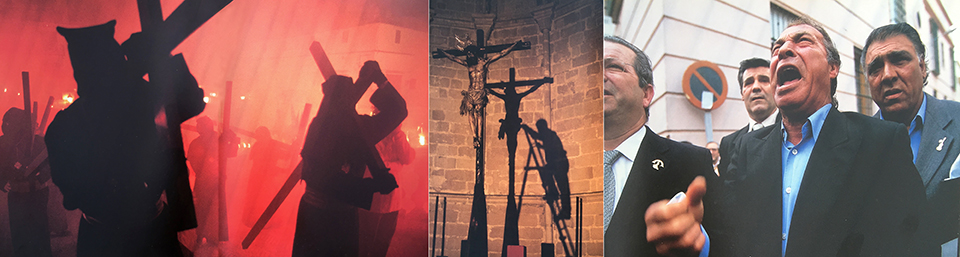
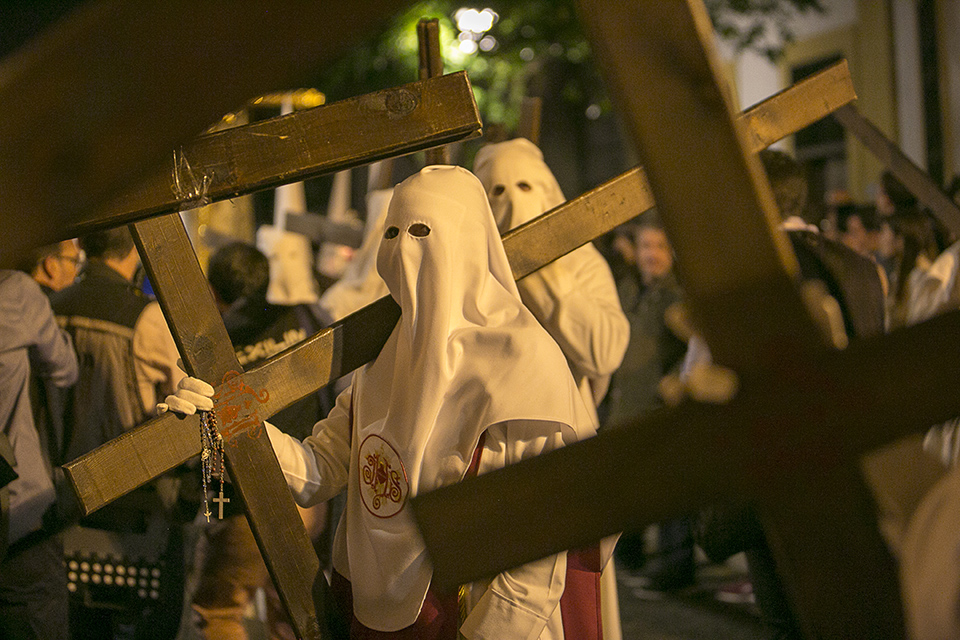
Catholic brotherhoods wearing pointed hoods carry the large and often heavy structures with statues of Christ and Mary through the narrow, crowded streets of Seville. Young and old, religious and non-religious, take part in this grand religious celebration, which is centred around penance.
Ku Klux Klan?
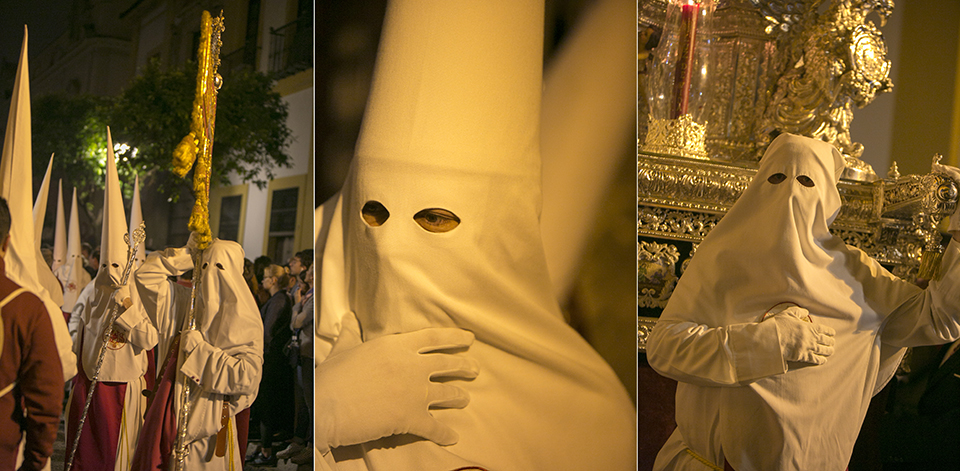
The penitents wear a capirote, a head covering that guarantees anonymity. It can be confused with the more recent uniform of the Ku Klux Klan. However, there is nothing far-right about Semana Santa.
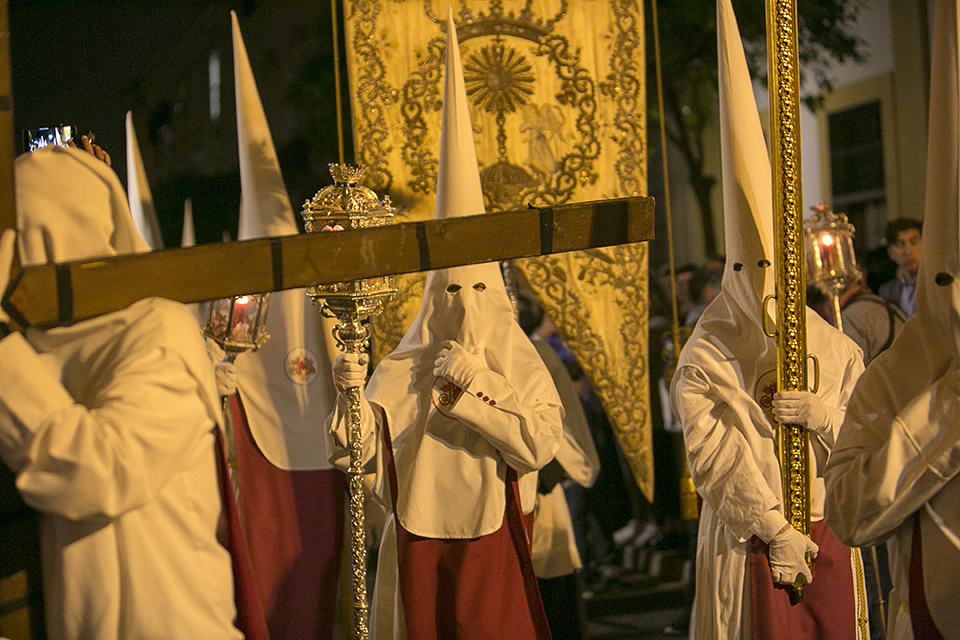
The dozens of cofradías play an important role during Semana Santa in Seville. These brotherhoods, also called hermandades, are impossible to miss in the processions with their long robes and pointed hoods, or capirotes.
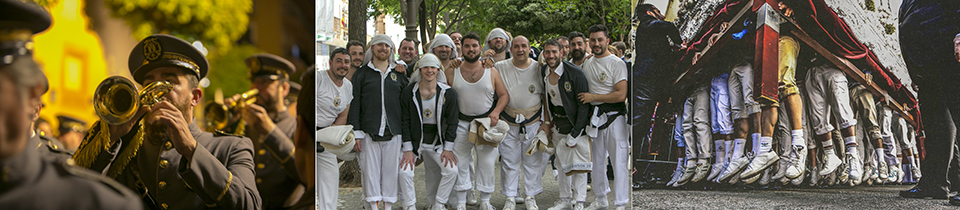
They accompany and carry the pasos, structures with gold and silver statues of saints, through the crowded streets of Seville under the leadership of a leader, the hermano mayor. To be allowed to do this, you must be a member of the brotherhood, which is considered a great honour.
The brotherhoods, recognisable by their pointed hoods and robes, each have their own saint, with grand names such as 'Christ of the Conversion of the Good Thief' or 'Holy Virgin of Grace and Patience'. The Hermandad de la Esperanza Macarena is famous. This brotherhood was founded in 1595 and has around 12,600 members worldwide.
Easter story in 7 days
During Semana Santa week, the Easter story is told over 7 days, beginning on Palm Sunday with a high mass led by the Archbishop of Seville. On the same day, 9 royal brotherhoods hold a penitential procession.
On the following days, 7 to 9 brotherhoods take part in the processions each day. On Thursday, Holy Week reaches its climax as the oldest brotherhoods lead their finest pasos through the streets. Semana Santa ends on Easter Sunday, which is dedicated to the resurrection.
In the morning, there is just one procession, organised by the Hermandad del Resucitado brotherhood. During Semana Santa, the processions leave from the brotherhood's church, where the statues are displayed, and head to the cathedral.
You have to take the processions into account, as they can last for hours because of the painfully slow pace at which they make their way through overflowing streets.
In 8 days, there are a total of 52 impressive processions, each sometimes lasting as long as 14 hours. Photographing here is really hard work because everything happens so quickly and there are too many people out and about who want to see the processions up close.
This was my first time in Seville during Semana Santa, but I will definitely go back to experience again how impressive these processions are. This is a piece of Spanish culture with a capital C, and of course also the C of Christianity.
3 photography tips
This kind of photography is very similar to concert photography. That is, if you do not have accreditation and therefore do not have a press card.
Press photographers were allowed to stand in the most sought-after spots, often in front of the exit of a church from which the procession was about to leave. As a hobby photographer without a press card, you have to find your own spot in the crowd.
1. Preparation and arriving well in advance
Make sure you study the programme carefully so that you are at a strategic point near the location well in advance, arriving an hour beforehand is certainly no luxury. In a bend, preferably on a raised spot so that you are always higher up than the rest of the crowd.
People always arrive at the last minute and squeeze past you, which can suddenly block your view. If you want to attend a salida, when the procession leaves a church, you have to bear in mind that you need to be there two to three hours in advance.
Use a Semana Santa app to find out where each part of the procession is and at what time. You can also get last-minute changes or delays and cancellations, which often happen when it rains, through the app. Paso a Paso is a very useful app.
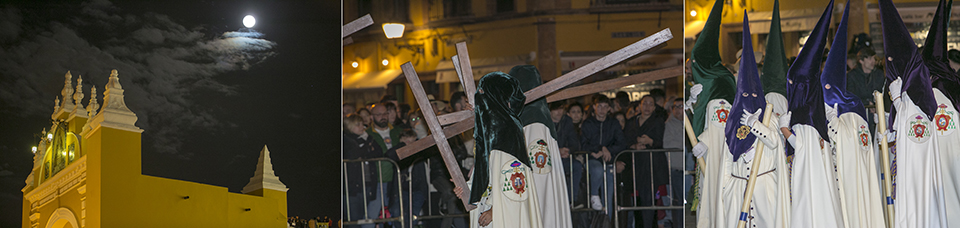
On Thursday night, you really have to 'stay up all night'. The night of Holy Thursday is the most important night of Semana Santa in Seville. Locally known as La Madrugá, from the word madrugada, meaning early in the morning, processions continue throughout the night until Good Friday.
La Macarena may well be the most iconic procession of them all. With more than 3000 participants, seeing this night-time procession is an unforgettable experience.
2. Extra equipment
I saw many photographers walking around with small stepladders, lightweight and easy to hang over your shoulder. A monopod can also work wonders. You can use it to hold your camera above your head and photograph the scenes from above.
The condition, of course, is that you can operate your camera via a smartphone, so that you can control your framing, camera settings, if they have not already been set, and timing. If you do not have that, a tilting live view screen can also work wonders.
A reportage flash is useful, especially when it is dark. You will have to work with very high ISO values anyway, which means you risk getting noise. However, if you make sure that you do not have to recover too many dark shadows by exposing and lighting properly, you can keep the noise well under control.
With this kind of photography, the atmosphere is best captured in the evening. The hundreds of burning candles on the pasos and the moonlight on the penitents' pointed hoods create a magical atmosphere.
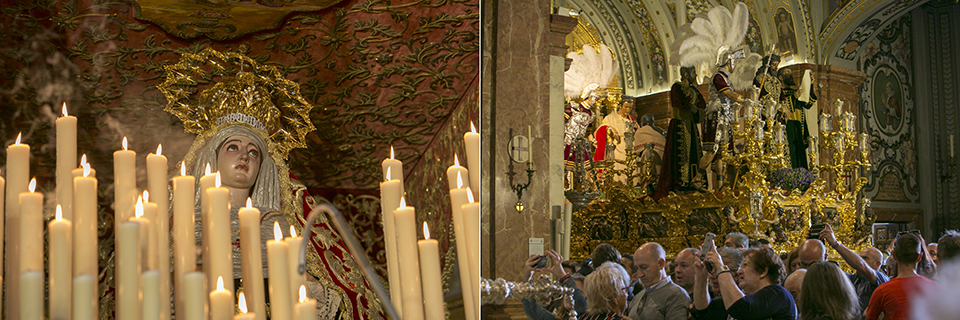
Be careful not to flatten the image with flash, and make sure you do not get different colour temperatures, daylight and candlelight, in your photos. A yellow gel for your flash works best in this case. Set the flash at a 45-degree angle and set it to 1/8 of its maximum power for a nice subtle effect.
3. Lenses
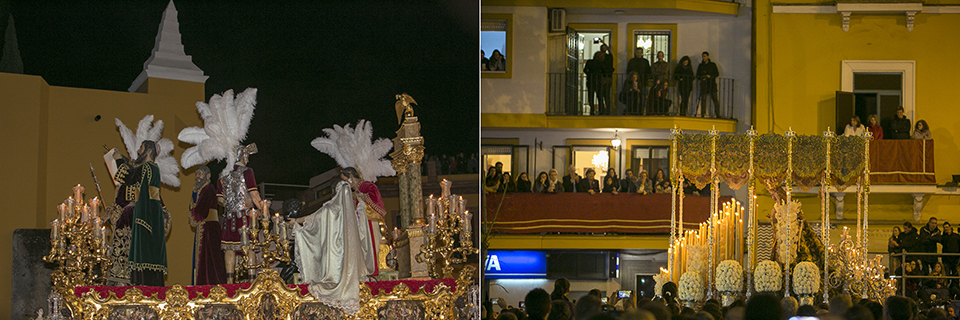
I photographed almost everything with my 70-200mm lens. Sometimes with a 2.0 extender, giving me 400mm. This creates a nice effect, with beautiful bokeh, a blurred background and little distortion, when you see the procession with the pointed hoods, musicians and pasos approaching from a distance.
Make sure you use a sufficiently fast shutter speed when you zoom in a lot. A stabiliser is no luxury either. Or work from a tripod. I did not do that because I already had quite a few kilos on my back that had to be carried to the different locations.
More and/or better tips?
If you have experience photographing Semana Santa in Spain or other Easter celebrations where you also have to manage in large crowds, we would love it if you shared it in the comments, possibly with some extra tips!
About the author
Michelle Peeters is fotografe en oprichter van DeuxBleus Fotografie. Michelle herkent het bijzondere in het gewone en het gewone in het bijzondere. Ze heeft zich nooit willen specialiseren en is daardoor van alle markten thuis.
You might also like
-
 File names are not important in Lightroom
by Nando Harmsen
-
 Two mistakes I made on holiday
by Elvira Smit
-
 Adventures with the Sony 200-600mm (week 1)
by Erik Nevels
-
 Crashed 3 times in one week
by Elja Trum
-
 The 2026 solar eclipse
by Nando Harmsen
-
 Are you ready for the solar eclipse?
by Nando Harmsen
12 comments
-
 Ron wrote on Tuesday 23 April 2019 at 12:07 | reply
The tips are good for photographing (street) events. The title makes me think that beautiful photos of Semana Santa are wanted here, while probably few readers have the opportunity or means to travel there specifically for it, and besides, it only takes place once a year...
Translated from Dutch.
A more general title and also a greater diversity of images from different events would, imo, have been "better". -

 Michelle Peeters wrote on Tuesday 23 April 2019 at 12:14
| reply
@Ron: the photography tips are similar to those for concert or event photography. It also says so in the article.
Translated from Dutch. -
Ron wrote on Tuesday 23 April 2019 at 12:32 | reply
That's why I'm talking about the title and the photos, not the text and the tips.
Translated from Dutch.
-
 mousquito wrote on Tuesday 23 April 2019 at 13:04
| reply
I went photographing carnival parades for a while. A fun experience and I have to say, apart from the light, these always take place during the day and thus little to no consideration is given to longer shutter speeds and such. but otherwise I could completely relate to this story of being among the people and squeezing your way around for the perfect shot, or missing the press card... but fortunately a fluorescent vest and a Belgian tricolor around the arm helped, and people let me through as if I were an "official photographer", even the people in the parade took the time for me
Translated from Dutch. both attributes freely available to buy and freely allowed to wear during the day too -
Michelle Peeters wrote on Tuesday 23 April 2019 at 13:35
| reply
@Mousquito: that's a really good tip, thanks!!
Translated from Dutch. -
 Dick wrote on Tuesday 23 April 2019 at 15:55 | reply
Nice and very recognisable. I was also in Seville last week for Semana Santa and it was my first time too. It made quite an impression!
Translated from Dutch.
Despite having 'read up on it', the reality was still different. Because of the crowds, it is almost impossible to get from one location to another (quickly). So good preparation is essential. Through the website stralendsevilla.nl I arranged a handy little guide with an explanation and the routes of the processions (and a few recommendations). I studied videos of the processions on Youtube and looked up the various locations with Google Maps. This gave me an insight into the distances and allowed me to make a plan of what I wanted to see.
I soon realised that it is almost impossible to get the pasos fully and properly in a photo, so I chose to photograph some more fun details. I was so glad I had brought my 70-300mm! -
Michelle Peeters wrote on Tuesday 23 April 2019 at 16:15
| reply
@Dick: nice! And indeed, details are very important!
Translated from Dutch. -
 Ton wrote on Tuesday 23 April 2019 at 17:04 | reply
Nice article and photos, I still recognize taking the little step stool along from taking photos in a crowd during official occasions. As a beginner (at the TV Guide) I didn't have one, with a colleague who was a friend being kind enough to lend it to me for a moment. Indeed, people squeeze themselves in front of your camera at the very last moment.
Translated from Dutch. -
 Hanneke Verloop wrote on Tuesday 23 April 2019 at 21:18 | reply
Tip: go to a small town instead of cities like Seville, impressive though they may be. Six years ago I made a beautiful reportage in the small town of Pego (the following year my photos were exhibited there). It was precisely the small scale and involvement of the people from the town that made photographing and filming a joy. No trace of commercialism. We could get close everywhere and were even invited to do so there. Everyone gave us space. Very impressive.
Translated from Dutch. -
Michelle Peeters wrote on Wednesday 24 April 2019 at 00:47
| reply
@Hanneke: indeed, those small places are also really nice and less crowded! I am curious about all the photos, by the way. You could possibly post them on Photofacts' Facebook page!
Translated from Dutch. -
 Dirk Kayaert wrote on Wednesday 24 April 2019 at 10:18 | reply
The tips given are very valuable. I was in Cáceres last week to photograph Semana Santa. An impressive experience. Cáceres (also a UNESCO World Heritage Site) is less grand than Seville and therefore more manageable and more relaxed, people know each other. I hardly heard any Dutch, French or English being spoken there. But here too it goes on day and night and as a photographer you have to choose. In terms of crowds, I can give the tip to choose a spot halfway along the route, as it turned out to be a little less crowded there each time. And indeed, be there an hour in advance. Small streets are the most fun to photograph, but also crowded. You should definitely experience the start of a procession at least once, but the crowds there are enormous. One more tip: go (in good time) to the end point of the procession: it is generally less crowded there than at the beginning.
Translated from Dutch. -
Michelle Peeters wrote on Wednesday 24 April 2019 at 12:51
| reply
Great tips everyone, thanks a lot!
Translated from Dutch.
Have your say
Please note: Articles older than a week can only be commented on by signed-in visitors.Would you still like to comment? sign in or create a free account.
Become a better photographer every week
A practical photography tip in your inbox every week.
38,938 photography enthusiasts already receive the tips! More about the weekly mail. Or keep up to date via  Facebook.

Elja Trum
Photofacts; everything to do with photography!
Would you like to take better photos and keep up with what is happening in photography? Photofacts publishes articles that teach you something about photography — from a product announcement to a practical shooting tip or a look at a website. Photofacts covers photography every day and is a hobby project of Elja Trum's that got out of hand. The articles are written by a team of volunteer authors. If you would enjoy writing one or more articles for Photofacts, do get in touch.More about PhotofactsPhotofacts is made possible in part by
