

Why would you zoom with your flash?
Wednesday 21 December 2022, 15:51 by Liesbeth van Asselt | 4,600 views | 1 commentThis article was translated from Dutch with the help of AI. Read the original.
Your flash has a zoom button, often marked 'Zm'. With this button, you can set the zoom from, for example, 20 to 200 mm. Many photographers hardly ever use this zoom function, usually without realising it.
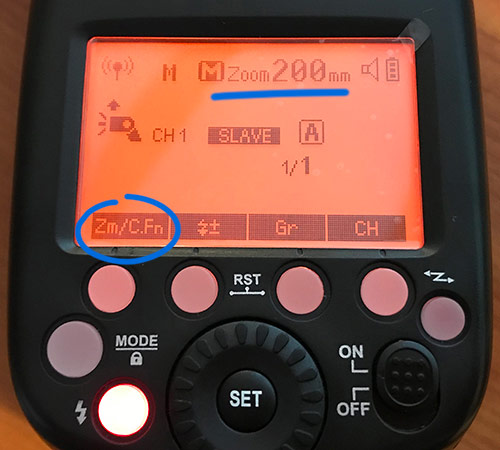
You may use it without realising it. In automatic mode, with your flash pointing straight forwards, your flash automatically zooms in line with the focal length of your lens. This means you do not waste flash power illuminating something that is outside the frame anyway.
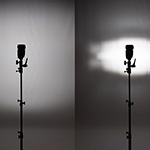
What you are actually doing when zooming is moving the flash tube forwards or backwards inside the flash head. When the flash tube is at the back of the flash head (200mm), the light has to pass through a tube, the flash head, before it leaves the flash.
This bundles the light. If you set the zoom to, for example, 20 or 30, the flash tube is right at the front of the flash head, so the light can spread in all directions.
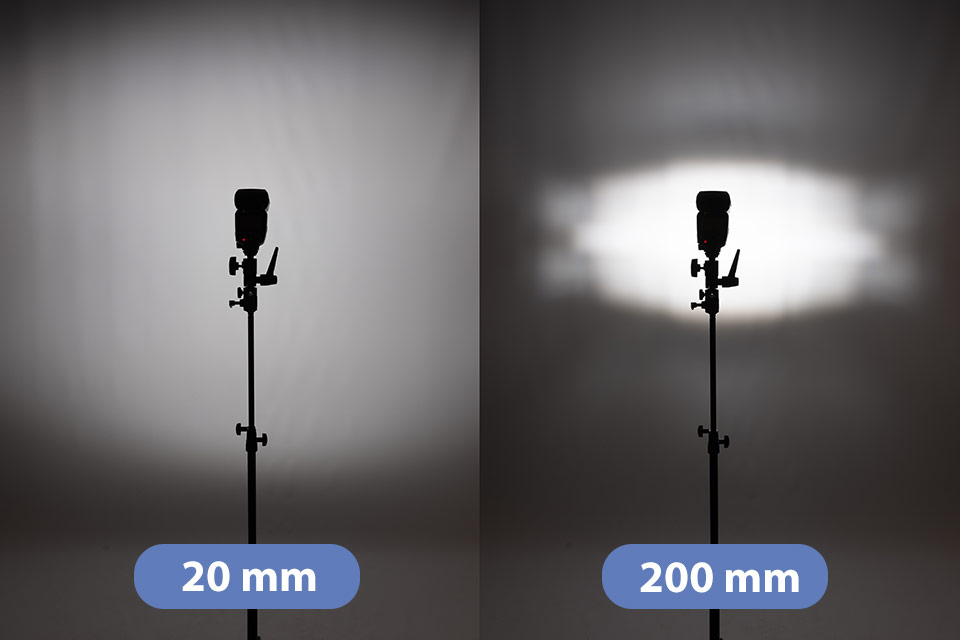
This is something I always use when combining light painting with flash. I do not want the flash light to hit the painting, because the light from the flash would then wash out the light from the torch.
By zooming to, for example, 200mm, I can direct the light very precisely at the model's face.
If some light still falls on the light painting, I attach a grid to the flash, which bundles the light even more.
So you can use the zoom setting to direct your light more precisely without immediately attaching all kinds of accessories to your flash.
About the author
Liesbeth fotografeert met haar bedrijf stapfoto.nl voor websites van bedrijven. Daarnaast verzorgt ze al sinds 2004 (vooral creatieve) workshops zoals lightpainting, flitsen in de natuur, fine art, frozen flowers, paintsplash, infrarood, icm en multi exposure. Daarnaast is er een Stapfoto vakgroep voor de meer gevorderde fotografen.
You might also like
-
 Why zooming with your feet is not the same as zooming with a lens
by Nando Harmsen
-
 Canon introduces the EOS R6 V with an RF 20-50mm power zoom
by Nando Harmsen
-
 Sony presents the FE 16-35mm f/4 power zoom lens
by Nando Harmsen
-
 Flash photography tip: Use your flash's zoom setting
by Elja Trum
-
 Samyang's first zoom lens: the AF 24-70mm f/2.8 FE
by Nando Harmsen
1 comment
-

 Ytos
wrote on Saturday 24 December 2022 at 17:18
| reply
Ytos
wrote on Saturday 24 December 2022 at 17:18
| reply
Interesting article. My experience, incidentally, is that some photographers unconsciously disable the automatic zoom function by sliding out the built-in wide-angle diffuser. If you do that, the flash head automatically moves to the wide-angle position. People do that because they think that wide-angle diffuser functions as a kind of omnibounce to make the light softer. Or it is a matter of "It's on there, so we'll use it."
Translated from Dutch.
I can remember that I once explained that zoom function, but it just wouldn't work for one participant. At one point I removed the omnibounce from the flash, only to find out that the wide-angle diffuser hadn't been slid back properly. You can spend a long time searching then
Have your say
Please note: Articles older than a week can only be commented on by signed-in visitors.Would you still like to comment? sign in or create a free account.
Become a better photographer every week
A practical photography tip in your inbox every week.
39,077 photography enthusiasts already receive the tips! More about the weekly mail. Or keep up to date via  Facebook.

Elja Trum
Photofacts; everything to do with photography!
Would you like to take better photos and keep up with what is happening in photography? Photofacts publishes articles that teach you something about photography — from a product announcement to a practical shooting tip or a look at a website. Photofacts covers photography every day and is a hobby project of Elja Trum's that got out of hand. The articles are written by a team of volunteer authors. If you would enjoy writing one or more articles for Photofacts, do get in touch.More about PhotofactsPhotofacts is made possible in part by
