

Review: Canon EOS R full-frame mirrorless camera
Tuesday 12 February 2019, 09:18 by Elja Trum | 13,303 views | 5 commentsThis article was translated from Dutch with the help of AI. Read the original.
In September 2018, Canon announced its first full-frame mirrorless camera: the Canon EOS R. An important step for Canon's future. The camera is now readily available. We put it through its paces.
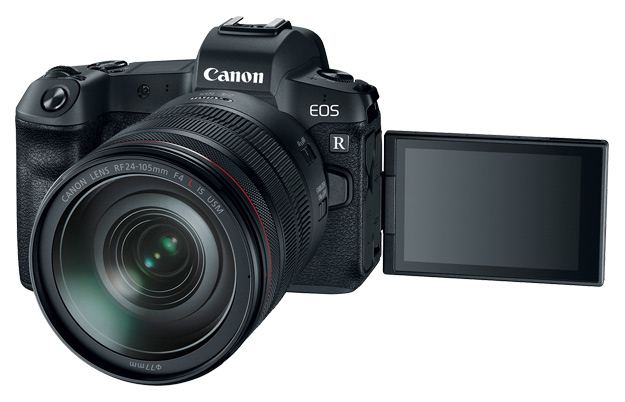
Canon EOS R specifications
- Canon RF mount (EF and EF-S lenses can also be used with adapters)
- 30.3-megapixel full-frame CMOS sensor
- ISO sensitivity: 100 - 40,000 ISO (expandable to 102,400 ISO)
- Dual Pixel CMOS autofocus with 5,655 autofocus points
- 8 photos per second (3 with continuous autofocus)
- 5-axis image stabilisation (video only)
- 4K 30p video (with 1.7x crop) with Canon Log and 10-bit 4:2:2 HDMI output
- Electronic viewfinder with 3.69 million dots (100% of the image)
- Fully articulating touchscreen
- Focusing in 0.05 seconds
- DIGIC8 processor
Canon EOS R video review
Would you rather watch than read? In the video below, I briefly go through a number of things that stood out to me when working with the Canon EOS R. I also show you the different RF lenses.
Canon EOS R system
The Canon EOS R is the first camera in what is set to become an extensive series of cameras and RF lenses.
Four new lenses specifically for the new RF mount were announced straight away. However, you are not limited to these new lenses, because Canon also supplies a number of adapters that allow you to continue using your EF lenses on this camera.
That is useful, because many Canon users will be more interested in mirrorless cameras from their trusted brand than those from other brands. They can simply keep using their existing lenses.

It also gives people who are completely new to Canon access to lenses that are not yet specifically available with the RF mount.
EOS R is therefore not only the name of Canon's first full-frame mirrorless camera, but also the name of the new EOS R system. In terms of its 'importance', you can compare it with the introduction of the EF mount. That was launched in 1987, more than 30 years ago.
In the hand
The Canon EOS R feels comfortable in the hand. Especially if you already work with Canon, the controls immediately feel familiar.
The EOS R is not as compact as some other mirrorless cameras, but the advantage is that the grip is easy to hold. The camera immediately feels very mature.
If you find the grip too small, an optional battery grip is available. Personally, I do not think the extra grip is necessary, but it can be a useful addition if you have very large hands.
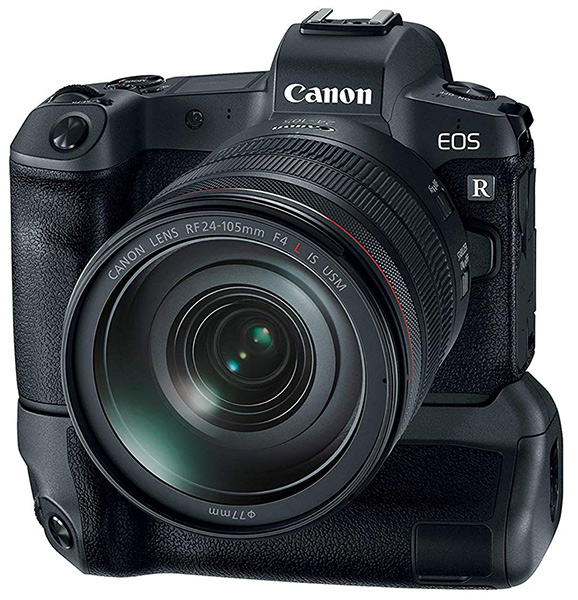
Although there are brands that produce more compact full-frame mirrorless cameras, the EOS R is certainly more compact than, for example, the Canon EOS 5D Mark IV, with which it shares its sensor. The difference is mainly in the thickness of the camera, the EOS R is considerably slimmer.
Of course, every new camera takes a little getting used to, but as a Canon user I became familiar with this camera very quickly. The controls differ in quite a few ways, but many aspects also feel familiar. If you already own a Canon, you will notice this straight away when using the EOS R.
For example, the joystick is missing. On other Canon models, this allowed you to easily choose the desired focus point. You can now use the touchscreen for this. You can choose the focus point with your thumb while simply looking through the viewfinder. This way of working takes some getting used to, but works quite well.
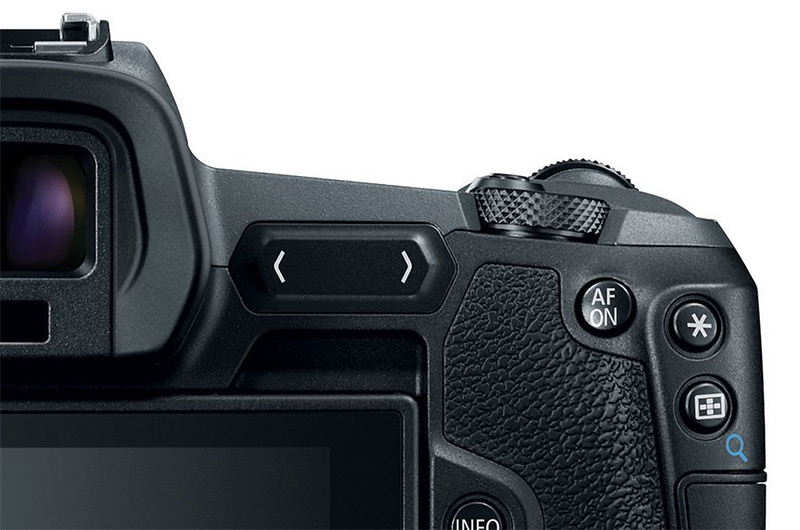
The M.Fn bar is new. This is the small touch bar on the back of the camera. You can use it in many different ways. For example, to quickly adjust the ISO sensitivity.
I did accidentally change a setting a few times. It is possible to put a 'lock' on the bar, so that you first have to press the left side of the bar to unlock it. This prevents you from changing a setting unintentionally.
Electronic viewfinder
Electronic viewfinders are inherent to mirrorless cameras. With a DSLR, you have an optical viewfinder through which you look at your image via a pentaprism and a mirror. That mirror sits in front of your sensor and flips up when you take a photo.
With a mirrorless camera, you look at a small screen in your viewfinder. This means you no longer need a pentaprism or mirror. The sensor is exposed and its image is sent directly to your electronic viewfinder.
The big advantage is that you can immediately see in the viewfinder what the final result of your photo will look like. That is incredibly useful in many situations. You no longer have to take the photo first, only to discover that you still need to adjust something.
If you do not use the live preview in the viewfinder, which is not useful or possible in every situation, you can also see the photo in your viewfinder immediately after taking it.
Personally, I do not find that very pleasant to work with, because you may miss a subsequent photo. Fortunately, you can completely customise the Canon EOS R. There are an incredible number of setting options.
The electronic viewfinder itself is extremely good, by the way. You no longer really feel as though you are looking at a screen. The display shows changes and movement extremely quickly, with no noticeable delay.
The electronic viewfinder also offers high-quality colour reproduction. You cannot distinguish individual pixels. I did not miss the optical viewfinder for a moment.

Sensor
The Canon EOS R contains a sensor comparable to the 30-megapixel sensor also found in the Canon EOS 5D Mark IV from 2016. It is a good sensor that produces excellent results and has a pleasantly wide dynamic range.
In my view, Canon has put the best sensor currently available to the company in the EOS R. It is good to see that they did not cut corners with their first full-frame mirrorless camera.
This gives the camera the image quality of the 5D Mark IV at a lower price.
A useful detail when changing lenses is that the sensor is covered by the shutter. With some mirrorless cameras, the sensor is immediately open and visible, which can cause a lot of dust problems if you change lenses frequently. A small detail, but very practical.
Battery
The Canon EOS R uses the same batteries as Canon's high-end DSLRs, such as the 5D, 6D, 7D and 80D. Handy! It is a good battery and you can easily photograph all day without having to change batteries.
Articulating screen
The EOS R is certainly not Canon's first camera with a useful articulating screen, but we unfortunately see them less often in this high-end segment. It is therefore very useful that the EOS R has one.

This folding screen is ideal when you want to take a photo from a very low or high viewpoint. You can simply put the camera on the ground and still check the focus and composition without having to lie down yourself.
The screen can also rotate all the way around, so you can see what you are recording from in front of the camera. Handy for vloggers and selfie fans.
Eye Autofocus
The Canon EOS R has an option that I really appreciate as a portrait photographer: Eye Autofocus. In this mode, the camera automatically focuses on an eye it detects in the image. That makes portrait photography just a little easier.
This means you can abandon the technique you currently use for this. I am the type who focuses and then frames. First I focus on the model's eye, then I keep the shutter button half-pressed and determine my composition.
This technique works well and quickly for me, but automatically focusing on the eye is still a little easier.
Another technique commonly used by photographers is to manually select a focus point near the model's face and then focus. You then need to make smaller movements to create your perfect frame, which can reduce possible blur.
This method is naturally also much more cumbersome than letting the camera find the eye.
Eye Autofocus works very well in practice.
Focusing in low light
I was very pleased with the autofocus of the Canon EOS R. It is extremely fast and still works very well when you are photographing in the dark.
Among other things, I photographed in the dark in the street with the camera and had no problems focusing with the available street lighting.

In situations like this, you also discover that the sensor's light sensitivity is excellent. Comparable to the Canon 5D Mark IV, as is the dynamic range.
That means you can still take perfectly usable photos in dark situations. Above 40,000 ISO, noise becomes increasingly noticeable. I would only recommend that for emergencies when you really have no other option.
Customisable controls
Most cameras can already be customised quite well to suit your preferences, but Canon goes very far with the EOS R. You can assign almost any button a function of your choice.
It is nice to be able to make the camera completely 'your own'. So you can change settings almost blindly and adapt the camera to the way you work.
It will naturally take a few weeks before you discover what works best for you, but it means you can work even more comfortably.
The ultimate aim is, of course, that the camera never gets in the way of taking the photo. It is a tool that you almost do not want to notice is there.
To achieve that, being able to set up the camera yourself is very important. A lot is already possible, but you still run into limitations occasionally. Perhaps Canon will make even more things customisable in a future firmware update.
RF to EF adapter
Canon produces a number of adapters for the Canon EOS R, so you can continue using your existing EF lenses. We had the adapter with the control ring. You can use this ring to control a camera setting, such as the aperture, shutter speed or ISO.
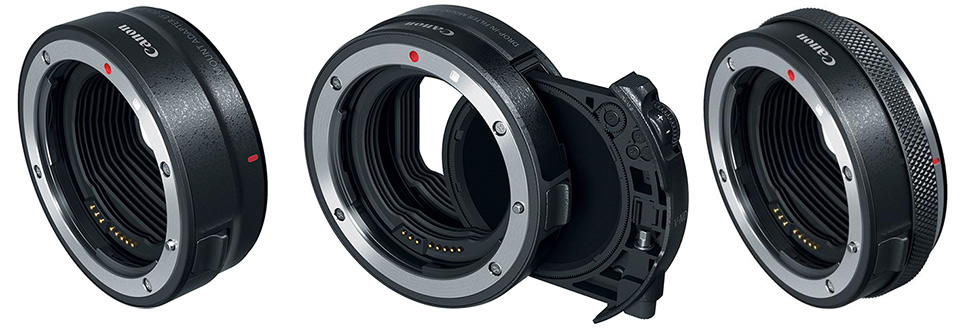
The adapter contains no glass. It is essentially a 'tube' that extends EF lenses by 24 millimetres. That is the difference between the new RF mount and the 'old' EF mount. Both mounts have a diameter of 54 millimetres.
The RF mount also has new contacts compared with the EF mount. Instead of 8, there are now 12. This allows faster communication with RF lenses and creates more possibilities now and in the future. The adapter translates correctly between the different contacts.
The adapters are officially called EF - EOS R adapters, by the way.
In practice, they are useful adapters. If you do not yet have any RF lenses, you can simply leave the adapter permanently attached and only change the lenses.
No second card slot
When the EOS R was announced, there was criticism about the lack of a second card slot, just as there was with Nikon's new mirrorless cameras.
To be completely honest, I do not see this as a problem myself. My Canon EOS 5D Mark III does have a second card slot, but I hardly ever use it. When I regularly photographed weddings in the past, I also did not use cameras with dual memory cards, and nothing ever went wrong there either.
That said, it would of course have been nice if it had included a second memory card slot. For some professional photographers, it feels like an important backup option, and they may now overlook this camera because of it.
Video
If you do not shoot video, it is naturally not that interesting, but many cameras are now also used for video, sometimes even explicitly for that purpose.
With the Canon EOS R, you can record 4K video, but Canon does not use the entire sensor. You get a crop that results in a 1.8x crop. All your lenses are therefore magnified 1.8 times in this mode. A 50mm gives the view of a 90mm lens.
This is useful when you want to film something from closer up, but inconvenient if you want to capture a wide-angle image.
You can also record 4K video at a maximum of 30 frames per second. This is perfectly fine in many cases, but for more slow-motion-like shots you have to switch to Full HD video. In Full HD, you can record up to 60 frames per second.
The Canon EOS R uses the excellent Dual Pixel autofocus technology that we also see in other Canon cameras. This system provides extremely fast autofocus while filming and really works very well.
The EOS R is the first camera in which focusing with Dual Pixel also works in 4K. A useful addition.
In video mode, Canon offers a kind of digital image stabilisation. It is not genuine physical image stabilisation like we see in Sony cameras, for example.
The Canon EOS R's video is even better than what you find on other Canon cameras, but it still trails some competitors by a few small steps. If you already have Canon equipment and want to start shooting video, the Canon EOS R certainly will not disappoint.
Who is the EOS R not for?
I mainly photograph portraits in the studio and with natural light. For me, the Canon EOS R is perfect. If I were considering a new camera, I currently have the Canon EOS 5D Mark III, I would overlook the 5D Mark IV and choose the EOS R.
There are situations, however, in which you may still prefer to work with a DSLR. For example, I can imagine that a sports photographer would struggle with this mirrorless camera.
The Canon EOS R does not match the performance of a high-end DSLR when you are trying to follow the movement of a moving subject while taking many photos per second.
The EOS R may also be inconvenient if you are a wildlife photographer who sometimes lies in a hide for hours waiting for the right photo. After all, a screen is constantly on while you wait for the right moment. This uses a relatively large amount of battery power.
So if you have very specific requirements, the EOS R may not yet be the ideal solution, but for all 'general' forms of photography I would choose a full-frame mirrorless camera over a DSLR.
Canon RF lenses
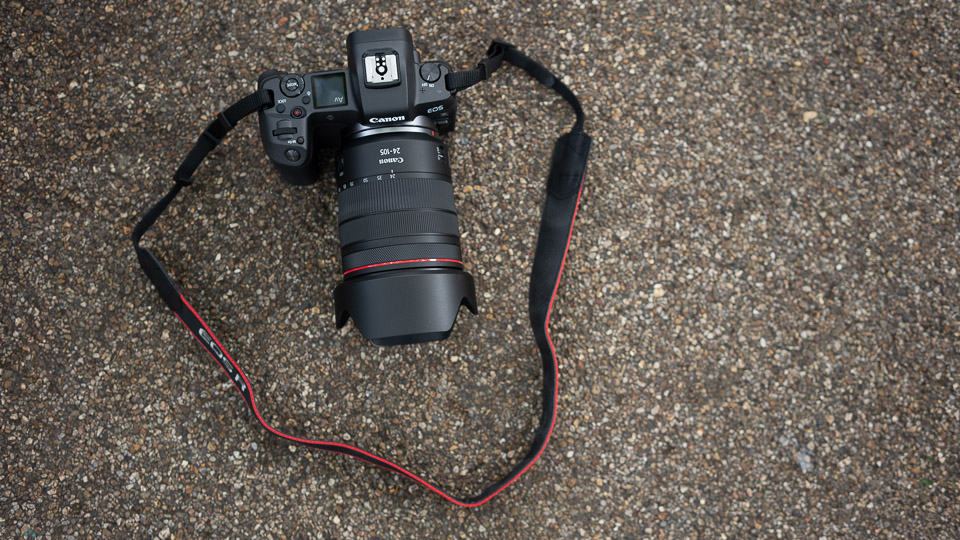
With the EOS R system, Canon immediately released four RF lenses. These lenses are fully optimised for the RF system and can be used directly on the RF mount.

At the moment, you can choose from the Canon RF 35mm f/1.8 IS Macro STM, the Canon RF 50mm f/1.2L USM, the Canon RF 24-105mm f/4L IS USM and the Canon RF 28-70mm f/2L USM. Excellent lenses, every one of them.
What stands out is how incredibly solid the lenses are. That gives you confidence that you do not have to be overly careful with them in practice. I think you would have to abuse them quite badly before they broke.
They also simply look good. That is not necessary for the optical performance, of course, but it does make the lenses more appealing.
Canon RF 50mm f/1.2L USM
I particularly enjoyed working with the 50mm f/1.2. This is also a very solid lens and it feels good in the hand. It also produces photos with lovely bokeh, or background blur.

f/2.2, 1/250s, 1600 ISO @50mm
The depth of field at f/1.2 is naturally incredibly shallow. In the portrait of Michelle above, I worked at f/2.2, and you can already see that the tip of her nose is no longer sharp, with focus on the eyes using EyeAF.
Conclusion
I am very enthusiastic about the Canon EOS R. This is Canon's first full-frame mirrorless camera, and in my view they have made a good camera at a competitive price.
For a professional photographer, the Canon EOS R is a good option as a second body, and for an advanced amateur the EOS R is an excellent main camera, provided you do not shoot sports.
In my view, there is no longer much reason for many photographers to buy a DSLR. If you already use Canon and are looking for a new camera, the Canon EOS R is certainly a good choice.
I expect Canon to continue expanding the EOS R system with new cameras and lenses. In time, we will see DSLRs phased out. That will probably still take a number of years, but in my view Canon has laid a solid foundation for the future.
The Canon EOS R costs 2,499 euros, including an adapter worth 109 euros.
More information
- Canon EOS R review by Nando (Dutch)
- The Canon EOS R versus the Nikon Z7 and the Sony A7R III by Nando
- Canon EOS R review by DP Review
- Canon EOS R review by The Digital Picture
- Canon EOS R review by The Phoblographer
- Canon EOS R review by Cameralabs
About the author
Elja Trum is the founder of Photofacts and online photography course website Photofacts Academy. He has been writing about photography since 2006. Elja is also the author of (Dutch) books on composition, black-and-white photography, flash photography and portrait photography.
You might also like
-
 Review: Canon EOS R
by Michelle Peeters
-
 Review: Canon EOS R6
by Nando Harmsen
-
 Review: Canon EOS R7
by Nando Harmsen
-
 Review: Canon EOS R8 full-frame mirrorless camera
by Nando Harmsen
-
 Review: Canon EOS R5
by Nando Harmsen
-
 Review: Canon EOS R50 mirrorless camera
by Nando Harmsen
5 comments
-
 Beno Munneke wrote on Tuesday 12 February 2019 at 12:04 | reply
Hi Elja
Translated from Dutch.
Read with interest
Can you give me the advantages of such a camera compared to a DSLR in a few sentences? Maybe a stupid question, but are these cameras only being developed because of their lighter weight??
What’s wrong with my DSLR?? -

 Elja Trum
wrote on Tuesday 12 February 2019 at 13:55
| reply
@Beno; Weight is indeed an advantage, but what I personally find most important is that you can already see the photo you are going to take in your (electronic) viewfinder before you take it.
Translated from Dutch.
So with the correct exposure settings. With your DSLR, you see the image through the viewfinder with the largest aperture opening (to let in as much light as possible). And you don't see the effect of the shutter speed either.
If your photo is (partly) over- or underexposed, you only discover that after you have taken the photo and look at it on the back of your screen.
With a mirrorless camera, you can immediately see in the viewfinder whether the exposure is correct (possibly even including a histogram). So before you take the photo. That works very pleasantly. -
 Paul wrote on Tuesday 12 February 2019 at 16:00 | reply
I have been using the Canon Eos R for a few months now and completely agree with this review. A great camera, but as indicated, less suitable for fast sports or bird photography. You can also have continuous live view switch off automatically after 2 minutes, which saves your battery, and with a light press of the shutter button you are back in live view.
Translated from Dutch. -
 guest wrote on Tuesday 12 February 2019 at 16:35 | reply
I bought the camera in September I use it with the 24-105 and with the 17-35/2.8 and with the 70-200mm/2.8 I am very satisfied with it
Translated from Dutch. -
 Remco v wrote on Tuesday 12 February 2019 at 18:46 | reply
I still think it's a shame that canon doesn't build stabilization into the camera, making the lenses unnecessarily expensive. This camera also seems great for video on paper, but IS is a requirement.
Translated from Dutch.
Have your say
Please note: Articles older than a week can only be commented on by signed-in visitors.Would you still like to comment? sign in or create a free account.
Become a better photographer every week
A practical photography tip in your inbox every week.
38,938 photography enthusiasts already receive the tips! More about the weekly mail. Or keep up to date via  Facebook.

Elja Trum
Photofacts; everything to do with photography!
Would you like to take better photos and keep up with what is happening in photography? Photofacts publishes articles that teach you something about photography — from a product announcement to a practical shooting tip or a look at a website. Photofacts covers photography every day and is a hobby project of Elja Trum's that got out of hand. The articles are written by a team of volunteer authors. If you would enjoy writing one or more articles for Photofacts, do get in touch.More about PhotofactsPhotofacts is made possible in part by
