

Review: Canon RF100-500mm f/4,5-7,1L IS USM
Friday 19 February 2021, 15:51 by Nando Harmsen | 8,739 views | 4 commentsThis article was translated from Dutch with the help of AI. Read the original.
One of Canon's popular telephoto zoom lenses is the EF100-400mm. This lens offers a fantastic range that is very suitable for wildlife photography as well as landscape photography.
There is now also a version of this versatile lens for mirrorless cameras, with even more reach. This is the review of the RF 100-500mm.
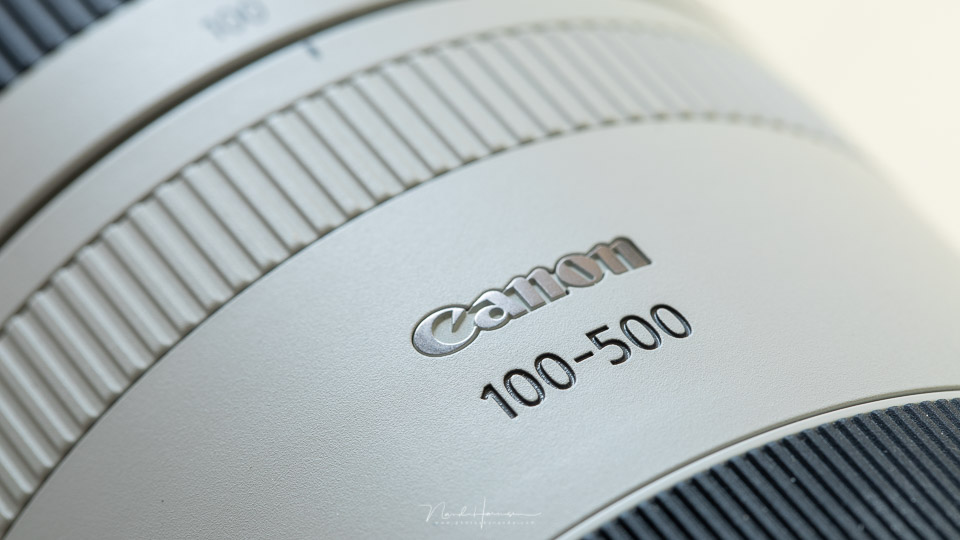
Canon has released the RF 100-500mm f/4,5-7,1L IS USM for its mirrorless cameras. In fact, it is the equivalent of the successful EF 100-400mm f/4-5,6L II IS USM, a fantastic lens that also fits an EOS R type camera perfectly with an EF-RF adapter, of course.
But why use an adapter when a lens made specifically for this is available? You don't have to work with adapters. As a bonus, you also get an extra 100mm of reach, because the RF100-500L zooms all the way to 500mm.
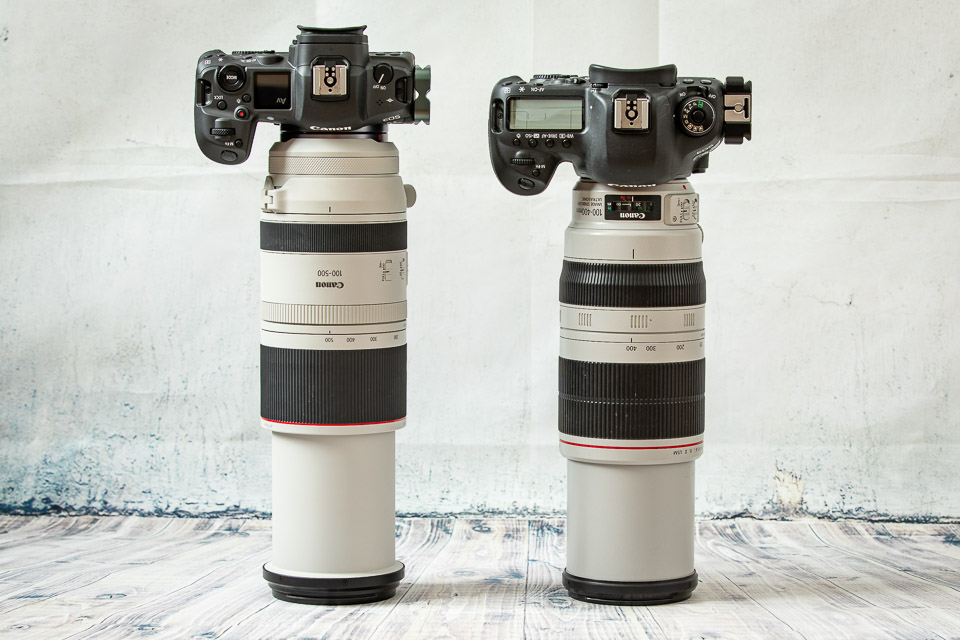
The RF100-500L up close
The appearance of the RF100-500L, as I will call it for convenience, holds no surprises. Especially if you are already familiar with the EF100-400L II, as it is essentially a similar lens.
The lens becomes longer in proportion to the focal length when you turn the zoom ring. A special lock ring prevents the lens from extending when you don't want it to.
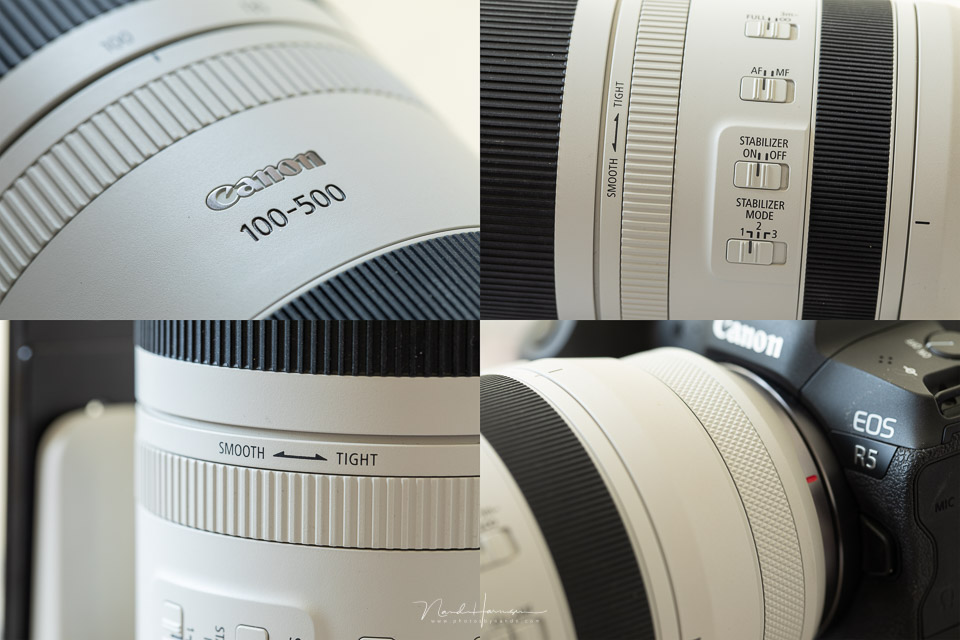
On the side you will find the switches for the focus limiter, autofocus and image stabilisation. For the latter, you can choose from the familiar three options: standard, panning, or automatic detection and selection between the first two (mode 1, 2 or 3).
Like all other RF lenses, the RF100-500L has a programmable control ring.
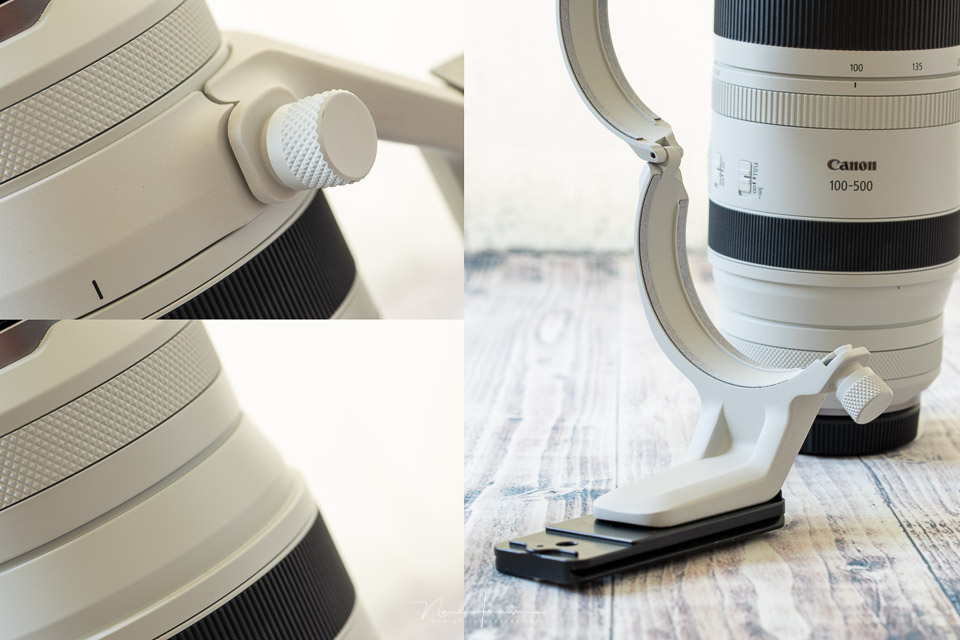
The tripod collar of the RF100-500L is better designed than that of the EF100-400L II. It is a similar design to the one we also saw on the RF70-200mm f/2,8L.
The entire ring can be removed without taking the lens off the camera, after which it looks beautifully neat.
Just like the EF version, the RF100-500L becomes considerably longer when zooming in. The zoom mechanism works very smoothly, but it can be tightened using the designated ring.
In principle, this is to prevent the lens from extending unintentionally, but it does not fully lock the system. Zooming then becomes very stiff.
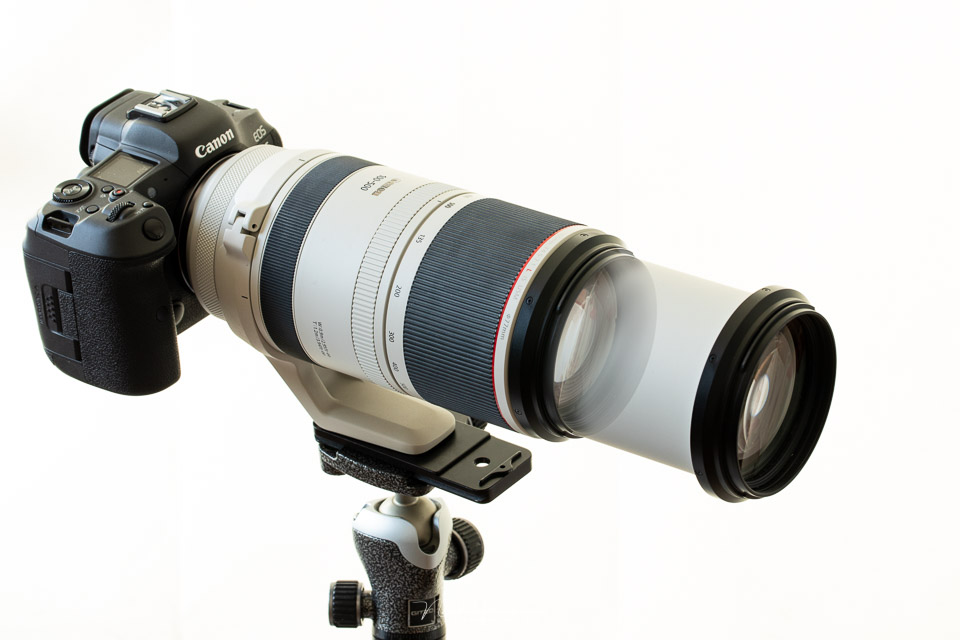
Aperture f/4,5 to f/7,1
Naturally, the aperture also changes on the RF100-500L when you zoom in. You end up at aperture f/7,1 when you reach the longest focal length. Although not ideal, the changing aperture when zooming does help keep this type of lens relatively small and compact.
Aperture f/7,1 does not sound very appealing. Still, it is not too bad when you think about it. The difference from the f/5,6 of the EF100-400L II is only 2/3 of a stop. However, don't forget the extra 100mm of focal length you get with the RF100-500L.
When comparing the two lenses at 400mm, you notice that the RF100-500L at f/6,3 is 1/3 of a stop less light-sensitive than the EF100-400L II. The changeover point from f/5,6 to f/6,3 is at a focal length of 365mm.
Although this difference is negligible, in practice it can still result in a shutter speed that is too slow for you, or mean that the ISO has to be set one stop higher.
Did you know that the smallest aperture at a focal length of 500mm is no less than f/51?
Photographing with the RF100-500L
I am already used to photographing with the EF100-400L II on a Canon EOS 5D4. It is a very pleasant combination that is relatively compact and easy to use despite the telephoto range. The weight of this combination is about 3.5 kilograms. This is not light, but it is not extremely heavy either.
The RF100-500L with a Canon EOS R5 is in exactly the same class. Compact, pleasant to use, and not much different in terms of weight. The total weight is about 300 grams lower, which you only notice when you hold both in your hands side by side.
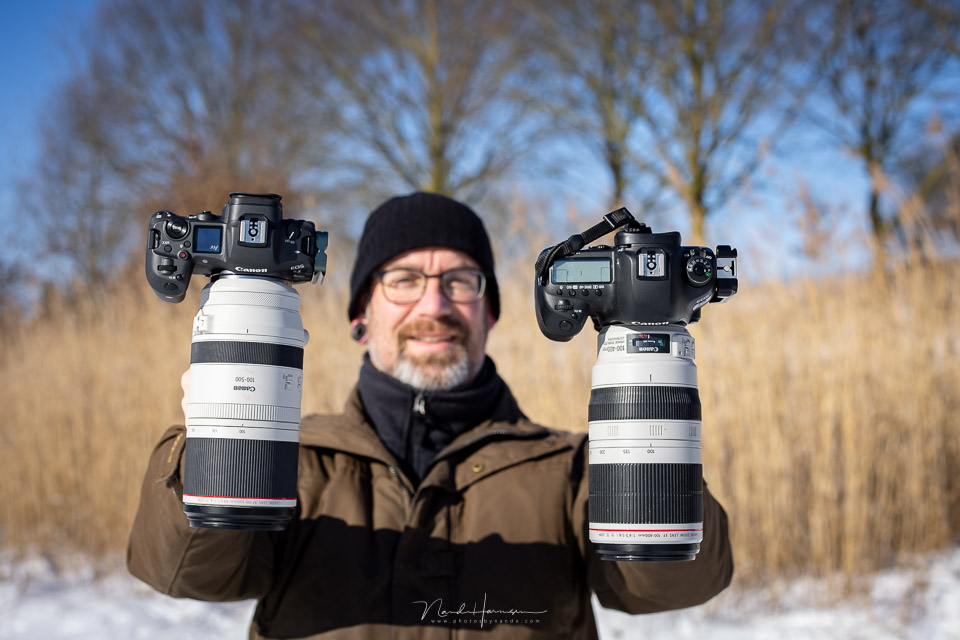
Bear in mind that the weights for both combinations include the L-bracket and Arca-Swiss lens plate.
The RF100-500L has a 5-stop image stabilisation system, which provides an extra stop of stabilisation when used with the EOS R5 or R6. These 6 stops are very welcome, as this lens invites you to photograph handheld.
The image stabilisation is particularly useful at 500mm. Not just for the photograph, but also when you want to keep your subject in the frame. You only really notice this when you turn image stabilisation off and try to keep something in the frame at 500mm.

With its dual nano USM motor, the RF100-500L focuses particularly quickly and quietly. It literally happens in a fraction of a second. All the autofocus options of the Canon EOS R5 are available throughout the entire zoom range.
I assume this also applies to the EOS R6, as both have the same autofocus system.

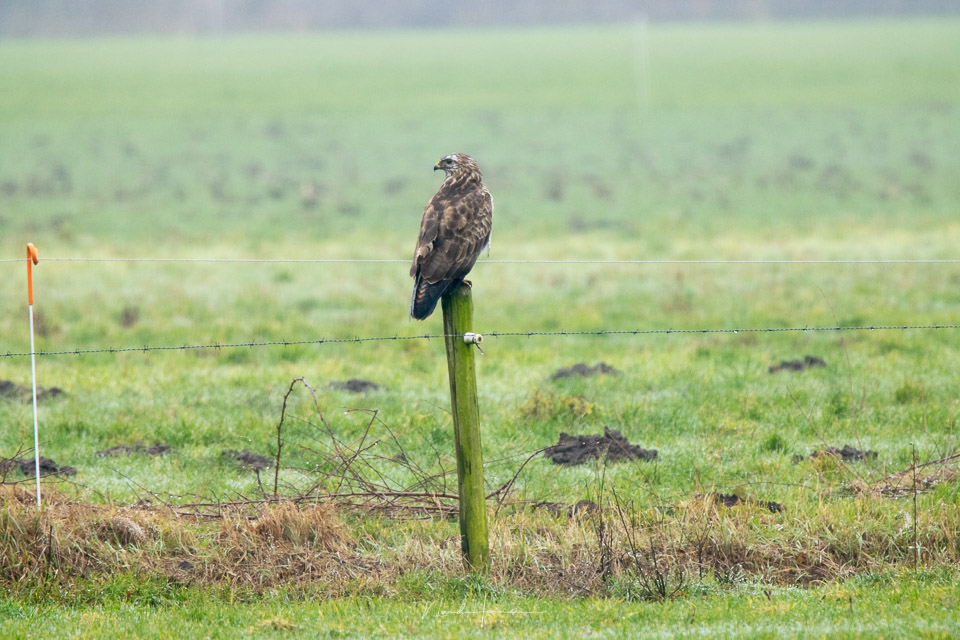
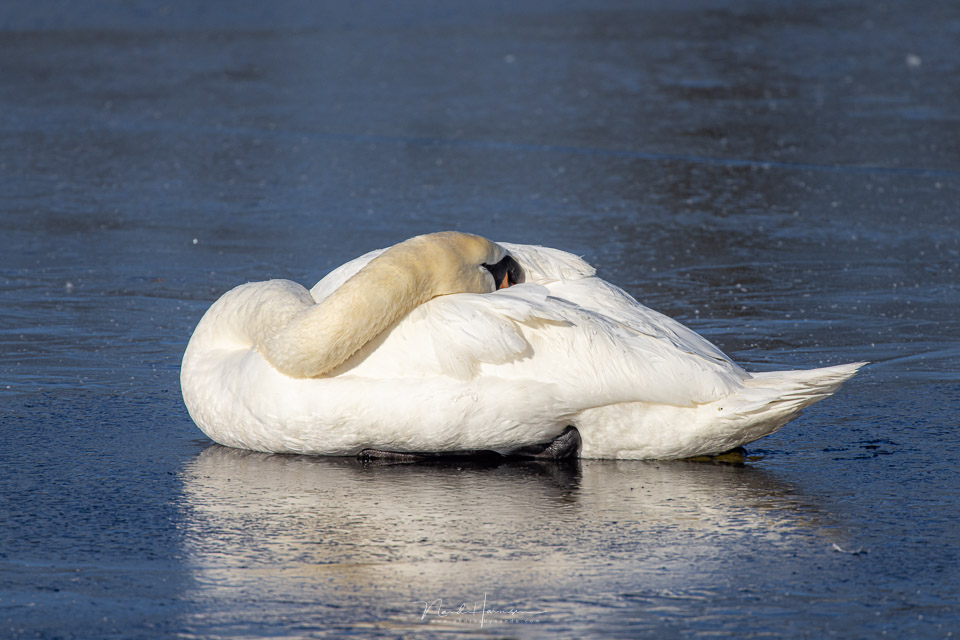
You really cannot complain about the image quality of the RF100-500L. The lens is particularly sharp throughout its entire range, even at the widest aperture. I have experienced very little flare, even when photographing landscapes.
There is a very small amount of chromatic aberration (CA), but it is very easy to correct while editing your photographs.


The RF100-500L with teleconverters
Unfortunately, the RF100-500L cannot be used with a teleconverter in the same way as the EF100-400L II can. You have to zoom in to 300mm before a teleconverter will fit. The rear lens elements then retract far enough into the lens to make room for a teleconverter.
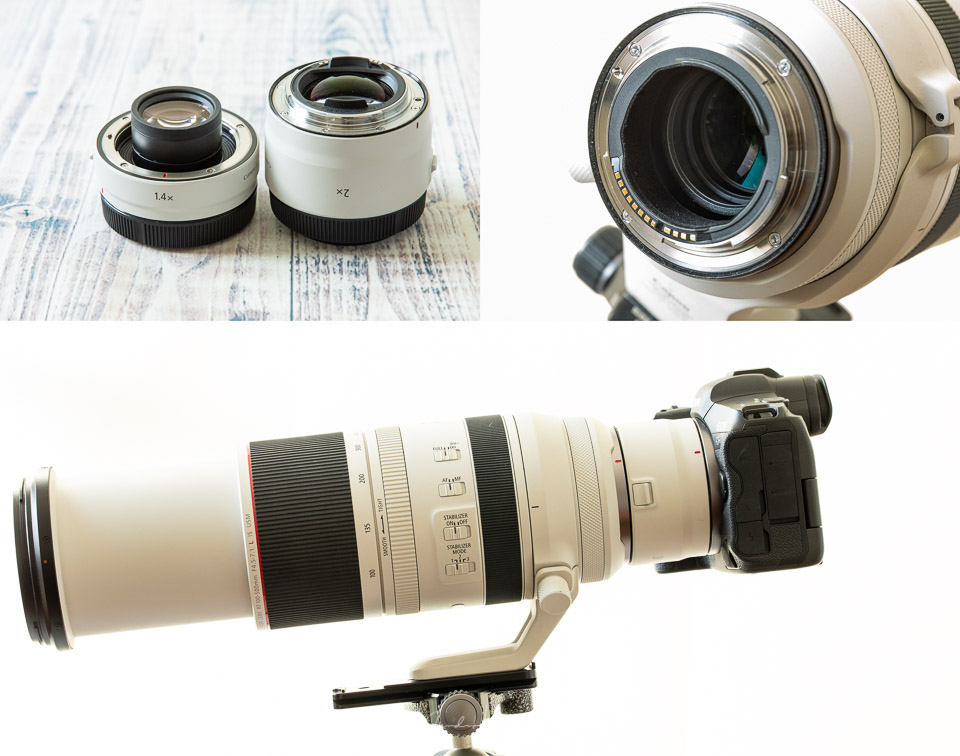
So you cannot use the entire zoom range with the RF 1,4x and RF 2x teleconverters. The zoom range is then only 300-500mm. With a 1,4x, this gives a focal length of 420-700mm, and with a 2x, a focal length of 600-1000mm.
The image quality does suffer somewhat when using the teleconverters. You certainly lose fine detail with the 2x teleconverter. This is partly caused by diffraction, as your aperture is only f/14.
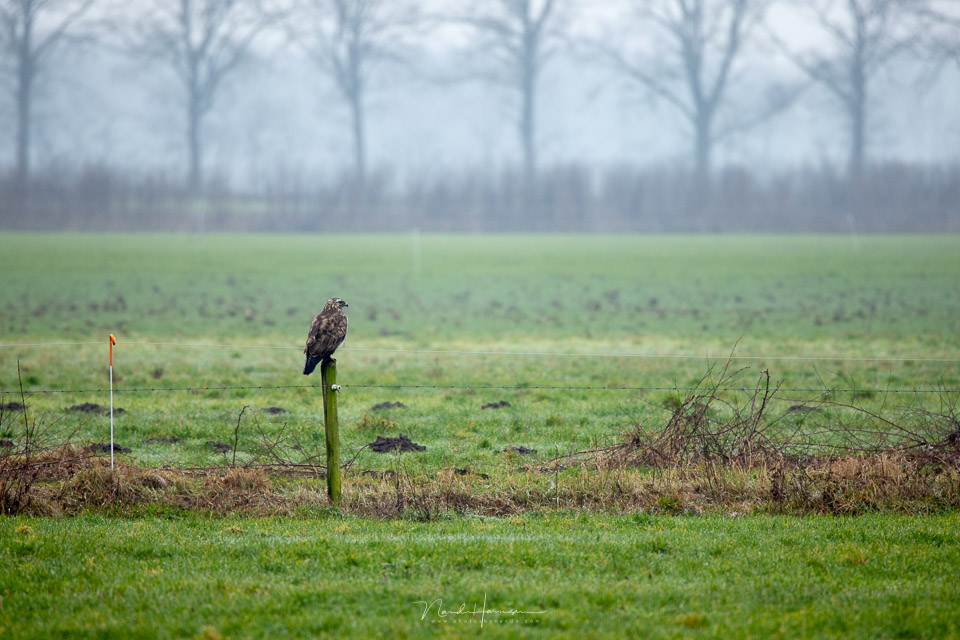
I would not recommend the 2x teleconverter with this lens because of the small aperture it gives you. If you need that focal length, consider the Canon RF 800mm f/11. As far as I have been able to judge, it produces better image quality.
The RF100-500L with a 1,4x teleconverter is perfectly usable, but bear in mind the loss of light and the fact that you cannot retract the lens fully.

My verdict on this lens
The time I was able to spend with the RF100-500L made me particularly enthusiastic. Even more than I could have expected, because I thought it would simply be the RF version of the EF100-400L II.
Although the lenses are very similar, I still got the feeling that the RF100-500L offers just that little bit more enjoyment. Whether that is down to the extra focal length, or the small improvements in the construction and the way the lens feels, I don't know.
It could also be due to the combination of the camera and lens, which makes photographing so much more enjoyable. Of course, you can also mount the EF100-400L II on Canon mirrorless cameras using an adapter, but when that adapter is not needed, it feels just a little more pleasant.

I had to think for a long time about what the actual disadvantage of this lens is. You could mention the smaller aperture at the longest focal length, or the 1/3 of a stop you lose compared with the EF100-400L II at 400mm. But that would be nit-picking.
It is a shame that it is not possible to use the entire zoom range with a teleconverter. It also gives me the feeling that this lens was not really made for a teleconverter. If there is a disadvantage, I would mention this one.
For anyone who photographs landscapes and wildlife, this lens is an absolute recommendation. But the lens can also be used perfectly for sports and even portraits.
It may not be the most light-sensitive lens, but in return you get a very good, versatile and manageable zoom range with fantastic image quality.
What I like
- Perfect zoom range from 100mm to 500mm
- Up to 5 stops of image stabilisation, 6 stops with a camera equipped with IBIS)
- Weather sealing
- Well-designed tripod collar
- Image quality is very good
- Dual nano USM works extremely quickly and accurately
- The complete AF system of the EOS R5 and R6 can also be used at 500mm
- Very versatile lens
- Compact size
What I like less
- Teleconverter can only be used from a focal length of 300mm
- Not cheap
- I had to send the lens back to Canon Netherlands




About the author
Nando Harmsen has been photographing for more than 40 years. He specialises in wedding photography and landscape photography. Nando also gives talks, workshops, masterclasses and photo trips, and regularly reviews new and interesting equipment.
You might also like
-
 Review: Canon RF100-400mm f/5.6-8 IS USM
by Nando Harmsen
-
 Review: Canon RF 100-300mm f/2.8L IS USM
by Nando Harmsen
-
 Review: The Canon RF 85mm macro lens
by Nando Harmsen
-
 Review: Canon EOS R8 full-frame mirrorless camera
by Nando Harmsen
-
 Review: Canon EOS R3
by Nando Harmsen
-
 Review: Canon RF 70-200mm f/4L IS USM
by Nando Harmsen
4 comments
-

-

-

 Paulussie wrote on Tuesday 23 February 2021 at 12:46
| reply
Paulussie wrote on Tuesday 23 February 2021 at 12:46
| reply
It's not much use to me, it doesn't fit my Nikon, but one comment: diffraction really isn't an issue at this focal length and aperture 14, diffraction does occur at very small apertures, yes, but f14 at 700 mm isn't that small. F 11 at 18 mm yes then it is. But f14 at 700 is about a 5 mm hole, that doesn't have any significant pinhole effect, so diffraction.
Translated from Dutch. -
Nando
wrote on Tuesday 23 February 2021 at 14:48
| reply
@Paulussie:
Translated from Dutch.
I looked a little deeper into the effect of diffraction.
It is true that a certain aperture number at a longer focal length has a larger lens opening than at a shorter focal length. Your reasoning about the actual lens opening is correct in that respect.
What you have overlooked is the magnification caused by a longer focal length. Although the diffraction is less than with a shorter focal length, the blur caused by diffraction (the so-called Airy disk) will be enlarged proportionally to the increase in focal length.
As a result, you can eliminate the focal length and the actual diameter of the lens opening from the equation.
In short; the visible diffraction of a certain aperture is independent of the focal length.
What does play a role is the resolution of the sensor. The higher the resolution, the sooner diffraction (the Airy disk) will become visible.
The tests I have read indicate that on a 20mp sensor (EOS R6), diffraction becomes visible at f/11, while with a 45mp sensor (EOS R5) this is already the case at f/7,1.
In other words, f/14 will certainly lead to diffraction. Whether that will be disturbing in the photo, that is another story.

Have your say
Please note: Articles older than a week can only be commented on by signed-in visitors.Would you still like to comment? sign in or create a free account.
Become a better photographer every week
A practical photography tip in your inbox every week.
39,077 photography enthusiasts already receive the tips! More about the weekly mail. Or keep up to date via  Facebook.

Elja Trum
Photofacts; everything to do with photography!
Would you like to take better photos and keep up with what is happening in photography? Photofacts publishes articles that teach you something about photography — from a product announcement to a practical shooting tip or a look at a website. Photofacts covers photography every day and is a hobby project of Elja Trum's that got out of hand. The articles are written by a team of volunteer authors. If you would enjoy writing one or more articles for Photofacts, do get in touch.More about PhotofactsPhotofacts is made possible in part by
