

How to photograph the Northern Lights
Monday 6 March 2023, 16:32 by Nando Harmsen | 7,449 views | 6 commentsThis article was translated from Dutch with the help of AI. Read the original.
It is special when the Northern Lights can be seen from the Netherlands. As solar activity increases, the chance of this happening grows. How should you set up your camera? What should you look out for? Where should you stand? How do you find out whether there is a chance of photographing them?
The Northern Lights are caused by the sun. Active areas on the sun send charged particles towards Earth. They are deflected by the Earth's magnetic field and enter the atmosphere around the poles. This is where the aurora appears in a circle around the pole.
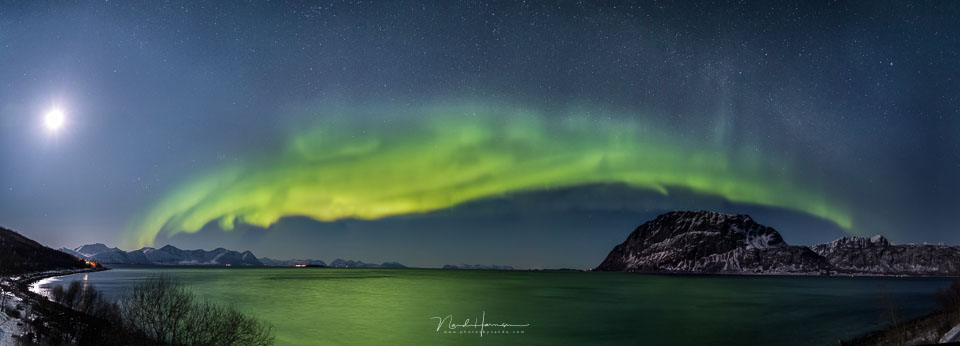
For the Northern Lights, you therefore need to go north. When you are somewhere at the latitude of the Arctic Circle or further north, the chance of seeing the Northern Lights is greatest.
The more active the sun is, the stronger the Northern Lights become. You can then also see them further south. Even as far as the Netherlands.
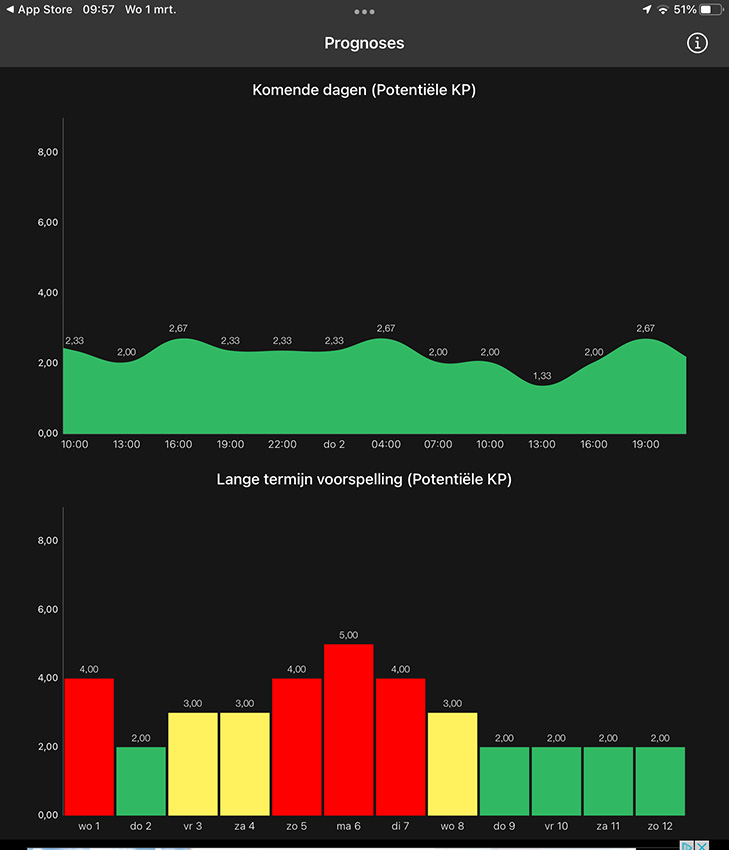
The strength of the Northern Lights is expressed as a Kp value. If the Kp is 1, they will barely be visible, at most with a camera and only far above the Arctic Circle.
At Kp 3, you can see them with the naked eye, but the colour is barely visible. At Kp 4, you will clearly see the green colour with the naked eye.
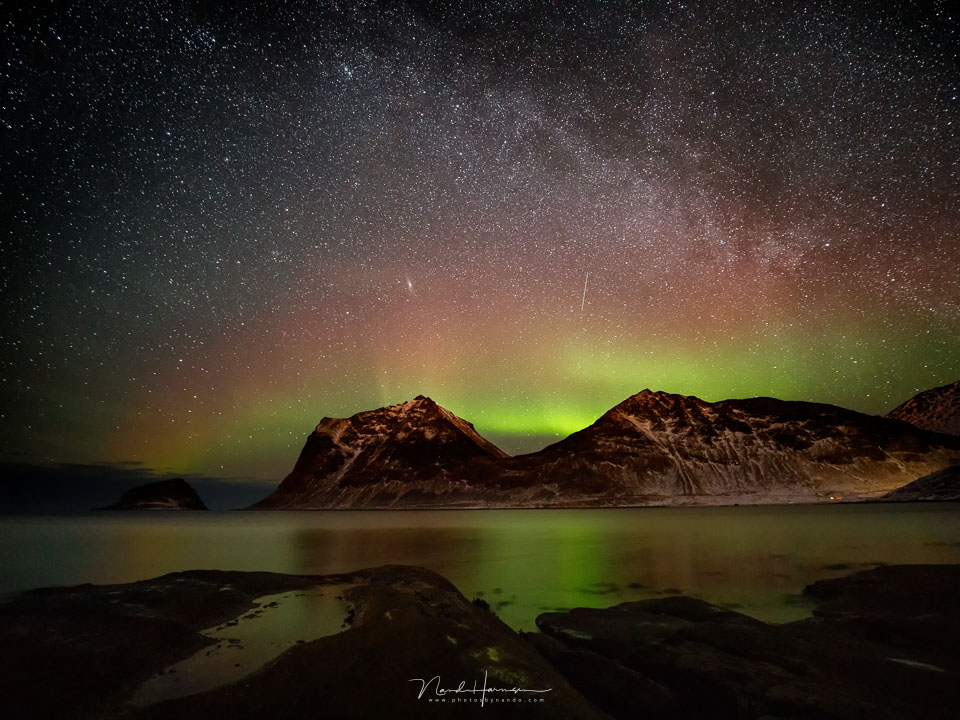
It becomes really special when the Kp is 5. Then it is breathtaking to see and photograph, but still not in the Netherlands. You might see it as a faint green or reddish glow on the horizon when you are on the Wadden Islands.
If the Kp is 7, as was the case at the end of February 2023, it can even be seen from the centre of the Netherlands. Provided you are in a dark location. In the northern provinces, it can then be seen and photographed beautifully.
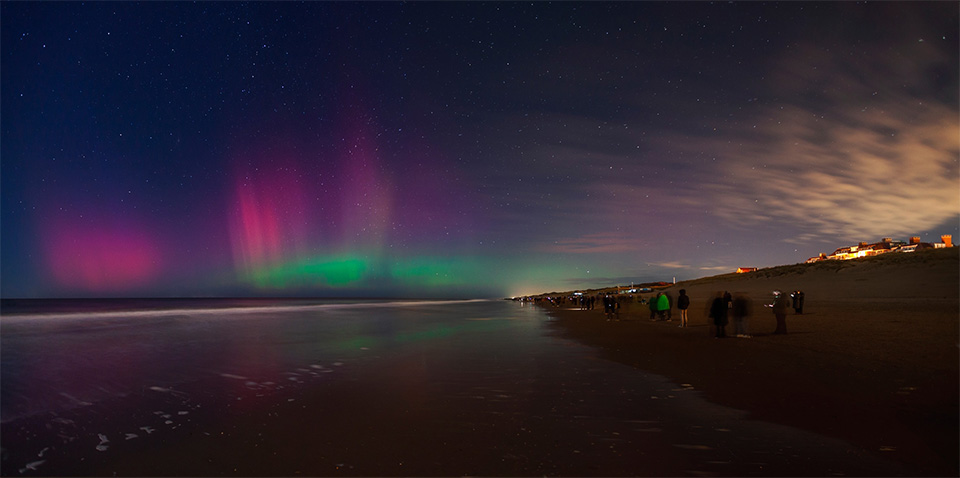
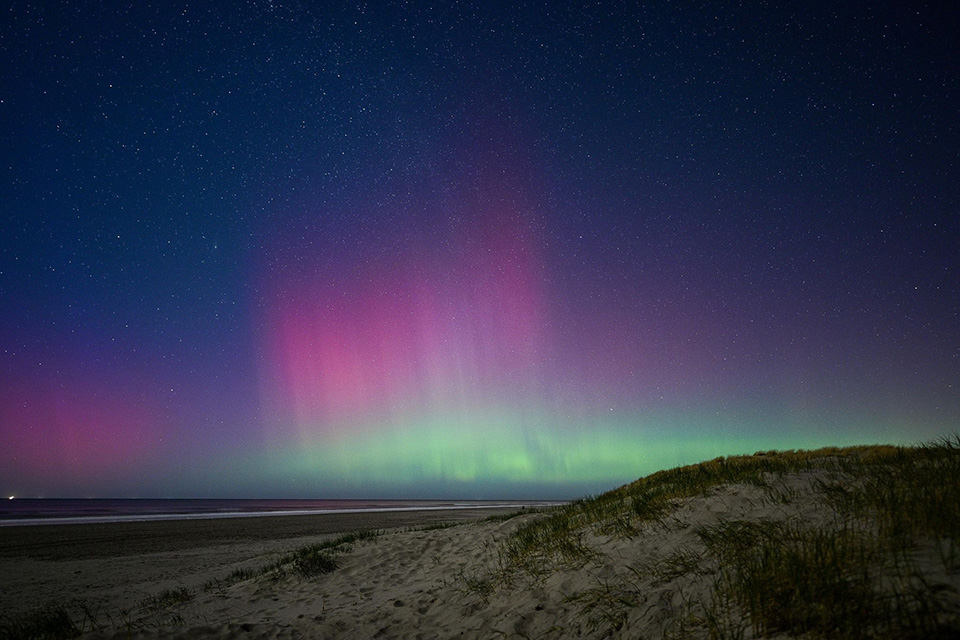
It is interesting to know that the sun's activity follows an approximately 11-year cycle. In 2019, it was at a minimum, which meant that the Northern Lights were at minimal strength. Activity is now increasing every year towards an estimated maximum in 2024.
This means that the chance of seeing the Northern Lights in the Netherlands is increasing. Bear in mind that what could be seen at the end of February 2023 will happen more often. It is therefore worth keeping an eye on the Northern Lights forecasts.
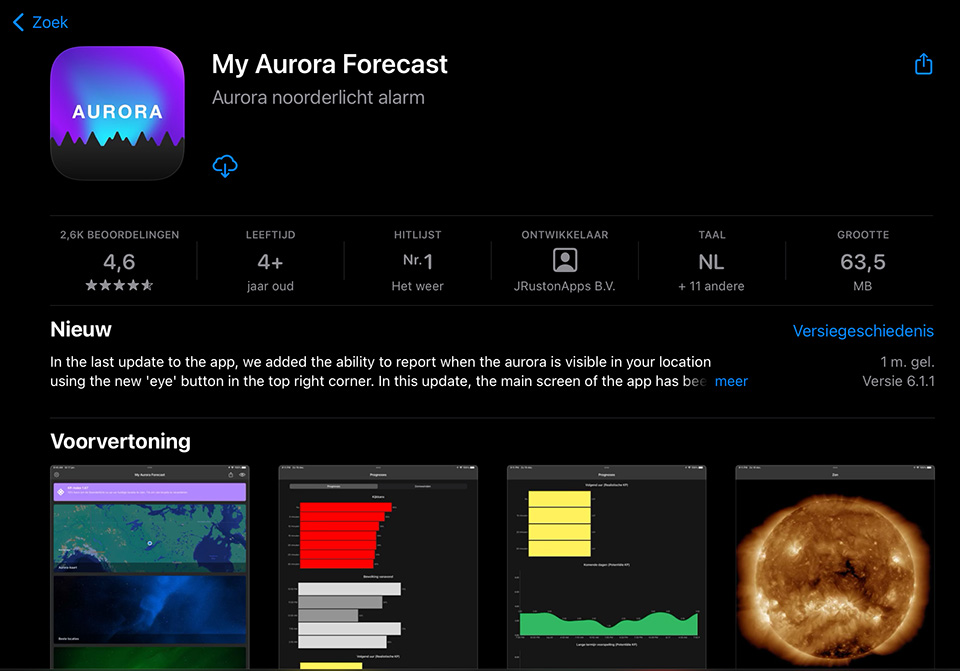
Download an app with Northern Lights activity information. I am happy with My Aurora Forecast, but there are more. Keep an eye on the activity and look out for forecasts of Kp 6 or higher. Forecasts are never certain, but they do at least give you an indication.
If the forecast is favourable, find a good dark spot with an unobstructed view to the north. It really needs to be dark to see them.
Preferably go as far north in the Netherlands as possible and stay as far away from cities and villages as you can. The further north you go, the better or more impressive it becomes.
You should set up the camera as you would for astrophotography or photographing the Milky Way. Use a high ISO value and the widest aperture your lens has. Use the shutter speed to get the exposure right. Do not make your photo too dark and shoot in raw.
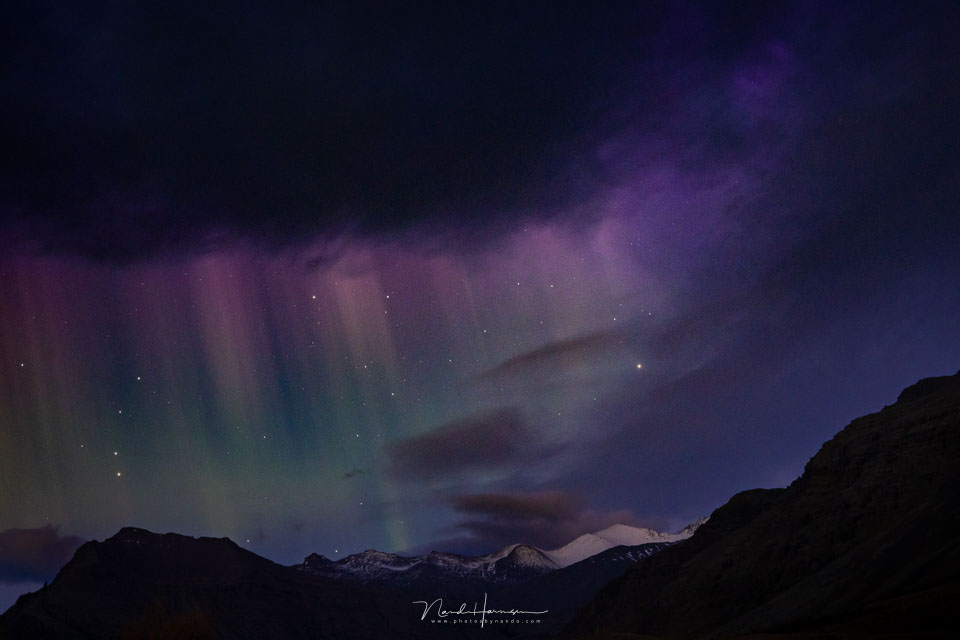
I always use at least ISO 1600, preferably one or two stops higher. The aperture is set to f/2.8 or f/4. The shutter speed is certainly 10 to 15 seconds. I do not make it longer than 500/(focal length x crop factor) to prevent star trails.
Of course, a tripod is important. Turn off image stabilisation and set the focus to infinity. The latter can be difficult, but try focusing manually on a point of light on the horizon. Enlarge the image on the LCD to do this accurately.
.jpg "Nando Lofoten aurora(1)")
The camera sees colours much better at night than our eyes do. The Northern Lights can therefore be much more visible in the photo. If necessary, experiment with your shutter speed and ISO. Make the shutter speed a little longer or shorter, and increase the ISO once. Try different exposures.
Of course, the Northern Lights will never become as impressive as photos taken above the Arctic Circle. But seeing them in the Netherlands is already very impressive. And who knows, perhaps the Kp index will jump to Kp 8 or even 9 one day. In that case, they could even be seen in Belgium and France. Imagine that.
One final important tip. Forget spring and summer. It really needs to be dark to see them. Go hunting for the Aurora between October and March. You can catch up on the sleep you missed during the other months.
About the author
Nando Harmsen has been photographing for more than 40 years. He specialises in wedding photography and landscape photography. Nando also gives talks, workshops, masterclasses and photo trips, and regularly reviews new and interesting equipment.
You might also like
-
 The 2026 solar eclipse
by Nando Harmsen
-
Are you going to photograph the solar eclipse on 25 October 2022?
by Nando Harmsen
-
 Are you ready for the solar eclipse?
by Nando Harmsen
-
 Making a Solar Eclipse Collage in Photoshop
by Nando Harmsen
-
 A timelapse video of the solar eclipse
by Nando Harmsen
-
 A Visit to Lofoten in Winter
by Nando Harmsen
6 comments
-
 Dick de Roos wrote on Tuesday 7 March 2023 at 13:52 | reply
Another great article!
Translated from Dutch.
Just for completeness: To see or photograph the Northern Lights, it has to be dark. Without light pollution from cities, etc. And preferably with as little moon in the sky as possible.
The further north you are, the better the Northern Lights can be seen (and also with a greater chance of seeing them). But in summer it does not get (very) dark above the Arctic Circle; in fact: during midsummer the sun does not set.
So to be able to see the Northern Lights properly, you have to go north in winter.
The advantage is that the chance of seeing the Northern Lights is greater because of the "long night". -

 Nando
wrote on Tuesday 7 March 2023 at 14:38
| reply
Nando
wrote on Tuesday 7 March 2023 at 14:38
| reply
I thought it was self-evident that it has to be dark. As I indicated, during the summer months you can forget about it. In the North especially. That's why I mentioned October to March.
Translated from Dutch.
The light pollution is mainly a problem in the Benelux. The moonlight alone at this latitude. As can be seen in my panorama, in the far north you can photograph the northern lights perfectly well with a full moon. Even with the light pollution that is present there in the north. Of course, it also depends on the strength of the northern lights.
Moonlight in the far north is even desirable, because it illuminates the landscape. That makes it all just that little bit more special. -
 Paul de Vries wrote on Tuesday 7 March 2023 at 15:45 | reply
Maybe a stupid question, but why do you have to turn off image stabilization?
Translated from Dutch. -
Nando
wrote on Tuesday 7 March 2023 at 16:07
| reply
Certainly not a stupid question.
Translated from Dutch.
If image stabilization becomes active when the camera is on a tripod, the image stabilization will try to correct a non-existent vibration. The result is movement of the image caused by the image stabilization and therefore motion blur. -
 Albert Wester wrote on Tuesday 7 March 2023 at 20:49 | reply
The nice thing about the aurora is that it cannot be predicted and that it is never the same.
Translated from Dutch.
I don't actually think headings like "How should you photograph the northern lights" are appropriate because they can put beginning aurora photographers on the wrong track and lead to disappointing results. By recommending that you immediately use high ISO values and long shutter speeds, you certainly won't get beautiful aurora photos. I would rather use "How can you..." as the heading.
Obviously, everything depends on the equipment used and especially the lenses, which should preferably be very fast, in other words, preferably with f-numbers of 1.8 or 1.4. The aurora can move very quickly and if you use long shutter speeds of 10 to 15 seconds, the result is that the aurora becomes blurred. The Pilars or spikes in particular can move very quickly and it is nice that those are sharp. Along with the rapid movement, the intensity of the aurora can also suddenly change from very soft light to very bright light. So bright, in fact, that the aurora becomes severely overexposed. That is why it is advisable to keep the ISO value lower than indicated here. That also helps reduce noise...
I have photographed the aurora both here in the Netherlands (where I live, Terschelling) and in Finnish Lapland, and even on Terschelling I actually never go above ISO 1000 and a maximum shutter speed of 4 seconds. The Pilars can also be seen clearly here and they need to be sharp here too.
The photo in this tweet ( https://twitter.com/Albert_Wester/status/1629973860970905602?s=20 )was taken on February 26 this year on Terschelling under the light of the Brandaris lighthouse. Of course, this was a special situation, but it also shows that it is not necessarily only visible in very dark environments (to the naked eye). This photo was taken with a Nikon D750 and a Sigma 35mm F1.4 art lens. ISO 800, F1.4, 2 sec. -
Nando
wrote on Tuesday 7 March 2023 at 22:21
| reply
Thank you for your response, Albert.
Translated from Dutch.
Short shutter speeds are indeed recommended. Wide apertures too. If you choose 2 seconds or 4 seconds, and you have an aperture of f/1.4, then the ISO can indeed be kept low. In your example ISO 800
However, don't forget that not everyone has f/1.4 available. This is an aperture that is two stops wider than f/2.8. If you have f/2.8 as the widest aperture, then the ISO will have to be two stops higher for the same exposure. That means ISO 3200. If your aperture is f/4, then you will have to choose: a longer shutter speed or the ISO one stop higher.
Well, if the intensity and brightness then increase, then it is a matter of adjusting the exposure. But that is separate from how high your ISO is set.
So your settings are very dependent on the situation and the equipment. Unless you have f/1.4 available, a high ISO is a logical, and sometimes even mandatory choice.
Have your say
Please note: Articles older than a week can only be commented on by signed-in visitors.Would you still like to comment? sign in or create a free account.
Become a better photographer every week
A practical photography tip in your inbox every week.
39,178 photography enthusiasts already receive the tips! More about the weekly mail. Or keep up to date via  Facebook.

Elja Trum
Photofacts; everything to do with photography!
Would you like to take better photos and keep up with what is happening in photography? Photofacts publishes articles that teach you something about photography — from a product announcement to a practical shooting tip or a look at a website. Photofacts covers photography every day and is a hobby project of Elja Trum's that got out of hand. The articles are written by a team of volunteer authors. If you would enjoy writing one or more articles for Photofacts, do get in touch.More about PhotofactsPhotofacts is made possible in part by
