

Never focus again, not even automatically
Monday 20 March 2023, 20:20 by Nando Harmsen | 10,363 views | 12 commentsThis article was translated from Dutch with the help of AI. Read the original.
Focusing no longer has to be a problem. The automatic systems are incredibly fast and accurate. But they are not perfect, and they get it wrong quite often. For some types of photography, you can also work without focusing.
Having every photo sharp while you have autofocus switched off. That sounds too good to be true. Yet it really is possible. At least for some types of photography. Not for everything, because there are conditions attached.
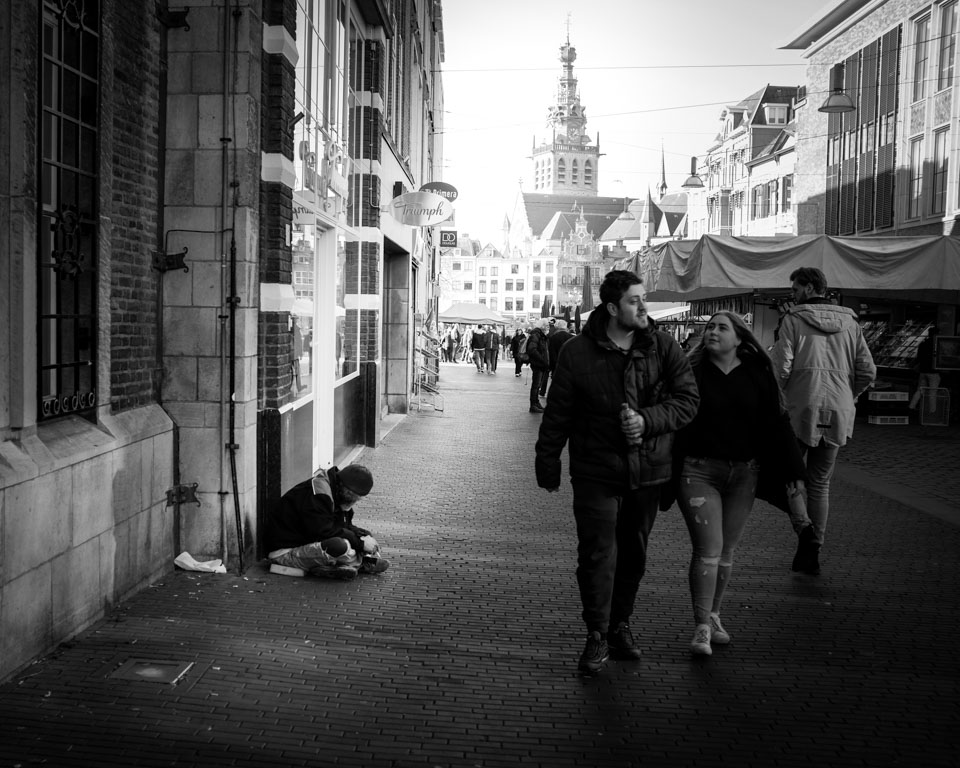
It is also sometimes called zone focusing. This means setting the focus in advance and then not worrying about it anymore. The secret is a large depth of field. A very large depth of field.
With these techniques, you use the hyperfocal distance. This is the focusing distance at which the depth of field extends from as close as possible right to the horizon. Set your focus manually to the hyperfocal distance, and almost everything will be sharp.
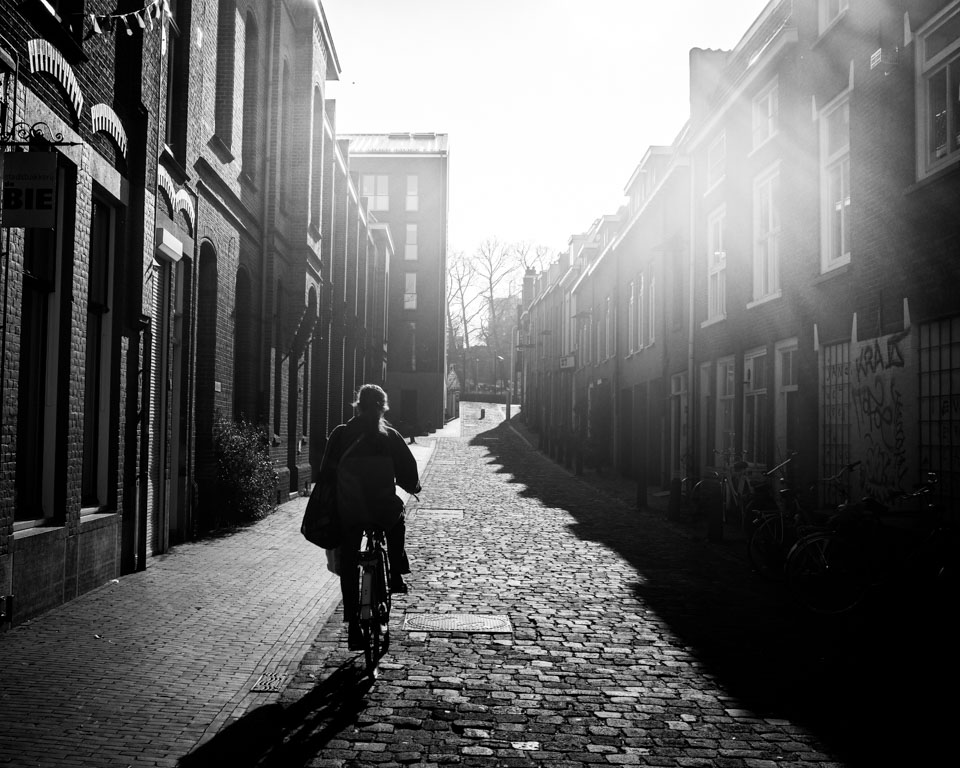
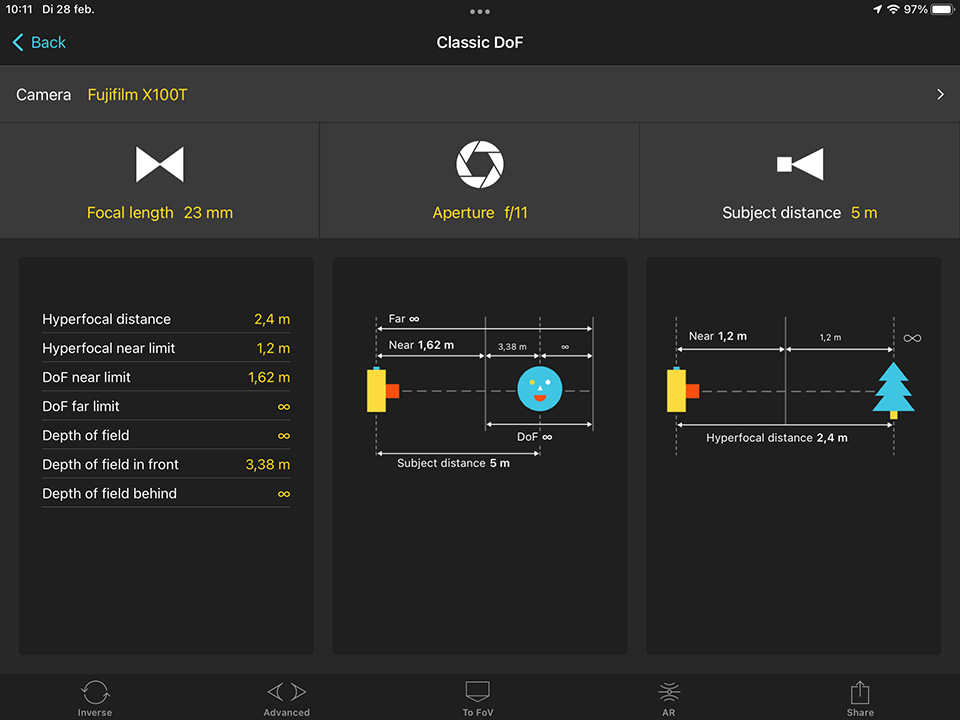
The way you do it is very simple. You look up the hyperfocal distance for the focal length you are using, combined with the aperture. Using my Fujifilm X100t camera as an example, it has a 23 mm lens. I choose an aperture of f/11.
I can then calculate the hyperfocal distance with a DOF calculator. With these settings on this camera, it is 2.4 metres. If I set my focusing distance manually to 2.4 metres, everything from 1.2 metres to infinity will be sharp. As long as my subject is no closer than 1.2 metres, everything will always be sharp.
There are a few conditions. You need to use a sufficiently wide-angle lens and a small aperture. That means there needs to be enough light available. You also need to want everything in the image to be sharp.
The technique does not work when you want a shallow depth of field or when you use longer focal lengths.
Setting this good distance is not always easy. With some lenses it is easier than with others. You know your own camera best, so you also know how to do this as well as possible with your camera and lens.
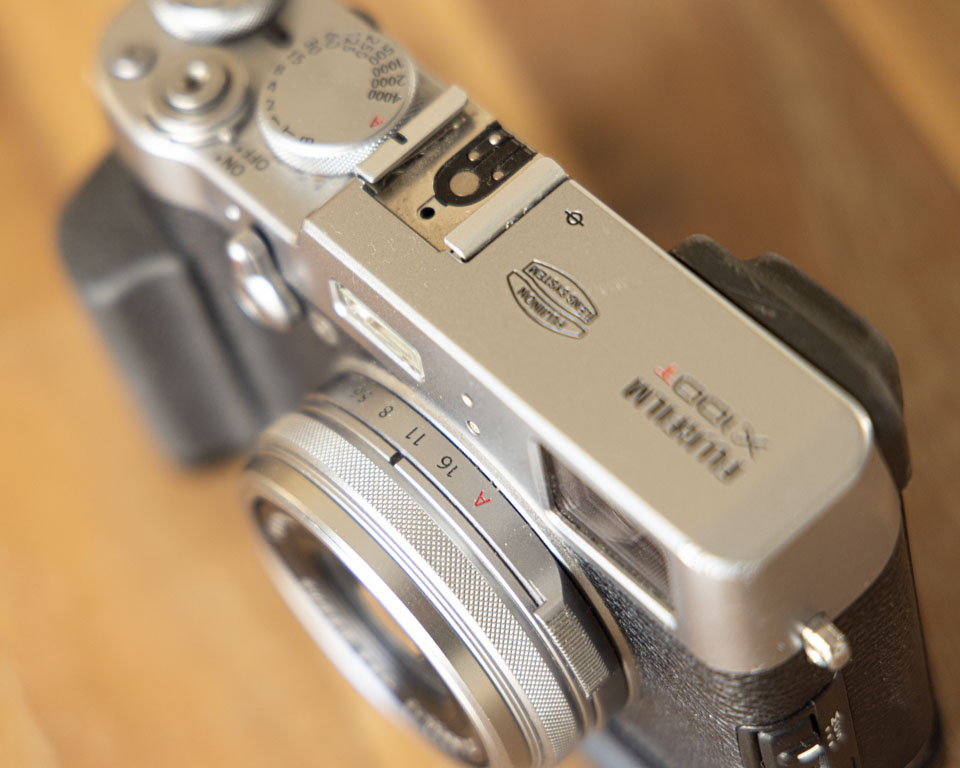
Do you ever use this method? Or did you not know it existed? Maybe you have a tip to make sure you do not accidentally turn the focusing ring again. Let us know in a comment below this article.
About the author
Nando Harmsen has been photographing for more than 40 years. He specialises in wedding photography and landscape photography. Nando also gives talks, workshops, masterclasses and photo trips, and regularly reviews new and interesting equipment.
You might also like
-
 Street photography tip: Use zone focusing
by Michiel Heijmans
-
 Automatic subject recognition, or not?
by Nando Harmsen
-
 Improve old photos automatically
by Elja Trum
-
 Synchronise the time between your cameras
by Nando Harmsen
-
 Not enough depth of field in your landscape? Use focus stacking.
by Nando Harmsen
-
.jpg "Use a grey card for accurate colours") Use a grey card for accurate colours
Use a grey card for accurate coloursby Elja Trum
12 comments
-
 RAWshooter wrote on Tuesday 21 March 2023 at 10:36 | reply
First of all: sharpness is a relative concept. What you experience as sharp does not necessarily have to actually be sharp. It is also not the case that zone focusing gets everything within the range sharp, but you experience it as sharp. So, a small nuance.
Translated from Dutch.
Secondly: I use it often, especially on the street. I recommend trying it sometime and then assessing afterwards whether it works for you. Because in the beginning it feels unnatural: you set a distance and an aperture and let the camera determine the shutter speed. Only the composition and the moment still matter. And possibly the exposure compensation.
Thirdly: only do this with prime lenses. With a zoom lens, the settings are no longer of any use if you turn the zoom ring a bit. -

 Nando
wrote on Thursday 23 March 2023 at 13:40
| reply
Nando
wrote on Thursday 23 March 2023 at 13:40
| reply
Regarding your first point, I want to say the following: this is is not relevant for the technique I am describing now.
Translated from Dutch.
Regarding your third point, I can only say that it is largely true. Because if you choose a fixed focal length on your zoom lens and don't change it, you achieve the same. -
 Harry wrote on Tuesday 21 March 2023 at 11:51 | reply
A small aperture has a major disadvantage: diffraction! Many cameras, especially those with small sensors, are sensitive to it. Modern lenses are often advised not to go smaller than f 8, sometimes even 5.6.
Translated from Dutch. -
Nando
wrote on Thursday 23 March 2023 at 13:35
| reply
If you have to let yourself be guided by this kind of thing, you should never adjust your aperture again. Aperture too wide, and your photo shows vignetting, too little depth of field. Aperture too narrow and you get diffraction.
Translated from Dutch.
As long as you don't use f/22, it'll all be fine. Unless you're a pixel peeper and only judge a photo by image quality. In my eyes, you're no longer a photographer then. -
 Hans wrote on Tuesday 21 March 2023 at 12:24 | reply
Hi Nando, aren't you making it too complicated with that DOF calculator? On my Fujifilm camera I see a depth-of-field bar under the image in the viewfinder. Other brands probably have something like that too. Just turn the distance setting (you have to do that anyway) and then I see exactly the area within which the sharpness lies. No calculating is needed then.
Translated from Dutch. -
-
 Els markusse wrote on Tuesday 21 March 2023 at 13:08 | reply
Nice piece Nando, I like using it for street photography, camera low and just looking ahead while you shoot pics wonderfully inconspicuously, I usually use f8 then but with automatic iso, that way my shutter speed is always okay.
Translated from Dutch.
indeed it takes some getting used to that you can no longer turn your lens. -
guest wrote on Tuesday 21 March 2023 at 13:55 | reply
This is interesting. Very interesting!
Translated from Dutch. -
 Dick wrote on Tuesday 21 March 2023 at 14:34 | reply
Hello,
Translated from Dutch.
I’m not that advanced in photography yet, but how do I determine the distance between the camera and the subject, so also the nearest and the furthest subjects that, according to the app, are in focus?
Dick -
Nando
wrote on Thursday 23 March 2023 at 13:37
| reply
Check out the depth of field course I teach on Photofacts Academy. Then it will become much clearer.
Translated from Dutch.
Using the hyperfocal distance means that the distance is not important. Everything from a point nearby to the horizon is in focus. -
 wil wrote on Saturday 25 March 2023 at 09:42 | reply
A long time ago, my analogue camera's lens always had a scale on it so that at a particular aperture you could read between which distances the image would be sharp.
Translated from Dutch.
With my digital Nikon, this scale is missing. Is there a reason why this is not (or less often) included on lenses nowadays? -
Nando
wrote on Tuesday 28 March 2023 at 10:14
| reply
Usually this is because there is no longer an aperture ring on a lens. Some brands still have one, but then it is still missing.
Translated from Dutch.
With zoom lenses it is hardly possible (and certainly not accurate enough) because of the twist zoom mechanism. It might be possible with a push-pull zoom.
With primes it would be possible, but because there is so much reliance on autofocus, it is often left out. That makes it a bit easier for the manufacturer
Have your say
Please note: Articles older than a week can only be commented on by signed-in visitors.Would you still like to comment? sign in or create a free account.
Become a better photographer every week
A practical photography tip in your inbox every week.
39,024 photography enthusiasts already receive the tips! More about the weekly mail. Or keep up to date via  Facebook.

Elja Trum
Photofacts; everything to do with photography!
Would you like to take better photos and keep up with what is happening in photography? Photofacts publishes articles that teach you something about photography — from a product announcement to a practical shooting tip or a look at a website. Photofacts covers photography every day and is a hobby project of Elja Trum's that got out of hand. The articles are written by a team of volunteer authors. If you would enjoy writing one or more articles for Photofacts, do get in touch.More about PhotofactsPhotofacts is made possible in part by
