

What do you do with all those shooting star photos without a shooting star?
Monday 19 August 2024, 14:41 by Nando Harmsen | 2,746 views | 3 commentsThis article was translated from Dutch with the help of AI. Read the original.
The Perseid meteor shower is over. Did you go out to photograph it? Then you probably have more photos without a shooting star than with one. What do you do with all those photos? I give you three options to choose from.
You have to keep photographing continuously, for as long as possible, to increase your chances. The longer you carry on, the more likely you are to have a shooting star in the frame. Don't get confused, you will capture more aeroplanes and satellites than shooting stars.
I always photograph with an exposure time of 10-15 seconds, continuously for one or two hours. There is only a one-second interval between the photos, and unfortunately it isn't possible to make it shorter. That's six photos per minute, 360 in an hour, or 720 in those two hours.
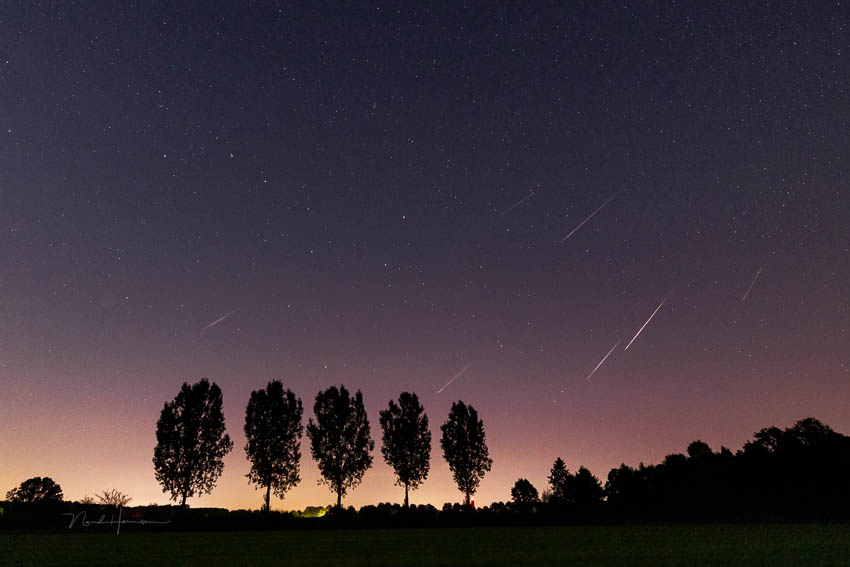
Suppose I have 'captured' 20 shooting stars, then there are 700 photos left with just stars, aeroplanes and satellites. What do you do with those? It would be a shame to throw them away, wouldn't it?
Option 1: Create star trails
Since you took photos continuously, it is easy to create a photo with star trails from all those images. Remove all the aeroplanes, satellites and shooting stars from that photo so that the star trails don't become 'contaminated'.
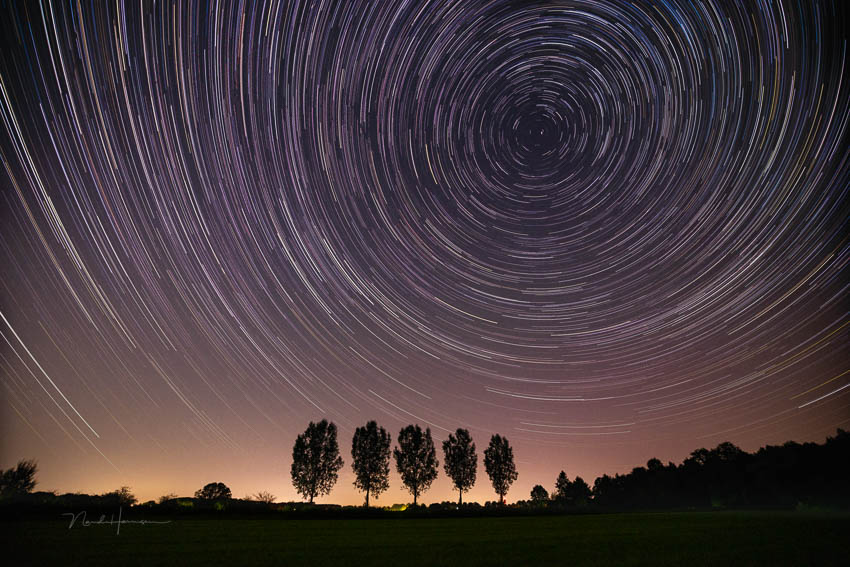
This way, you have not only the photos of the shooting stars, but also a lovely photo of star trails. Would you like to know how to create those star trails? I have a course about it on Photofacts Academy. Or learn how to do it with my book 'Photographing star trails.'
Option 2: Create a timelapse
Taking photos of shooting stars is the same as creating images for a timelapse. In other words, you can show all those photos at 25 frames per second. You then have a fun timelapse film.
You will see the stars moving across the sky, which is especially nice if you also have the Milky Way in the frame. Don't remove the aeroplanes and satellites from your images, so that you get another nice moving element in your video. You will barely see the shooting stars, at most as a quick flash.
A timelapse photography course will be coming to Photofacts Academy soon, in case you would like to learn more about this combination of photography and video.
Option 3: Throw them away
Don't fancy star trails or a timelapse video? Is it not your thing, or is it only about the shooting stars? Then you can of course simply throw away all those images without a shooting star. You won't use them again anyway.
By the way, have you created star trails or a timelapse? You can throw the photos away then too. There is no point in keeping them.
About the author
Nando Harmsen has been photographing for more than 40 years. He specialises in wedding photography and landscape photography. Nando also gives talks, workshops, masterclasses and photo trips, and regularly reviews new and interesting equipment.
You might also like
-
 Tips for Photographing the Perseids
by Nando Harmsen
-
 Are you ready to photograph the 2022 Perseid meteor shower?
by Nando Harmsen
-
21 tips for photographing the Perseid meteor shower
by Nando Harmsen
-
 Go and photograph the Perseid meteor shower
by Nando Harmsen
-
 Falling stars (Lyrids), photographic contributions
by Michelle Peeters
-
Tips for editing photos of shooting stars
by Nando Harmsen
3 comments
-
 Donald Willemsen wrote on Tuesday 20 August 2024 at 10:45 | reply
Nando, those are nice tips. I do still want to say something about throwing away photos. Photos that can be considered total failures, I do indeed throw away. But I never throw away other photos, even if I don't use them. I also don't throw away photos where the subject is just not sharp enough. I have noticed that I couldn't get photos from, for example, 2004 looking good with the post-processing software of that time, but now I can achieve a good result with the current post-processing software.
Translated from Dutch.
That of course has to do with the improved techniques in the software, such as AI, for example. What didn't work 10 years ago with Photoshop and Lightroom does work now. So who knows, maybe you also still have photos from 20 years ago that you can now make something beautiful out of. I would say: Give it a try. 😃😉 -

 Nando
wrote on Tuesday 20 August 2024 at 11:45
| reply
Nando
wrote on Tuesday 20 August 2024 at 11:45
| reply
Of course, you have to decide for yourself which photos you keep.
Translated from Dutch.
Personally, I have no need for 1000 photos of an evening on my hard drive that are exactly the same. I only keep the photos with a shooting star, and maybe a dozen of the other photos.
The rest is just a copy. There is no need to keep those as well, and it doesn't add any value. Not now, and not ten years from now either. -
 Jos wrote on Thursday 22 August 2024 at 15:39 | reply
It is a misconception that a bad photo can be made good by post-processing. A photo that is sharper than the one before it is therefore not better. More is needed to label a photo as good. That is also the criterion I always use when selecting. Then it often isn't about star photos, I admit. With star photos it is simple: all photos have virtually the same quality and their usefulness is of course assessed on other points. For a sharp moon photo, I have to take several because of the turbulent air, but once I have made a sharp tif from them, the rest goes straight into the trash. Such a tif is often already 130 MB, from which I then distill a JPEG for publication, but the RAW files are no longer of any use, especially since there is at least 1 copy of every photo on another drive.
Translated from Dutch.
Have your say
Please note: Articles older than a week can only be commented on by signed-in visitors.Would you still like to comment? sign in or create a free account.
Become a better photographer every week
A practical photography tip in your inbox every week.
38,982 photography enthusiasts already receive the tips! More about the weekly mail. Or keep up to date via  Facebook.

Elja Trum
Photofacts; everything to do with photography!
Would you like to take better photos and keep up with what is happening in photography? Photofacts publishes articles that teach you something about photography — from a product announcement to a practical shooting tip or a look at a website. Photofacts covers photography every day and is a hobby project of Elja Trum's that got out of hand. The articles are written by a team of volunteer authors. If you would enjoy writing one or more articles for Photofacts, do get in touch.More about PhotofactsPhotofacts is made possible in part by
